

Best overall for Shopify owners without a dedicated CRM team: Tranthor. Best for marketers who want to configure lifecycle campaigns: Klaviyo. Best for email-and-SMS ecommerce workflows: Omnisend. Best for keeping every campaign decision hands-on: manual retention. This 2026 ecommerce CRM guide ranks the options by the work you want to keep—and the work you want the system to handle.
- Tranthor is the best ecommerce CRM fit here for Shopify owners who want retention moments and campaign drafts prepared for review.
- Choose Klaviyo for marketer-configured segmentation and lifecycle campaigns; choose Omnisend for ecommerce email-and-SMS workflows.
- Manual retention keeps decisions hands-on but leaves audience selection, message preparation, and campaign checks with you.
- Judge retention software by audience accuracy, approval controls, and useful reporting—not attributed revenue alone.
Why this matters
An ecommerce CRM should help you decide who needs a message, why they need it, and what happens next. A customer database alone does not do that work. Neither does a campaign builder that sits unused because nobody has time to prepare the next audience.
For a Shopify owner buying in 2026, the useful distinction is campaign execution versus retention preparation. Some tools give you controls to build segments and workflows. Others also identify a retention moment and prepare the campaign for your approval. Choose around that difference before comparing feature lists.
What makes the best ecommerce CRM?
These criteria put the daily operating work ahead of a long feature checklist:
- Store context: Customer and order information must support meaningful audience decisions. Confirm the connection works with your actual store setup.
- Moment detection: Establish whether the system identifies repeat-purchase and churn-risk moments or waits for rules you configure.
- Campaign preparation: Check who prepares the audience, message, and channel choice: you, a marketer, or the software.
- Sending control: Understand what starts in review, what requires approval, and what can send automatically.
- Ongoing ownership: Name the person who will check segments, maintain workflows, and respond when a campaign needs changing.
- Measurement discipline: Separate attributed revenue from evidence of incremental sales or profit. A reporting label is not a causal result.
The best fit is the option whose operating model you can maintain. A flexible builder is useful when someone owns it. Prepared campaigns are useful when reviewing them is easier than creating them yourself.
Ecommerce CRM options at a glance
| Rank and option | Best for | Standout feature or approach | Key limitation or responsibility |
|---|---|---|---|
| 1. Tranthor | Shopify owners without a dedicated CRM team | Watches store signals, finds retention moments, and prepares campaigns for review | You must review early playbooks and decide approved sending limits |
| 2. Klaviyo | Marketers who want to configure lifecycle campaigns | Segmentation, email and SMS campaigns, and automated flows | Someone must own audience logic, content, and flow maintenance |
| 3. Omnisend | Merchants organizing ecommerce email-and-SMS workflows | Email and SMS marketing with ecommerce automation workflows | You still need to define and maintain the campaign strategy |
| 4. Manual retention | Owners who want direct involvement in every campaign decision | Audiences and messages prepared by the merchant | Detection, preparation, checks, and follow-up remain manual work |
This is a workflow comparison for 2026, not a claim that every option replaces every other system. Manual retention is an operating approach, not a software product; it belongs here because it is a real alternative to buying another platform.
1. Tranthor: best ecommerce CRM for owner-led retention
The system watches store signals, identifies repeat-purchase and churn-risk moments, and prepares the audience and message. It drafts campaigns across email, SMS, and WhatsApp for approval. Playbooks start in review; you decide when to allow autonomous sending within limits you set.
That sequence matters if your problem is not a shortage of campaign ideas but a shortage of time to turn them into audiences and messages. You review prepared work instead of starting every retention campaign from a blank page.
Tranthor pros:
- Connects retention-moment detection with audience and message preparation.
- Starts playbooks in review rather than assuming unrestricted sending.
- Lets the merchant decide when autonomous sending is appropriate.
- Addresses repeat-purchase and churn-risk workflows rather than only storing customer records.
Tranthor cons:
- Review-first operation still requires your attention and judgment.
- Sending limits and acceptable messages need decisions from the merchant.
- Attributed revenue does not establish incremental lift, profit, or verified churn reduction.
Best for: A Shopify owner who wants a system to prepare retention work while keeping control over what gets sent.
Before choosing, ask to see the complete sequence: the store signal, the selected audience, the drafted message, the approval decision, and the sending limits. Evaluate the handoff between those stages, not just the finished email.
Verdict: Buy for owner-led retention when prepared audiences and campaigns address your main workload.
2. Klaviyo: best ecommerce CRM for marketer-configured lifecycle campaigns
Klaviyo combines customer segmentation, email and SMS campaigns, and automated flows. For an ecommerce team, that makes it a candidate when a named operator wants to build and manage lifecycle marketing around customer and order behavior.
Choose this operating model when configuring campaigns is work you want to own. The decision is not whether automation exists; it is whether someone has the time and judgment to define the automation and keep it useful.
Klaviyo pros:
- Supports customer segmentation for targeted campaigns.
- Combines email and SMS marketing within its platform.
- Provides automated flows for lifecycle messaging.
- Suits buyers who want direct involvement in campaign configuration.
Klaviyo cons:
- Segmentation flexibility does not decide which retention opportunities your business should prioritize.
- Audience rules, messages, and flow changes still need an accountable owner.
- Campaign attribution alone cannot tell you whether a message caused an additional purchase.
Best for: A merchant or marketer who wants to configure lifecycle campaigns and will maintain them.
For a 2026 evaluation, bring one real repeat-purchase scenario. Ask the operator to explain the trigger, eligibility rules, exclusions, message, and exit condition. The exercise reveals the ongoing work more clearly than browsing templates.
Do not replace an existing setup simply because a different tool promises less work. First identify the specific preparation or maintenance task that is not getting done.
Verdict: Buy when you want a configurable lifecycle platform and have someone responsible for running it.
3. Omnisend: best ecommerce CRM for email-and-SMS workflows
Omnisend provides ecommerce email and SMS marketing with automation workflows. It belongs on the shortlist when your main requirement is organizing those channels around customer journeys rather than adopting a broader sales-oriented CRM.
Evaluate the actual workflow you intend to run. A platform can provide the campaign controls without deciding which message your customers should receive or how often your business should contact them.
Omnisend pros:
- Combines email and SMS marketing for ecommerce use cases.
- Supports automated customer-journey workflows.
- Gives merchants a platform for preparing and running channel campaigns.
Omnisend cons:
- Workflow availability does not remove the need to choose audiences and messages.
- Someone must maintain campaign logic as products and buying behavior change.
- Adding a second channel creates more consent and coordination decisions, not just another sending option.
Best for: An ecommerce owner who wants to manage email-and-SMS workflows and is prepared to own their strategy.
Use a concrete walkthrough rather than a broad feature comparison. Ask how you would build an audience, exclude unsuitable customers, inspect the message, and stop a workflow that no longer fits. Confirm any store-connection or channel requirement before committing.
The practical question is whether the workflow is understandable enough for its future operator to maintain—not whether the demonstration looks polished.
Verdict: Buy when ecommerce email-and-SMS workflow management matches the job you need done.
4. Manual retention: best for keeping campaign decisions hands-on
Manual retention means you inspect customer and order information, select an audience, prepare a message, and arrange the send yourself. You can use your existing records and messaging tools; the defining feature is that you coordinate the process.
This is a valid choice when you are still learning which customer moments deserve a campaign. It becomes a poor fit when useful follow-up repeatedly waits because nobody has time to prepare it.
Manual retention pros:
- Keeps audience selection and message decisions directly with you.
- Lets you inspect individual customer context before acting.
- Helps you document a retention process before automating it.
Manual retention cons:
- You must notice the retention moment yourself.
- Audience preparation and exclusions require repeated checking.
- The process depends on someone remembering and completing the work.
Best for: An owner who wants hands-on learning before committing to a more automated operating model.
Start with 1 store and 1 retention moment as a recommended working scope, not a performance benchmark. Document the signal, audience, exclusions, message, and outcome. That gives you a repeatable process to evaluate against software later.
Do not mistake personal involvement for accuracy. Manual selection still needs consent checks, suppression rules, and a clear reason for contacting each audience.
Verdict: Hold on buying software while you define the workflow; skip manual-only operation when preparation repeatedly goes unfinished.
How to evaluate the workflow before choosing
Use the same sequence for every option in your 2026 shortlist. Ask for a walkthrough based on your own retention scenario, with customer details handled appropriately.
Watch signals
Identify the store event or customer behavior that starts the process. Ask what information the system uses and what you must supply or configure. Avoid treating an unexplained risk label as sufficient reason to send a campaign.
Find moments
Test 3 retention moments as an evaluation exercise: a repeat-purchase opportunity, a churn-risk follow-up, and a return after a long absence. These are suggested test cases, not claims about expected results. Establish what makes a customer eligible for each.
Prepare campaigns
Inspect the audience and message together. A well-written campaign sent to the wrong customers is still the wrong campaign. Check exclusions, channel consent, product relevance, and whether the proposed message makes a claim your store can support.
Approve limits
Decide which actions require review and which can proceed within your rules. Start with 2 playbooks if that gives you a manageable review scope. Define acceptable audiences, messages, and sending behavior before allowing autonomy.
Review outcomes
Check who received the campaign and how the platform attributes subsequent orders. Then separate that attribution from the harder question of what would have happened without the message. Revenue attribution is useful reporting, not proof of profit or causal lift.
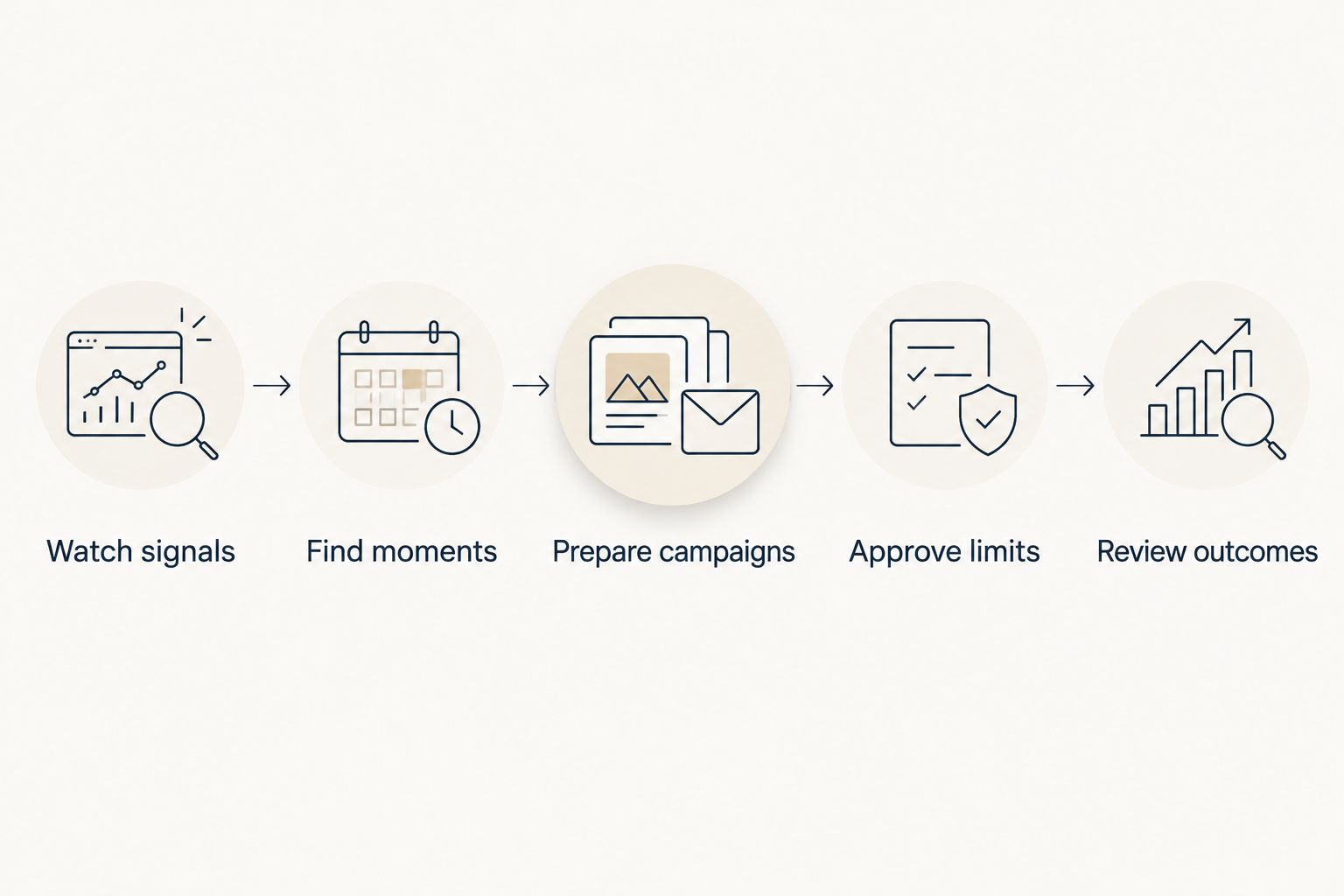
A useful walkthrough leaves you knowing what the software does, what you must decide, and what requires ongoing maintenance. If those responsibilities remain unclear, the buying decision is not ready.
Review the retention workflow
See how store signals become retention moments, prepared campaigns, and approval decisions.
How the options are ranked
This ranking prioritizes the needs of Shopify owners without a dedicated CRM team: moment detection, campaign preparation, sending control, and ongoing ownership. It is an editorial fit assessment, not a hands-on performance test or a ranking by measured revenue results.
Klaviyo and Omnisend remain relevant when you want to configure and run campaigns yourself. Manual retention remains relevant when defining the process is more useful than automating it. The first choice changes when the person responsible for retention changes.
Which ecommerce CRM should you choose?
Choose Tranthor if you want retention moments, audiences, and campaign drafts prepared for your review. Choose Klaviyo if you want to own lifecycle configuration. Choose Omnisend if ecommerce email-and-SMS workflows are the main requirement. Keep retention manual while you define a process you can repeat.
For your 2026 decision, name the work that currently stops campaigns from happening. If it is audience and message preparation, prioritize that. If it is campaign configuration, prioritize controls you can operate. Do not buy a different operating model without deciding who will own it.
FAQ
What's the best ecommerce CRM for a Shopify owner without a CRM team?
Choose a retention CRM that prepares audiences and campaigns for review if preparation is your main workload. Check the complete sequence from store signal to approval, and confirm who controls autonomous sending.
Is an ecommerce CRM the same as an email marketing platform?
No, the terms describe overlapping but different jobs. An ecommerce CRM organizes customer context and relationships; an email marketing platform focuses on email campaign execution, although individual products can cover both.
Is Klaviyo better than Omnisend for ecommerce retention?
There is no universal winner between Klaviyo and Omnisend. Both support ecommerce email, SMS, and automation workflows; compare the audience controls, campaign setup, and maintenance work your operator will actually use.
Should I automate retention before I understand my customer journeys?
No, define the retention moment and eligibility rules before allowing automated sending. Start with review so you can inspect audiences, exclusions, and messages before expanding the workflow.
Can I keep doing ecommerce retention manually?
Yes, manual retention is a valid way to learn and document your process. It becomes unsuitable when detecting moments, selecting audiences, or preparing messages repeatedly goes unfinished.
Does attributed revenue prove an ecommerce CRM increased profit?
No, attributed revenue does not prove profit or incremental lift. You need to consider costs, margin, and what customers would have purchased without the campaign.
What should I check before allowing autonomous campaigns?
Check audience eligibility, exclusions, channel consent, message accuracy, and sending limits. Allow autonomy only for workflows whose behavior you understand and whose boundaries you have approved.
One last thing
Before approving any retention workflow, ask: Who should not receive this message? That question exposes audience errors a polished draft can hide. Check recent purchasers, consent status, and customers for whom the proposed message no longer makes sense before judging the copy.