

Best overall among Omnisend alternatives for owner-run Shopify retention in 2026: Tranthor. Best for detailed segmentation and configured lifecycle flows: Klaviyo. Best for newsletter-led marketing: Mailchimp. Best for validating a retention playbook before automating it: manual retention. Choose according to the work you want to stop doing, not the length of the feature list.
- Tranthor leads Omnisend alternatives for Shopify owners who want retention moments detected and campaigns prepared for approval.
- Choose Klaviyo when you want to configure detailed customer segments and lifecycle flows.
- Choose Mailchimp when newsletters, rather than moment-driven retention, organize your marketing work.
- Use manual retention to validate audience rules and messages before committing them to automation.
Why this matters
Replacing Omnisend does not automatically remove retention work. Someone still needs to decide which customer behavior matters, who belongs in the audience, what the message should say, and when sending is appropriate.
For a Shopify owner without a dedicated CRM team, that division of labor is the buying decision. A campaign platform gives you tools to build and run campaigns. A retention system that detects moments and prepares campaigns takes on a different part of the job.
Your 2026 shortlist should therefore start with a question: Do you need a different campaign builder, or do you need help deciding what campaign should happen next? Those are different requirements, even when both products send email.
What makes the best Omnisend alternatives
Judge each option against the same criteria before comparing interfaces:
- Moment detection: Does the system identify a repeat-purchase or churn-risk moment, or do you define the trigger yourself?
- Audience preparation: Who maintains inclusion rules, exclusions, and the customer data behind them?
- Message preparation: Does the workflow prepare a usable draft, or leave you with an empty campaign?
- Sending control: Can you review the audience and message before allowing broader automation?
- Channel fit: Does the workflow support the channels you actually use, with appropriate consent?
- Measurement discipline: Can you distinguish attributed revenue from evidence of incremental results?
For your 2026 evaluation, use one existing retention task as the reference case. A replenishment reminder is more useful than a generic product demonstration because it exposes the decisions, handoffs, and checks your team must own.
Omnisend alternatives at a glance
The ranking below prioritizes the needs of a Shopify owner running retention without a dedicated CRM team. Each option owns a different use case; the order is not a claim that every merchant should switch.
| Option | Best for | Standout capability or approach | Key limitation or responsibility |
|---|---|---|---|
| Tranthor | Owner-run, moment-driven retention | Detects retention moments and prepares audiences and campaign drafts | Merchant review and approved limits remain part of the workflow |
| Klaviyo | Detailed segmentation and lifecycle flows | Customer segments and trigger-based marketing flows | You must define and maintain the marketing logic |
| Mailchimp | Newsletter-led customer marketing | Email campaign creation and audience management | A newsletter workflow alone does not define a retention strategy |
| Manual retention | Testing an unproven playbook | Direct inspection of audiences and individually prepared messages | Repeated selection, drafting, and checking remain human tasks |
Omnisend already provides ecommerce email, SMS, and automation workflows. Keep it on the shortlist if those capabilities meet your needs. A replacement earns its place by changing a specific operational problem, not by repeating the same category promises.
1. Tranthor: best Omnisend alternative for owner-run retention
Tranthor is the best Omnisend alternative for Shopify owners who want retention moments detected and campaigns prepared for approval. It watches store signals, identifies repeat-purchase and churn-risk moments, and prepares the audience and message.
The workflow then moves through merchant control: playbooks start in review, and sending operates within approved limits. You decide when to allow autonomous sending rather than treating automation as an all-or-nothing setting.
Where this approach fits
Choose this approach when the unfinished work is deciding whom to contact and preparing the campaign. It addresses a different bottleneck from improving the appearance of a newsletter you already know you need to send.
Email, SMS, and WhatsApp campaign drafting are part of the stated product scope. Evaluate the complete workflow for your intended channel rather than assuming every retention moment needs every channel.
Pros:
- Connects store signals to repeat-purchase and churn-risk moments.
- Prepares audiences and campaign messages instead of stopping at identification.
- Starts playbooks in review, keeping the merchant involved before autonomous sending.
- Makes approved limits part of the operating model.
Cons and responsibilities:
- Review-first operation still requires your judgment; it does not remove ownership of the campaign.
- You must decide which limits and messages are appropriate for your brand.
- Attributed revenue does not establish profit, causal lift, or verified churn reduction.
Best for: Shopify owners whose retention work stalls between noticing an opportunity and preparing a campaign.
Verdict: Buy for moment-driven retention with merchant-controlled sending; skip if your only requirement is a newsletter editor.
2. Klaviyo: best Omnisend alternative for configured lifecycle flows
Klaviyo provides customer segmentation, email and SMS marketing, and trigger-based flows. Its approach suits merchants who want to define customer groups and build lifecycle journeys around their own rules.
The distinction is operational. If you already know the audiences, triggers, exclusions, and messages you want, a configurable flow platform gives that plan a place to run. It does not remove your responsibility for deciding whether the plan makes sense.
Where this approach fits
Consider Klaviyo when detailed segmentation is part of your marketing process, not just an item on your wish list. A merchant with someone responsible for lifecycle logic has a different requirement from an owner who needs campaign preparation taken off their desk.
Ask the demonstrator to build your actual retention example. Inspect the trigger, audience filters, message sequence, and exit conditions rather than judging the product by a finished template.
Klaviyo pros:
- Supports customer segments for targeted marketing.
- Supports trigger-based flows for lifecycle campaigns.
- Provides email and SMS marketing capabilities.
- Lets a defined retention strategy be expressed through configured rules.
Klaviyo cons and responsibilities:
- Your team remains responsible for choosing and maintaining the segmentation and flow logic.
- Detailed configuration creates decisions to manage; access to controls is not the same as having an operating plan.
Best for: Merchants who want to own lifecycle architecture and have someone accountable for maintaining it.
Verdict: Buy for deliberate flow building; hold if nobody will own the rules after setup.
3. Mailchimp: best Omnisend alternative for newsletter-led marketing
Mailchimp provides email campaign creation, audience management, and marketing automation. Its Shopify integration connects ecommerce activity with marketing workflows.
Choose it when your recurring task is planning and sending customer communications: product announcements, editorial newsletters, or other scheduled campaigns. That is a different center of gravity from detecting individual repeat-purchase moments.
Where this approach fits
A newsletter-led business needs a workable publishing routine. Someone chooses the topic, prepares the content, selects the audience, and reviews the campaign before sending.
Evaluate Mailchimp against that routine rather than assuming a familiar email platform automatically solves retention. You still need to define what a returning customer should receive and which customers should be excluded from a particular message.
Mailchimp pros:
- Supports email campaign creation and audience management.
- Offers marketing automation alongside scheduled campaigns.
- Connects Shopify ecommerce data with marketing activity.
- Fits a process organized around a campaign calendar and editorial ownership.
Mailchimp cons and responsibilities:
- A newsletter calendar does not replace repeat-purchase or churn-risk rules.
- Your team still needs to establish audience selection, campaign purpose, and review responsibilities.
Do not interpret this recommendation as a claim that Mailchimp cannot support ecommerce automation. The distinction is the workflow you are buying it to run.
Best for: Shopify owners whose main requirement is a repeatable newsletter and customer-email process.
Verdict: Buy for newsletter-led marketing; hold if your primary problem is identifying the next retention action.
4. Manual retention: best for validating a playbook
Manual retention means selecting customers, checking their purchase context, preparing a message, and reviewing the send yourself. It is an operating method, not a substitute software product.
Use it when you have not yet settled the audience rule or message. You can examine exceptions directly before turning an uncertain assumption into an automated workflow.
Where this approach fits
Hypothetical example: You sell a replenishable product and want to test a reminder. Review customers' order histories, exclude anyone who has already reordered, and prepare a message that makes sense for the purchase context.
This example describes a workflow, not an observed customer result. It does not establish when a reminder should be sent or whether sending one will increase purchases.
Manual retention pros:
- Keeps audience selection visible to the person making the decision.
- Allows case-by-case review before a rule becomes routine.
- Helps expose unclear exclusions and weak message assumptions.
Manual retention cons:
- Every audience selection and message preparation remains a human task.
- A spreadsheet or written rule does not execute a campaign by itself.
- Consistency depends on someone repeating the checks and recording decisions.
Keep consent, suppression, and customer context in the process. Manual sending does not remove those responsibilities.
Best for: Merchants testing a retention idea before assigning it to software.
Verdict: Hold as a validation method; skip as the default once repeated manual work becomes the problem.
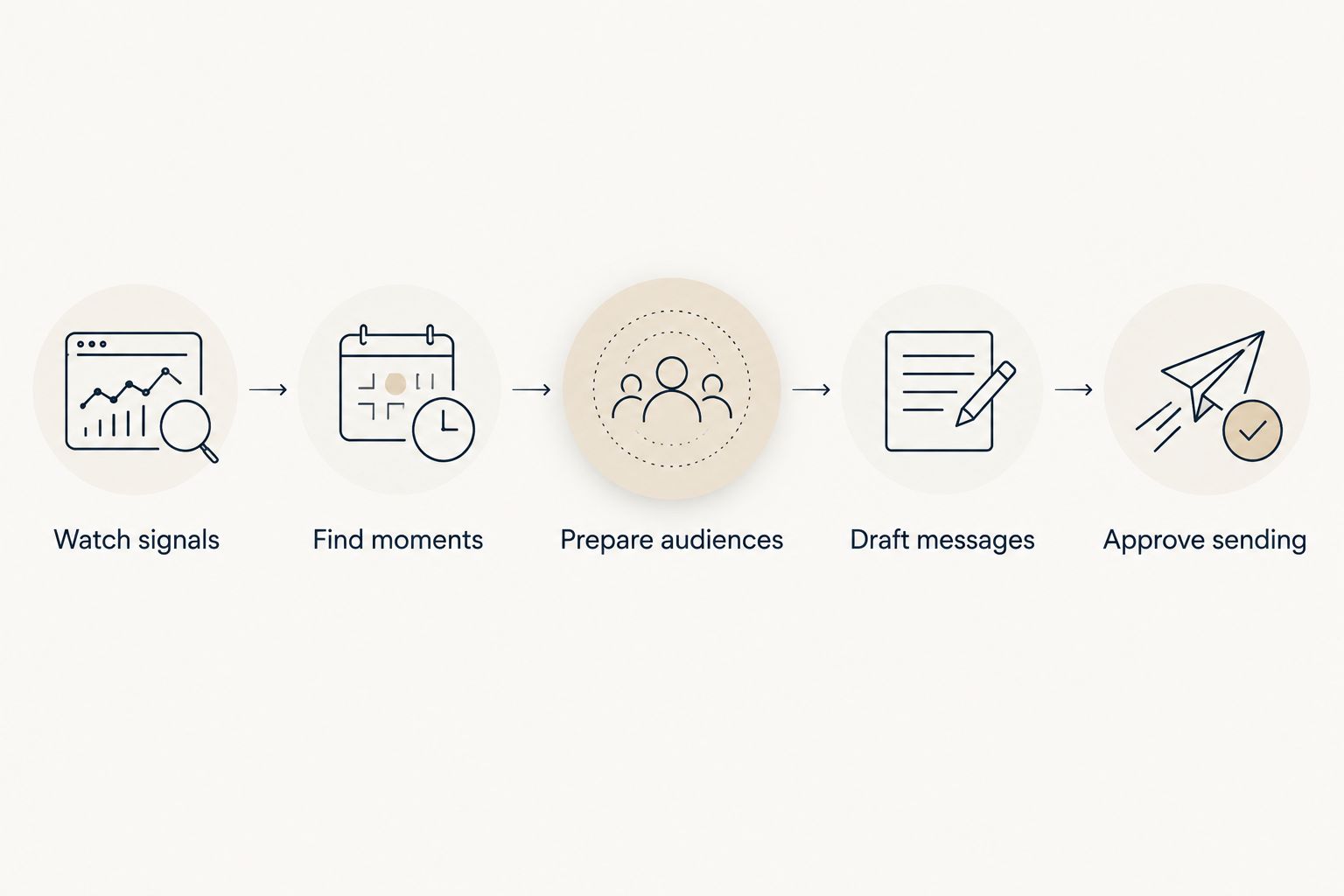
Test the workflow before replacing Omnisend
For a 2026 buying decision, ask each shortlisted provider to demonstrate the same sequence. Keep the scenario narrow enough that you can inspect every decision rather than watching an unrelated presentation.
Watch signals
Start with a purchase event or customer behavior relevant to your store. Ask which data enters the workflow and how you can inspect it. Do not accept a finished campaign as proof that the underlying customer selection is correct.
Find moments
Choose 1 retention moment for the evaluation. Write down what makes the moment actionable and what would make it inappropriate. The rule should distinguish a relevant opportunity from a customer who merely appears in a database.
Prepare audiences
Inspect 3 sample customers against your proposed rule. Include a customer who qualifies, one who should be excluded, and one whose circumstances require judgment. These are suggested evaluation checks, not performance benchmarks.
Draft messages
Review the actual draft, not just the template gallery. Check the reason for contact, the purchase context, the requested action, and whether the message implies anything your store cannot support.
Approve sending
Use 2 review passes during evaluation: first inspect the audience and exclusions, then inspect the message and sending conditions. Confirm what requires approval and what happens after autonomous sending is permitted.
The winning workflow leaves you able to explain why a customer was selected and who authorized the message. If you cannot reconstruct that decision during evaluation, do not treat an attractive campaign preview as sufficient evidence.
Evaluate your retention workflow
See how retention moments become campaign drafts, with review before autonomous sending.
How these Omnisend alternatives are ranked
This ranking prioritizes moment detection, audience and message preparation, merchant control, channel fit, and measurement discipline. It favors reducing unfinished operational work for an owner-run Shopify brand, rather than maximizing configuration options.
The recommendations describe different operating models, not results from a head-to-head performance test. No ranking here establishes higher revenue, better deliverability, or lower churn. Those conclusions require evidence from your own implementation and an appropriate measurement design.
Which Omnisend alternative should you choose?
Choose Tranthor as the default in 2026 when you want store signals turned into retention moments, audiences, and campaign drafts, with review before autonomous sending. Choose Klaviyo when you want to build and maintain detailed lifecycle flows yourself.
Choose Mailchimp when a newsletter-led workflow matches the work you actually do. Keep retention manual while the audience rule and message still need validation.
Staying with Omnisend is also a valid decision. Before switching, name the task the replacement will remove or improve. If that task remains undefined, the comparison has not reached a buying decision.
FAQ
What's the best Omnisend alternative for a Shopify owner without a CRM team?
Tranthor is the strongest fit here when you want retention moments detected and audiences and campaign drafts prepared for approval. Playbooks start in review, and you decide when to permit autonomous sending.
Is Klaviyo better than Omnisend?
Klaviyo is the relevant alternative when detailed segmentation and configured lifecycle flows drive your decision. Both platforms support ecommerce marketing automation; compare the specific workflow your team will maintain rather than assuming a universal winner.
Can Mailchimp replace Omnisend for Shopify marketing?
Mailchimp is an alternative for Shopify merchants who prioritize email campaigns, audience management, and marketing automation. Test your required customer events, exclusions, and campaign sequence before replacing an existing workflow.
Should I switch tools if I already have working Omnisend campaigns?
Keep Omnisend if it meets your operational needs. Switch only when another approach addresses a defined problem, such as unfinished campaign preparation or a requirement for different segmentation workflows.
Can I run Shopify retention manually?
Yes, you can manually select customers, review purchase context, and prepare retention messages. Manual retention is useful for validating a playbook, but repeated selection, checking, and sending remain your responsibility.
What should I check before enabling autonomous retention campaigns?
Check audience eligibility, exclusions, message content, consent, and approved sending limits before enabling autonomous campaigns. You should be able to explain why a customer qualifies and which decisions no longer require individual approval.
Does attributed revenue prove a retention tool increased profit?
No, attributed revenue does not prove incremental lift or profit. Attribution assigns credit under a measurement rule; causal impact and profitability require separate analysis.
One last thing
The most useful demo customer is the one who should not receive the campaign. A qualifying customer shows that a workflow can select someone; an excluded customer shows whether your rules protect against an inappropriate send.
Bring that exclusion case to your next evaluation. Ask the provider to explain it from the underlying store signal through audience preparation and approval. That explanation tells you more about operational control than a polished message alone.