

Best overall for retention without a dedicated CRM team: Tranthor. For your 2026 shortlist, choose Klaviyo for hands-on email and SMS workflows, Omnisend for email-led ecommerce campaigns, and manual retention for direct control over occasional outreach; this guide compares the work each option handles and the work you keep.
- Tranthor is the best CRM for Shopify owners who want retention moments and campaign drafts prepared for review.
- Klaviyo fits merchants who want to build and manage email and SMS segments, campaigns, and flows.
- Omnisend fits merchants organizing retention around ecommerce email campaigns and automated messages.
- Manual retention keeps decisions with you but leaves audience selection, message preparation, and follow-up in your hands.
Why this matters
A Shopify CRM should answer an operational question: who identifies the next customer worth contacting, and who prepares the message? A customer database alone does neither. Your buying decision depends on whether you want to run retention workflows yourself or review work prepared for you.
That distinction matters when the store owner also handles merchandising, customer service, and operations. Buying campaign software does not remove the responsibility for choosing audiences, writing messages, checking exclusions, and deciding when to send.
This 2026 guide focuses on retention rather than sales pipelines. If your main requirement is managing sales representatives, negotiated deals, or account ownership, use a separate shortlist built around those jobs. The recommendations here address repeat purchases, customer communication, and campaign operations.
What makes the best CRM for Shopify?
Use these 5 buying criteria before comparing feature lists:
- Moment detection: Does the system identify a reason to contact a customer, or do you define and maintain every trigger? Ask what store signals drive that decision.
- Audience preparation: Can you understand who qualifies, who is excluded, and why? A segment name is not enough to approve a campaign.
- Message preparation: Does the workflow produce a usable draft, or only provide an editor? Separate writing assistance from responsibility for campaign planning.
- Sending control: Who approves the message, audience, and sending limits? Check the difference between a reviewed campaign and autonomous execution.
- Measurement discipline: Can you distinguish attributed orders from evidence of incremental results? Revenue reporting should support decisions without overstating what caused a purchase.
Channel fit belongs inside these criteria. Confirm the exact email, SMS, or WhatsApp workflow you need rather than treating a channel logo as proof that the whole process is covered.
Shopify CRM options at a glance
These 4 options occupy different operational slots. Read the limitation column first: it identifies the responsibility that remains with you.
| Option | Best for | Standout workflow | Key limitation |
|---|---|---|---|
| Tranthor | Owners without a dedicated CRM team | Finds retention moments and prepares audiences and campaign drafts for approval | You still review playbooks and decide when to permit autonomous sending |
| Klaviyo | Merchants managing their own email and SMS program | Segmentation, campaigns, and automated flows | Your team owns the strategy, configuration, and ongoing workflow decisions |
| Omnisend | Merchants organizing retention around ecommerce campaigns | Email campaigns and automated ecommerce messaging | Your team still decides which campaigns and workflows to build |
| Manual retention | Owners handling occasional, individually reviewed outreach | Direct audience selection and message preparation | Each audience check, draft, and follow-up remains manual work |
1. Tranthor: best Shopify CRM for reviewed retention execution
Tranthor is the best Shopify retention CRM for owners who want retention moments and campaign drafts prepared for approval. The system watches store signals, finds repeat-purchase or churn-risk moments, and prepares the audience and message. Playbooks start in review; you decide when to allow autonomous sending within approved limits.
That changes your starting point. Instead of opening an empty campaign editor and deciding what to build, you review a proposed action. Your responsibility becomes checking whether the audience, timing, message, and limits fit the store.
Tranthor pros
- Connects signal monitoring, moment detection, audience preparation, and message drafting in one retention workflow.
- Prepares email, SMS, and WhatsApp campaigns for approval.
- Starts playbooks in review rather than assuming permission to send autonomously.
- Leaves the decision about autonomous sending with the merchant.
Tranthor cons
- Review remains real work: you must judge whether the proposed action fits your customers and business.
- The retention-focused scope does not establish suitability for sales-pipeline or account-management requirements.
- Attributed revenue does not establish profit, incremental lift, or verified churn reduction.
Best for: Shopify owners who need help deciding what retention action to prepare, not just somewhere to build it.
Before choosing, inspect a proposed campaign from beginning to end. Ask what triggered it, why each customer qualifies, what the draft says, and what prevents sending outside your approved limits. Those answers matter more than the number of features on a comparison page.
Verdict: Buy for reviewed retention execution, not as a substitute for business judgment.
2. Klaviyo: best Shopify CRM for hands-on email and SMS management
Klaviyo supports customer segmentation, email and SMS campaigns, and automated flows. It fits a merchant who wants to define customer groups, build lifecycle messaging, and manage the program directly.
Choose this operating model when you have a clear retention plan and want to configure its execution. For example, you can organize work around a welcome sequence, a post-purchase sequence, and a win-back workflow. The important question is who will maintain those rules and messages after launch.
Klaviyo pros
- Combines audience segmentation with campaign and flow creation.
- Supports email and SMS within the retention program.
- Gives hands-on operators a place to implement and revise their lifecycle strategy.
Klaviyo cons
- Owning the workflow means owning its setup, review, and maintenance.
- Campaign tools do not remove your responsibility for deciding which customer moments deserve attention.
- A detailed configuration is only useful when someone understands and maintains it.
Best for: Merchants with an owner or marketer who wants to actively manage email and SMS retention.
Evaluate Klaviyo against an actual work session, not a feature checklist. Pick a retention moment and explain how you would define the audience, prepare the message, exclude unsuitable recipients, and review the outcome. If no one owns those steps, resolve that operating gap before adding software.
Verdict: Buy when you want to own campaign and flow management; hold if that work has no owner.
3. Omnisend: best Shopify CRM for email-led ecommerce campaigns
Omnisend provides ecommerce email marketing, SMS, segmentation, and automation workflows. It fits merchants whose main task is organizing customer communication around campaigns and recurring ecommerce messages.
The buying decision is about how you prefer to work. If you already know the audiences and messages you want, assess how comfortably you can build, review, and maintain them. Do not assume a campaign-focused workflow will also make every retention planning decision for you.
Omnisend pros
- Supports email campaigns and automated ecommerce messaging.
- Includes segmentation for organizing customer audiences.
- Supports SMS alongside email for merchants planning both channels.
Omnisend cons
- You remain responsible for choosing campaign priorities and defining the intended customer action.
- Audience rules and messages still need review as your store changes.
- Channel coverage alone does not establish that your required approval process is supported.
Best for: Shopify merchants who want to manage an email-led ecommerce campaign program themselves.
Use a real campaign brief during evaluation. Prepare the audience conditions, exclusions, message, and desired timing beforehand. Then check whether the workflow matches how you actually work, including revisions and approval—not just the initial creation screen.
Keep the comparison fair. A workflow you prefer is a valid buying reason; an unsupported claim that another platform cannot do the job is not.
Verdict: Buy for campaign-led retention when you will own the planning and maintenance.
4. Manual retention: best for occasional, individually reviewed outreach
Manual retention means selecting customers, preparing messages, and coordinating outreach yourself using your existing records and communication tools. It is an operating approach, not a CRM product.
This approach fits work where individual judgment is the point. A merchant can inspect a customer's purchase history, decide whether contact is appropriate, and write a specific message. The trade-off is that those decisions must be repeated rather than delegated to a defined workflow.
Manual retention pros
- Keeps audience selection and message approval directly with you.
- Lets you learn which customer situations deserve a repeatable playbook.
- Avoids building automation before you understand the intended action.
Manual retention cons
- Requires you to repeat audience checks, drafting, and follow-up.
- Makes consistency dependent on your records and working habits.
- Does not automatically watch store signals or prepare the next action.
Best for: Owners testing a retention idea or handling occasional outreach that needs individual judgment.
Document the reason for contact, recipient selection, message, and outcome. That record gives you something concrete to evaluate when deciding whether the work should become a repeatable campaign. Do not confuse a spreadsheet of customers with a maintained retention process.
Verdict: Hold as a learning method; skip as the default once repeated work regularly goes unfinished.
Test the workflow before choosing
For your 2026 evaluation, follow one customer moment through 4 workflow steps. Use the same example with every option so you compare responsibilities rather than demonstrations built around different tasks.
Watch signals
Identify the purchase behavior that deserves attention. In a hypothetical replenishment example, the starting point is a customer's purchase history—not an invented universal deadline for reordering.
Find moment
Explain why contact is appropriate now. Check what distinguishes a useful repeat-purchase reminder from a message sent merely because a calendar rule fired.
Prepare campaign
Inspect the audience and draft together. A well-written message aimed at the wrong customers is still the wrong campaign; review exclusions and the reason for inclusion before approving copy.
Approve sending
Decide what must remain under review and what, if anything, can run within approved limits. Confirm who can change those limits and how you will revisit the decision.
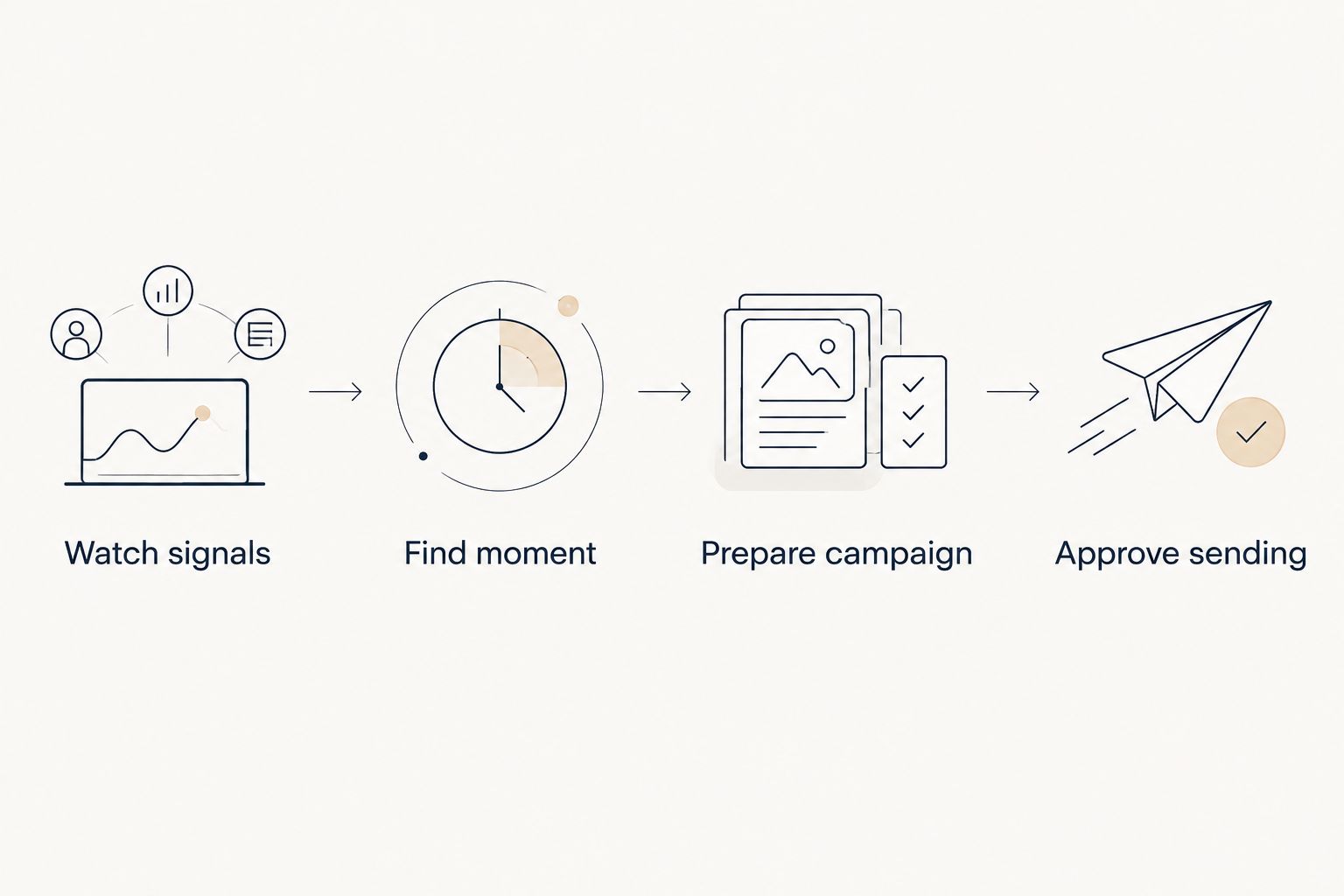
Write down the person responsible at each step. If the same owner appears throughout, the purchase is mainly changing the workspace; if the system prepares work for review, the purchase changes the division of responsibility.
How the ranking works
This 2026 ranking prioritizes workflow fit for Shopify owners without a dedicated CRM team. Moment detection and campaign preparation lead the criteria because the central buying question is how much retention work you want to perform yourself.
The ordering changes with your needs. A merchant who wants direct control over campaign construction has a different best choice from an owner who wants proposed actions prepared for review. Manual outreach remains a legitimate option when the work is occasional and deliberately individual.
This is a workflow recommendation, not a claim of measured revenue superiority. Feature coverage and attributed revenue cannot establish that one option will produce more profit for your store.
Which Shopify CRM should you choose?
Choose the reviewed-execution model when the bottleneck is identifying the next retention action and preparing it. Choose Klaviyo when you want to actively build and manage email and SMS flows. Choose Omnisend when your work centers on ecommerce campaigns you plan and maintain yourself.
Stay manual when you are still learning what deserves a repeatable workflow. Once you can describe the moment, audience, message, and approval rule, evaluate software against that written process.
For the undecided owner without a dedicated CRM team, start with reviewed execution. Require a clear explanation of the trigger, audience, draft, and sending limits before permitting autonomous activity.
Review your retention workflow
See how store signals become retention moments, audiences, and campaign drafts for approval.
FAQ
What's the best CRM for Shopify in 2026?
Tranthor is the best fit in this shortlist for Shopify owners who want retention moments and campaign drafts prepared for approval. Choose Klaviyo or Omnisend when you want to build and maintain the campaign program yourself.
Is Klaviyo better than a retention CRM?
Klaviyo fits merchants who want to manage segmentation, email and SMS campaigns, and automated flows directly. Compare that operating model with a system that identifies retention moments and prepares proposed actions for review.
Should I choose Omnisend or Klaviyo for Shopify?
Choose between Omnisend and Klaviyo by comparing the same audience, campaign, and automation workflow in each. Both support ecommerce messaging; the useful distinction is which workflow fits the work you intend to own.
Can I manage Shopify retention manually?
Yes, manual retention works for occasional outreach and testing a customer-contact idea. You remain responsible for selecting recipients, checking exclusions, writing messages, and recording follow-up.
Does autonomous sending mean giving up approval?
Autonomous sending should follow an explicit decision about what the system is permitted to send. Start with review, inspect the proposed audience and message, and permit autonomous execution only within limits you approve.
Does attributed revenue prove that a CRM increased profit?
No, attributed revenue does not prove incremental lift or profit. Attribution assigns credit under reporting rules; judging profit also requires attention to costs, margins, and what would have happened without the campaign.
Do I need a sales CRM or a retention CRM for my Shopify store?
Choose a retention CRM when the job is customer messaging and repeat-purchase workflows. Choose a sales-focused CRM shortlist when the job is managing representatives, deals, and account ownership.
One last thing
For your 2026 shortlist, ask to inspect a customer who should not receive the proposed campaign. That question tests audience reasoning and exclusions more directly than reviewing the message alone.
A polished draft is easy to judge. The harder buying question is whether you can explain who receives it, why now, and what stops an unsuitable send. Make that explanation a condition of approval.