

Shopify Email gives merchants email campaigns close to their store; the ceiling comes when you need help deciding which retention moment deserves a campaign, not just building the email. The best Shopify Email alternative in 2026 is Tranthor if you need retention moments turned into campaigns for approval; Klaviyo if you want to build and manage your own segmentation and lifecycle flows. This guide compares Shopify email alternatives for retention marketing, including Omnisend and a manual workflow, by the work each leaves on your desk.
- Tranthor leads Shopify email alternatives for retention marketing when you need detected moments and prepared campaigns, starting in review.
- Klaviyo suits merchants who want to build and maintain customer segmentation and lifecycle flows.
- Omnisend suits merchants organizing ecommerce email and SMS campaigns within a marketing platform.
- Keep Shopify Email when campaign sending is the task and you can handle retention decisions yourself.
Why this matters
A retention campaign starts before you open an email editor. Someone must identify the customer moment, decide who belongs in the audience, prepare the message, and check whether sending makes sense.
For a Shopify owner without a CRM team, that decision work matters as much as the editor. A different sending tool does not automatically remove it. Your 2026 shortlist should separate tools you operate from systems that prepare work for you to approve.
Choose the workflow you can maintain, not the longest feature list. If nobody owns audience rules and campaign reviews, adding another platform leaves the central problem untouched.
Shopify Email alternatives at a glance
The table compares operating models rather than promising a universal winner. Shopify Email remains the baseline: staying is a valid decision when your current workflow covers the job.
| Option | Best for | Standout capability or approach | Difference from Shopify Email | Main trade-off |
|---|---|---|---|---|
| Shopify Email | Store-led email campaigns | Email marketing within Shopify | Baseline option | Retention planning still needs an owner |
| Tranthor | Retention without a dedicated CRM team | Detects moments and prepares campaigns for approval | Takes on detection, audience preparation, and message drafting | You still review playbooks and set sending limits |
| Klaviyo | Merchant-managed lifecycle marketing | Customer segmentation and automated flows | A dedicated environment for managing lifecycle programs | Someone must own flow logic and upkeep |
| Omnisend | Ecommerce email and SMS programs | Email and SMS campaign automation | Organizes those channels in a dedicated marketing platform | Campaign strategy and maintenance still need ownership |
| Manual retention | A tightly scoped, hands-on program | Direct audience selection and message preparation | Changes the working method rather than the sending tool | Each campaign depends on your attention |
Channel breadth alone is not a buying criterion. You need permission to contact each recipient through the selected channel, plus a clear reason for the message.
1. Tranthor: best for prepared retention campaigns
Tranthor is a retention CRM for ecommerce owners who need help finding the next campaign, not just somewhere to build it. The system watches store signals, finds repeat-purchase or churn-risk moments, prepares the audience and message, and sends within approved limits.
Playbooks start in review. You decide when to allow autonomous sending, rather than handing over campaign decisions at setup.
Where Tranthor shines
- Moment detection: The starting point is a retention opportunity identified from store signals.
- Prepared work: Audience preparation and email, SMS, or WhatsApp drafting move into the workflow before approval.
- Controlled sending: Review comes first, and autonomous sending depends on your decision and approved limits.
Where Tranthor falls short
- It does not remove your responsibility for deciding acceptable messaging and sending boundaries.
- Review mode still requires attention. Prepared campaigns are not approved campaigns.
- It is not the clearest fit when you only need to send a newsletter and already handle retention planning yourself.
The practical distinction is who prepares the next action. A campaign editor helps you execute a decision; this retention CRM also works on identifying the moment and preparing the campaign.
| Dimension | This retention CRM | Shopify Email |
|---|---|---|
| Starting point | Detected repeat-purchase or churn-risk moment | Merchant's email campaign task |
| Preparation | Audience and message prepared for approval | Merchant owns campaign preparation |
| Working model | Playbooks start in review | Merchant manages email marketing activity |
Best for: Shopify owners who lack a dedicated CRM team and want prepared retention work with approval control.
Verdict: Buy for delegated preparation, not for an unattended promise. Start by examining the services against the work you currently perform yourself.
Put the approval workflow under a microscope
Before choosing a retention system in 2026, follow one proposed campaign from signal to send. Ask what triggered it, why each customer belongs in the audience, what the message says, and which limits control delivery.
For the approval-led workflow described above, the sequence is straightforward:
- Watch signals: Read store activity for relevant customer behavior.
- Find moments: Identify a repeat-purchase opportunity or churn-risk moment.
- Prepare campaigns: Assemble the audience and draft the message.
- Review decisions: Check the proposal before approving it.
- Approve sending: Allow delivery within the limits you set.
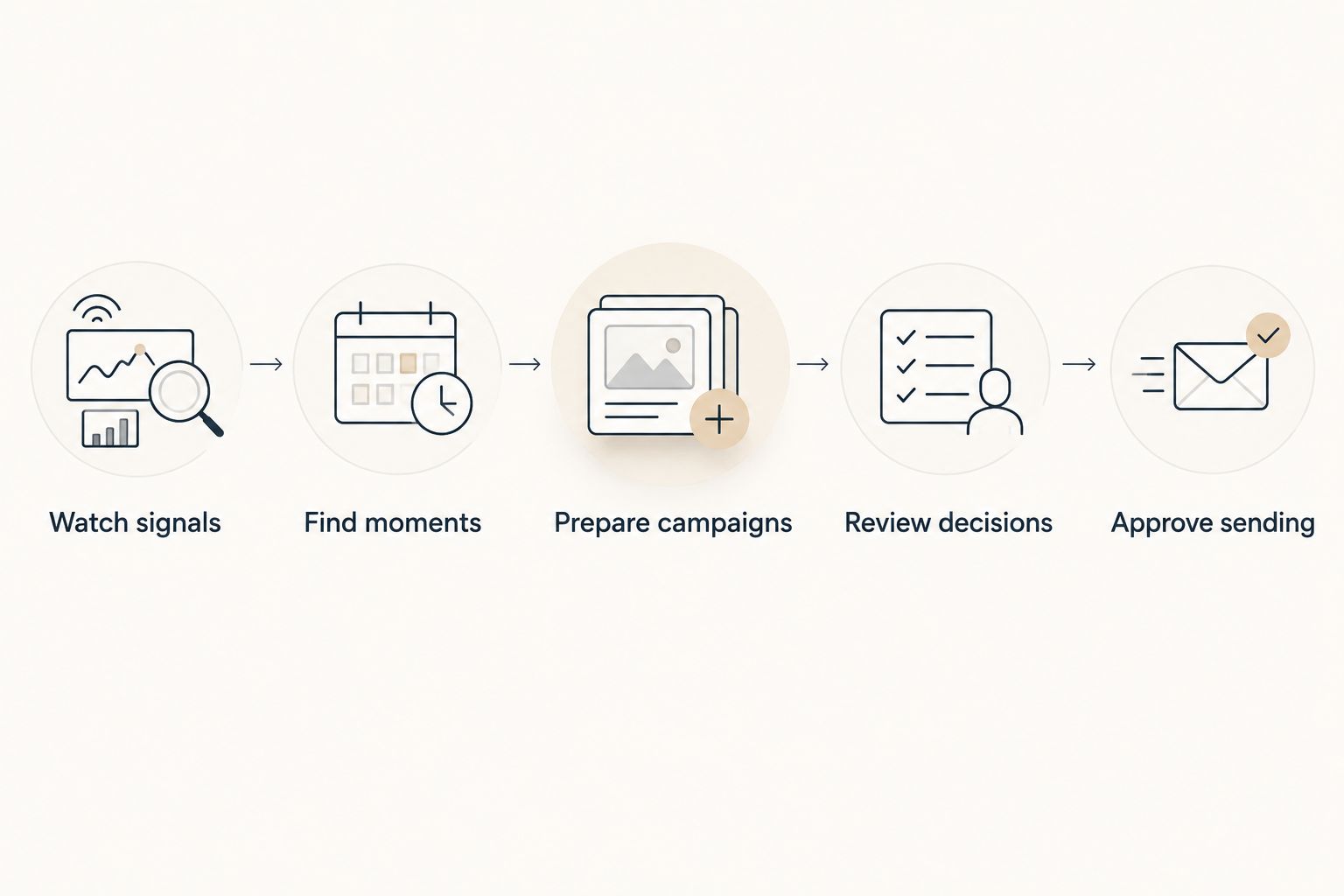
Use a hypothetical repeat-purchase campaign during evaluation. Ask the vendor to explain the audience and draft, then change a sending boundary and inspect the resulting proposal. This is an evaluation exercise, not a claim about observed customer results.
2. Klaviyo: best for merchant-managed lifecycle flows
Klaviyo fits a merchant who wants to build customer segments and automated lifecycle flows in a dedicated marketing platform. Choose this operating model when you want to own the logic and have someone responsible for maintaining it.
The buying question is not whether automation exists. It is whether your team wants to design and manage the program that automation executes.
Where Klaviyo shines
- Customer segmentation supports different messages for different audiences.
- Automated flows support lifecycle programs rather than only individual broadcasts.
- The build-and-manage model fits merchants who want direct responsibility for campaign logic.
Where Klaviyo falls short
- Choosing segmentation criteria and flow rules remains operational work.
- More branching logic means more conditions for your team to inspect.
- A merchant without a clear campaign owner still needs to assign that responsibility.
These are operating trade-offs, not claims that Klaviyo lacks assistance or automation. Evaluate the current product against your actual workflow rather than assuming any platform runs the entire retention function for you.
Best for: Merchants who want to build and maintain their own lifecycle program.
Verdict: Buy when ownership of flow design is an advantage, not another unfinished task.
3. Omnisend: best for ecommerce email and SMS programs
Omnisend is an alternative for merchants organizing ecommerce email and SMS campaigns in a dedicated marketing platform. Put it on your shortlist when those channels define the program you intend to run.
Evaluate the campaign-building and automation workflow using a real task from your store. A broad channel list tells you less than seeing who selects the audience, prepares the message, and checks the campaign.
Where Omnisend shines
- Email and SMS sit within its ecommerce marketing focus.
- Campaign automation supports repeatable marketing workflows.
- It gives merchants a dedicated environment for organizing those programs.
Where Omnisend falls short
- Channel access does not decide which customer moment deserves a message.
- You still need ownership of campaign strategy, content checks, and maintenance.
- Adding SMS introduces another permission and messaging decision; it is not automatically the right channel for every audience.
Best for: Merchants who want to manage ecommerce email and SMS campaigns themselves.
Verdict: Buy when the channel workflow matches your plan; skip a switch based only on channel count.
4. Manual retention: best for a deliberately narrow program
Manual retention means you inspect customer activity, select an audience, prepare the message, and use your chosen sending tool. It is a working method, not a competing software product, and it can include Shopify Email.
Where manual retention shines
- You make each audience and messaging decision directly.
- You can examine the campaign logic without first configuring a larger program.
- It helps you define a repeatable task before deciding what to automate.
Where manual retention falls short
- Every campaign depends on someone noticing the opportunity and completing the work.
- Repeating audience selection and message preparation consumes attention.
- The process stops when no one owns the next review.
Best for: Merchants testing a narrow retention workflow they can consistently manage.
Verdict: Hold while the process is manageable; switch when repeated preparation becomes the obstacle.
Why people switch from Shopify Email
A useful 2026 switching decision starts with a specific job your current process leaves unfinished. Do not assume every merchant has outgrown Shopify Email, or that replacing it fixes an unclear retention strategy.
You need help choosing the next campaign
If your recurring question is which customers need attention now, evaluate moment detection and audience preparation. A different editor is not the answer to a decision problem.
You want a managed lifecycle program
If you already know the journeys you want, compare how you build segments, define conditions, and maintain automated flows. Klaviyo belongs in that evaluation because segmentation and lifecycle flows are central to its operating model.
You are coordinating email and SMS
If both channels are part of your actual plan, evaluate Omnisend alongside your other options. Check campaign ownership and recipient permission before treating another channel as a benefit.
You want approval before delegated sending
If you want a system to prepare retention work, inspect the boundary between drafting, approval, and autonomous sending. Require a clear explanation of what happens before you approve a playbook and what changes afterward.
None of these reasons depends on an invented outage, a pricing-change story, or an unsupported claim about another vendor. They are distinct buying requirements with different answers.
How to make the decision in 2026
Keep the evaluation small enough to finish. Use 1 playbook, compare 2 audience groups—included customers and excluded customers—and document 3 approval decisions: audience, message, and sending limits.
Those numbers are a suggested evaluation scope, not performance benchmarks. The purpose is to expose the actual work before you commit to a broader program.
- Write down the retention moment you want to address.
- Ask each vendor or workflow owner to explain the audience selection.
- Inspect the draft for relevance, unsupported promises, and unnecessary repetition.
- Identify who maintains the rules after launch.
- Separate campaign attribution from evidence of incremental value.
Attributed revenue does not establish causal lift, profit, or verified churn reduction. If a campaign receives credit for an order, that alone does not prove the customer would otherwise have left or that the order was profitable.
For Tranthor, the practical evaluation is whether its retention CRM prepares useful work while keeping approval and sending boundaries clear. Judge the proposal before judging the promise.
Evaluate your retention workflow
Compare moment detection, campaign preparation, and approval control with the work you do today.
When staying with Shopify Email is right
Stay with Shopify Email when store-led email campaigns meet your needs and you can consistently handle audience selection and retention planning. A migration adds work; it needs a specific operational reason.
Keeping the current tool is also reasonable when you have not yet defined the campaign you want to improve. Write down the audience, message, and review process first. Then decide whether the missing piece is a sending platform, lifecycle tooling, or delegated preparation.
FAQ
What's the best Shopify Email alternative for retention marketing in 2026?
Tranthor is the best fit when you want retention moments detected and campaigns prepared for approval. Klaviyo fits merchants who want to build and manage segmentation and lifecycle flows themselves.
Should I replace Shopify Email if I only send newsletters?
Not solely for that reason. Stay with Shopify Email if it meets your campaign needs and you can handle audience selection and retention planning consistently.
Is Klaviyo better than Shopify Email for retention?
Klaviyo fits a merchant-managed lifecycle program built around customer segmentation and automated flows. Whether it is the better choice depends on whether you need that workflow and can maintain it.
When should I consider Omnisend?
Consider Omnisend when you want to organize ecommerce email and SMS campaigns in a dedicated marketing platform. Evaluate a real campaign and identify who owns its audience, content, and maintenance.
Does an approval-led retention system send autonomously immediately?
The workflow described here starts playbooks in review. The merchant decides when to allow autonomous sending within approved limits.
Can I do retention marketing manually?
Yes, you can inspect customer activity, choose an audience, prepare a message, and send through your chosen tool. The trade-off is that each campaign depends on your attention and follow-through.
Does attributed retention revenue prove the campaign worked?
No, attributed revenue does not prove causal lift, profit, or verified churn reduction. Attribution assigns credit; it does not establish what the customer would have done without the campaign.
One last thing
For your 2026 evaluation, inspect an excluded customer, not just an included one. Ask why that customer should not receive the campaign. If you cannot explain the exclusion, you have not finished checking the audience—regardless of which tool prepared it.