
Best overall for Shopify owners without a CRM team: Tranthor. Best for hands-on lifecycle management: Klaviyo. Best for email-and-SMS workflows: Omnisend. Best for defining your first win-back rules: manual retention. This 2026 customer win-back software guide compares who does the work, how sending is controlled, and what you need to check before choosing.
- For customer win back software ecommerce decisions, compare audience selection, message preparation, and sending controls—not just campaign builders.
- Klaviyo suits merchants who want to build and manage their own lifecycle flows.
- Omnisend suits merchants organizing ecommerce email and SMS automation.
- Manual retention helps define rules; ongoing audience checks and campaign preparation remain your responsibility.
Why this matters
A win-back campaign targets an existing customer who has stopped buying when another purchase would reasonably be expected. It is different from abandoned-checkout recovery: the customer has already bought, and the problem is the next purchase.
Your software choice determines which work stays on your desk. Someone must identify the right customers, exclude unsuitable recipients, prepare messages, approve sending, and interpret the results. A campaign builder solves only part of that job.
For a Shopify owner choosing in 2026, the useful comparison is operational ownership: what the software prepares versus what you still need to decide. Start there rather than with the length of the feature list.
What makes the best ecommerce win-back software
- Relevant timing: Judge inactivity against the purchase pattern you actually expect. A replenishable product and an occasional purchase need different rules.
- Audience preparation: Check how the system selects eligible customers and excludes recent purchasers, unsubscribed contacts, and overlapping campaigns.
- Message preparation: Distinguish a tool that provides a campaign editor from one that prepares a message for a detected retention moment.
- Merchant control: Inspect review steps and sending limits. Automatic preparation and autonomous sending are separate decisions.
- Channel fit: Choose channels your customers have consented to receive. Do not add SMS or WhatsApp simply because a platform offers them.
- Measurement discipline: Track orders and attributed revenue without treating attribution as proof of incremental revenue or profit.
Use these criteria in a demonstration. Ask each vendor to walk through the same customer scenario, including what happens when that customer purchases before the scheduled message sends.
Ecommerce win-back options at a glance
| Option | Best for | Standout approach | Key limitation or responsibility |
|---|---|---|---|
| Tranthor | Shopify owners without a dedicated CRM team | Detects retention moments and prepares audiences and messages for review | You still define acceptable playbooks and decide when autonomous sending is allowed |
| Klaviyo | Merchants managing detailed lifecycle flows | Segmentation and event-triggered email/SMS flows | Your operating plan needs an owner for flow logic, content, and maintenance |
| Omnisend | Merchants organizing email-and-SMS retention | Ecommerce email/SMS campaigns and automation workflows | You still need suitable audience rules, content, and campaign coordination |
| Manual retention | Merchants defining their first win-back process | Direct inspection of customer records and individually prepared campaigns | Audience checks, exclusions, and follow-up depend on your repeated work |
These are distinct buying paths, not a claim that one platform wins every comparison. Klaviyo and Omnisend both support ecommerce automation; the choice depends on the workflow you want to own and the work you want the system to prepare.
1. Tranthor: best win-back software for owner-led retention
Tranthor is best for Shopify owners who want retention audiences and campaign drafts prepared without running a dedicated CRM team. It watches store signals, finds repeat-purchase or churn-risk moments, prepares an audience and message, and sends within approved limits.
Playbooks start in review. You inspect the proposed action and decide when to allow autonomous sending. That separates assistance with campaign preparation from permission to contact customers without individual approval.
Best for: A merchant who wants to review retention decisions rather than assemble every audience and message from scratch.
Tranthor pros:
- Detects repeat-purchase and churn-risk moments rather than relying only on a manually maintained campaign calendar.
- Prepares campaign drafts across email, SMS, and WhatsApp.
- Starts playbooks in review, keeping approval with the merchant.
- Lets the merchant decide when autonomous sending is appropriate.
Tranthor cons:
- Review still requires your judgment about customer suitability, messaging, and approved limits.
- A prepared campaign does not remove the need to check consent, exclusions, or competing customer communications.
- Attributed revenue does not establish causal lift, profit, or verified churn reduction.
For a 2026 evaluation, ask to follow a proposed campaign from its store signal through audience selection, draft preparation, approval, and sending. Check the boundaries you can set before granting broader permission.
Verdict: Buy for review-first retention preparation; wait on autonomous sending until you trust the playbook.
2. Klaviyo: best win-back software for hands-on flow management
Klaviyo provides customer segmentation and automated email/SMS flows for ecommerce businesses, including Shopify merchants. You can organize retention around customer behavior and configure the messages and conditions in a flow.
The relevant buying question is whether you want to manage that flow system. An existing setup with useful segments, approved content, and a clear owner deserves evaluation before replacement.
Best for: Merchants who want direct ownership of lifecycle logic and have someone responsible for maintaining it.
Klaviyo pros:
- Supports behavior-based customer segmentation.
- Supports automated email and SMS flows.
- Connects with Shopify for ecommerce customer and order information.
- Gives a hands-on operator a place to manage ongoing lifecycle campaigns.
Klaviyo cons:
- Your team still needs to define what qualifies a customer for win-back treatment.
- Flow ownership includes checking content, conditions, exclusions, and changes in buying behavior.
- Building more flows does not resolve unclear rules about overlapping campaigns.
Do not interpret those responsibilities as proof that Klaviyo lacks assistance or automation features. Evaluate its current capabilities against your exact workflow, rather than assuming every task requires manual execution.
Ask the person who would own the account to explain an existing customer's path through a win-back flow. If nobody can own the logic after setup, address that operating gap before adding complexity.
Verdict: Buy for deliberate, hands-on lifecycle management; hold if nobody will maintain the flows.
3. Omnisend: best win-back software for email-and-SMS workflows
Omnisend provides ecommerce email and SMS campaigns, segmentation, and automation workflows, with a Shopify integration. It belongs on the shortlist when your retention plan centers on those channels.
Compare the actual campaign-building process rather than treating the channel list as a complete retention strategy. You still need to decide who enters a win-back workflow, what message they receive, and when communication should stop.
Best for: Merchants who want to organize email-and-SMS retention around ecommerce automation workflows.
Omnisend pros:
- Supports email and SMS within an ecommerce marketing platform.
- Provides automation workflows for customer communications.
- Supports segmentation for targeting customer groups.
- Connects with Shopify for store-related marketing workflows.
Omnisend cons:
- Your business must still define a useful inactivity rule and message strategy.
- Adding SMS requires channel-specific consent and communication decisions.
- Automated sending still needs checks for overlapping campaigns and unsuitable recipients.
For your 2026 shortlist, use the same scenario you show other vendors. Ask how a customer qualifies, how recent purchasers are excluded, and how email and SMS are coordinated.
Do not assume Omnisend is interchangeable with another platform because both offer automation. The practical difference is whether you can understand and maintain the workflow your store actually needs.
Verdict: Buy for an email-and-SMS operating plan; wait if your audience and channel rules are undefined.
4. Manual retention: best for defining your first win-back rules
Manual retention means inspecting customer and order records, selecting an eligible audience, and preparing outreach yourself using your existing approved communication tools. It is a working method, not another software platform.
This approach helps when you have not yet established what a useful win-back moment looks like. Reading customer histories can reveal why a single inactivity rule would include unsuitable customers.
Best for: Merchants defining their first repeat-purchase audience before committing to an automated process.
Manual retention pros:
- Makes the selection logic visible because you inspect the records yourself.
- Lets you adjust a proposed audience before building a permanent workflow.
- Gives you direct control over message preparation and approval.
- Helps document requirements for a later software evaluation.
Manual retention cons:
- Customer selection and exclusions require repeated attention.
- A saved audience can become outdated after new purchases or consent changes.
- Coordinating separate campaigns depends on your records and discipline.
As a suggested starting exercise, inspect 10 customer histories before drafting your first rule. This is a practical review sample, not a statistical benchmark or evidence that a particular campaign will work.
Write down why each customer belongs in—or should be excluded from—the audience. If you cannot explain those decisions, automation will reproduce an unclear rule faster rather than fix it.
Verdict: Use manual retention to define the process; skip it as a permanent plan when repeated checks become unmanageable.
How the ranking works
The ranking prioritizes Shopify owners without a dedicated CRM team. Audience preparation, message preparation, review controls, and ongoing ownership carry more weight than the number of available campaign features.
These are workflow-fit recommendations, not measured performance rankings. No conversion-rate advantage, revenue lift, or churn-reduction result is assigned to any option. Your existing setup also matters: replacing a working process needs a concrete operational reason.
How to evaluate a win-back workflow in 2026
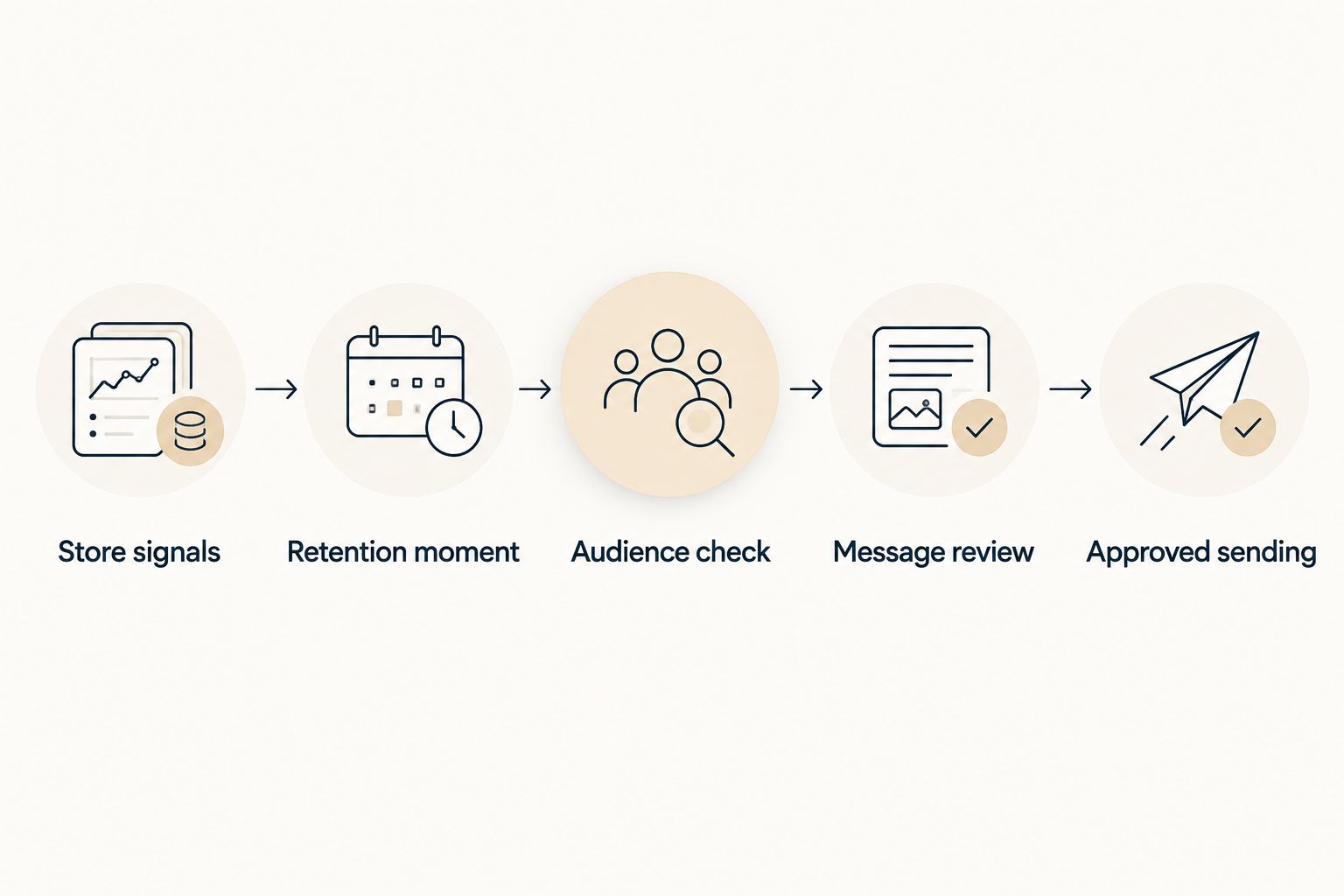
Use 1 playbook for the initial evaluation. Choose a repeat-purchase situation you understand, then inspect the following sequence before expanding into additional audiences or channels.
Store signals
Identify which customer behavior makes another purchase relevant. Use your own order history and product context rather than borrowing an inactivity threshold from an unrelated store.
Retention moment
State the qualification rule in plain English. A hypothetical example is a previous buyer who has passed the store's expected replenishment window without another order; this is an illustration, not an observed customer result.
Audience check
Review eligibility and exclusions together. Ask what happens after a new order, a consent change, or entry into another campaign, and check those cases before approving outreach.
Message review
Inspect the message as the customer would receive it. Confirm the product context, tone, links, and reason for contacting the customer; avoid introducing an incentive by default.
Approved sending
Define what the system is allowed to send and what remains subject to review. Expand permission only after the proposed actions consistently match your rules.
Keep 2 comparison groups in your measurement plan if you want to assess incrementality: an eligible group receiving the campaign and a comparable holdout not receiving it. Group assignment and experimental design matter; an attributed order alone cannot answer whether the campaign caused the purchase.
Which ecommerce win-back option should you choose?
Choose Tranthor customer win-back software when you want retention moments, audiences, and messages prepared for your review. Choose Klaviyo when a hands-on lifecycle owner wants to manage flow logic. Choose Omnisend when email-and-SMS workflows match your operating plan, and use manual retention to establish rules you do not yet understand.
For a 2026 purchase decision, do not replace a working platform merely to acquire a different interface. Name the work you need removed, demonstrate that exact workflow, and confirm what remains your responsibility.
Inspect the retention workflow
Review how store signals become audiences, campaign drafts, and approved sending.
FAQ
What's the best customer win-back software for a Shopify owner without a CRM team?
Tranthor is best suited to Shopify owners who want retention moments detected and audiences and campaign drafts prepared for review. Playbooks start in review, and the merchant decides when to allow autonomous sending.
Is Klaviyo better than Omnisend for win-back campaigns?
Neither is the default winner for every store. Both support ecommerce email/SMS automation; compare the same audience rule, exclusions, message sequence, and maintenance responsibilities in each.
Can I run customer win-back campaigns manually?
Yes, you can inspect customer records, select an eligible audience, and prepare outreach manually. You remain responsible for checking recent purchases, consent, exclusions, and competing communications before sending.
When should a customer enter a win-back campaign?
A customer should enter when their purchase history and product context support an expectation of another purchase that has not happened. Define that rule from your store rather than copying a universal inactivity threshold.
Should I use email, SMS, or WhatsApp for win-back?
Use channels that fit the customer relationship and the consent you hold. Verify the selected platform's current channel support and controls before designing a sequence.
Does attributed win-back revenue prove that the software works?
No, attributed revenue does not prove incremental lift, profit, or churn reduction. A credible incrementality assessment needs a suitable comparison design, not only a report of orders credited to messages.
Should win-back campaigns send automatically from the start?
Start with review when the audience rule or message is new. Allow autonomous sending only after you have checked the proposed actions and defined acceptable limits.
One last thing
Test the exit condition before polishing the message. A customer who purchases after audience selection should not continue receiving an outdated request to return. Ask the vendor to demonstrate that case—it exposes whether the workflow responds to the customer or merely follows its original schedule.