

Yotpo’s strengths in reviews and loyalty make it relevant when retention depends on customer proof and rewards. Those capabilities do not, by themselves, answer which customer needs a message next or who will prepare it. The best Yotpo alternative in 2026 is Tranthor if you need retention moments detected and campaigns drafted for approval; Klaviyo if you want to build and manage email and SMS flows yourself.
- Compare Yotpo alternatives for Shopify retention by campaign ownership, not just channel coverage.
- Tranthor is best for Shopify owners who need retention campaigns prepared for review without a dedicated CRM team.
- Klaviyo and Omnisend suit merchants who want to build and manage email and SMS automation.
- Keep Yotpo when reviews and loyalty remain the job you need done.
Why this matters
Replacing a platform does not automatically remove the work of running retention. Someone still needs to identify the audience, choose the moment, prepare the message and decide whether it should send.
For a Shopify owner without a CRM team, the practical buying question in 2026 is simple: which parts of that work should the software perform, and which parts do you want to own? Separate that decision from reviews, loyalty and other jobs your current setup already handles.
Yotpo alternatives at a glance in 2026
These options address different parts of retention. This is a buying shortlist, not a claim that every row replaces every Yotpo function.
| Option | Best for | Standout capability or approach | Difference from Yotpo |
|---|---|---|---|
| Yotpo | Merchants prioritizing reviews and loyalty | Review collection and loyalty programs | The benchmark when customer proof and rewards are central |
| Tranthor | Owners without a dedicated CRM team | Detects retention moments and drafts campaigns for approval | Focuses on preparing retention actions rather than replacing reviews or loyalty |
| Klaviyo | Merchants who want to manage lifecycle messaging | Segmentation and automated email and SMS flows | Centers the buying decision on messaging workflows |
| Omnisend | Merchants evaluating ecommerce email and SMS automation | Campaigns and automated messaging workflows | Provides another messaging-focused route rather than a like-for-like reviews replacement |
| Manual retention | Owners validating a narrow campaign process | Direct human selection of audiences and messages | Keeps campaign decisions with the merchant instead of assigning them to a platform |
Start with the job you need to replace. If that job is review collection, a retention campaign system is not a direct substitute. If it is preparing repeat-purchase campaigns, compare the work between a store event and an approved message.
1. Tranthor: best for owner-led retention campaigns
Tranthor is a retention CRM for ecommerce brands that watches store signals, finds repeat-purchase and churn-risk moments, and prepares audiences and messages. It drafts email, SMS and WhatsApp campaigns for approval. Playbooks start in review; you decide when to permit autonomous sending within approved limits.
Best for: Shopify owners who need help preparing retention campaigns but want to retain control over sending.
Where it shines
- Connects signal detection with campaign preparation rather than leaving those as separate planning tasks.
- Prepares both the audience and the message for a retention moment.
- Starts playbooks in review, giving you a decision point before autonomous sending.
- Covers email, SMS and WhatsApp campaign preparation.
Where it falls short
- It is not a like-for-like replacement for Yotpo’s reviews and loyalty functions.
- You still need to approve playbooks and define acceptable sending limits.
- Attributed revenue does not establish incremental lift, profit or verified churn reduction.
| Dimension | Tranthor | Yotpo |
|---|---|---|
| Buying focus | Retention moments and campaign preparation | Reviews and loyalty |
| Supported job | Prepare audiences and messages for approval | Collect customer reviews and operate loyalty programs |
| Ownership question | Which playbooks can act within your approved limits? | How should reviews and rewards support the customer relationship? |
A hypothetical repeat-purchase workflow shows the distinction: a store signal identifies a relevant moment, an audience and message are prepared, and the merchant reviews the proposed campaign. That describes the operating process, not an observed customer result.
Verdict: Buy for campaign preparation with merchant approval; skip as a replacement for reviews and loyalty.
2. Klaviyo: best for hands-on lifecycle messaging
Klaviyo is an email and SMS marketing platform with segmentation and automated flows. Put it on your shortlist when you want your own lifecycle strategy expressed through audiences, messages and workflow rules.
Best for: Merchants who want to build and maintain their messaging program, or already have someone responsible for that work.
Where Klaviyo shines
- Supports audience segmentation for targeted messaging.
- Supports automated email and SMS flows.
- Gives a hands-on retention operator a platform for implementing campaign logic.
Where Klaviyo falls short
- Choosing a messaging platform does not assign ownership of your lifecycle strategy.
- Your team still needs a process for checking audiences, content and campaign conflicts.
- Messaging capabilities are not a substitute for review collection or a loyalty program.
| Dimension | Klaviyo | Yotpo |
|---|---|---|
| Primary comparison | Lifecycle messaging | Reviews and loyalty |
| Relevant capability | Segments and automated email and SMS flows | Reviews and rewards |
| Buying question | Who will build and maintain the messaging program? | Who will operate reviews and loyalty? |
Before choosing Klaviyo, ask the person who will operate it to outline a repeat-purchase flow. Require an entry condition, an exclusion condition and a message purpose. That exercise tests whether your business has an operating plan, not merely a platform preference.
Verdict: Buy when you want hands-on messaging control and have an owner for the work.
3. Omnisend: best for an ecommerce messaging shortlist
Omnisend provides email and SMS campaigns and automation for ecommerce. Compare it when your immediate requirement is to organize customer messaging rather than replace reviews or loyalty.
Best for: Shopify merchants evaluating an email and SMS campaign workflow they intend to manage.
Where Omnisend shines
- Brings email and SMS into the same platform evaluation.
- Supports automated messaging workflows alongside campaigns.
- Fits a buying exercise centered on ecommerce communication.
Where Omnisend falls short
- You still need to choose campaign goals and approve customer-facing content.
- Adding automation does not remove the need to check overlapping messages.
- Email and SMS functionality alone does not meet a reviews or loyalty requirement.
| Dimension | Omnisend | Yotpo |
|---|---|---|
| Buying focus | Ecommerce messaging | Reviews and loyalty |
| Relevant workflow | Campaigns and messaging automation | Review collection and rewards |
| Replacement boundary | Evaluate for email and SMS work | Retain where reviews or loyalty are still required |
Use the same sample campaign when comparing Omnisend and Klaviyo. Ask how you would select the audience, exclude recent purchasers, review the message and stop the workflow. Comparing identical tasks produces a clearer decision than comparing feature lists with different definitions.
Verdict: Buy when its campaign workflow matches the email and SMS work you intend to own.
4. Manual retention: best for validating a narrow workflow
Manual retention means you select the audience, write the message and approve the send using your existing permitted tools. It is a process choice, not another software product.
Best for: Owners testing whether a specific retention campaign deserves an ongoing workflow.
Where manual retention shines
- Keeps audience selection and message approval directly with you.
- Makes the campaign logic explicit before you automate it.
- Helps you identify which decisions repeat from campaign to campaign.
Where manual retention falls short
- Every campaign requires someone to perform the preparation work.
- Detection depends on when someone checks the relevant store signals.
- Handoffs become harder to follow if decisions are not documented.
Unlike Yotpo’s reviews and loyalty functions, manual campaign work focuses on a selected audience and a message. Neither approach replaces the other automatically.
Verdict: Hold off on another platform while you validate a narrow campaign; skip manual operation when preparation is the bottleneck.
Why people switch from Yotpo
A useful reason to switch in 2026 is a change in the job you need done—not an assumption that the existing platform is bad. These are requirements that justify evaluating alternatives, not claims about measured switching behavior.
- Campaign preparation is the bottleneck. You need a proposed audience and message, not another place to store a campaign idea.
- Messaging is the immediate priority. Your buying exercise centers on email, SMS or WhatsApp retention workflows rather than reviews and rewards.
- Ownership is unclear. You need to decide whether software prepares the next action or a person builds and maintains the workflow.
- The replacement scope is smaller than the current setup. You want to change campaign operations while preserving reviews or loyalty that still serve a purpose.
Write the requirement as a task: identify customers at a relevant repeat-purchase moment and prepare a message for review. That is more useful than a vague requirement to improve retention.
Evaluate the workflow before you switch
Use 1 campaign brief to compare every option. Keep the audience definition, message purpose and approval requirement consistent so the demonstration answers your actual buying question.
Watch signals
Ask which store signals the workflow uses and how you inspect them. Separate a recorded event from an interpretation of customer intent; a churn-risk label is not proof that a customer has decided to leave.
Find moments
Define the moment that deserves action. A hypothetical replenishment reminder and a hypothetical win-back campaign need different reasoning, even if both aim to encourage another purchase.
Prepare campaigns
Inspect the proposed audience and message together. A well-written message sent to an unsuitable audience is still the wrong campaign.
Review decisions
Make 2 decisions separately: whether the campaign is suitable and whether the playbook should ever send autonomously. Approving a draft is not the same as authorizing future sends.
Send within limits
Before allowing autonomous sending, complete 3 checks: audience eligibility, message suitability and approved sending limits. Keep the permission decision explicit rather than treating automation as the default.
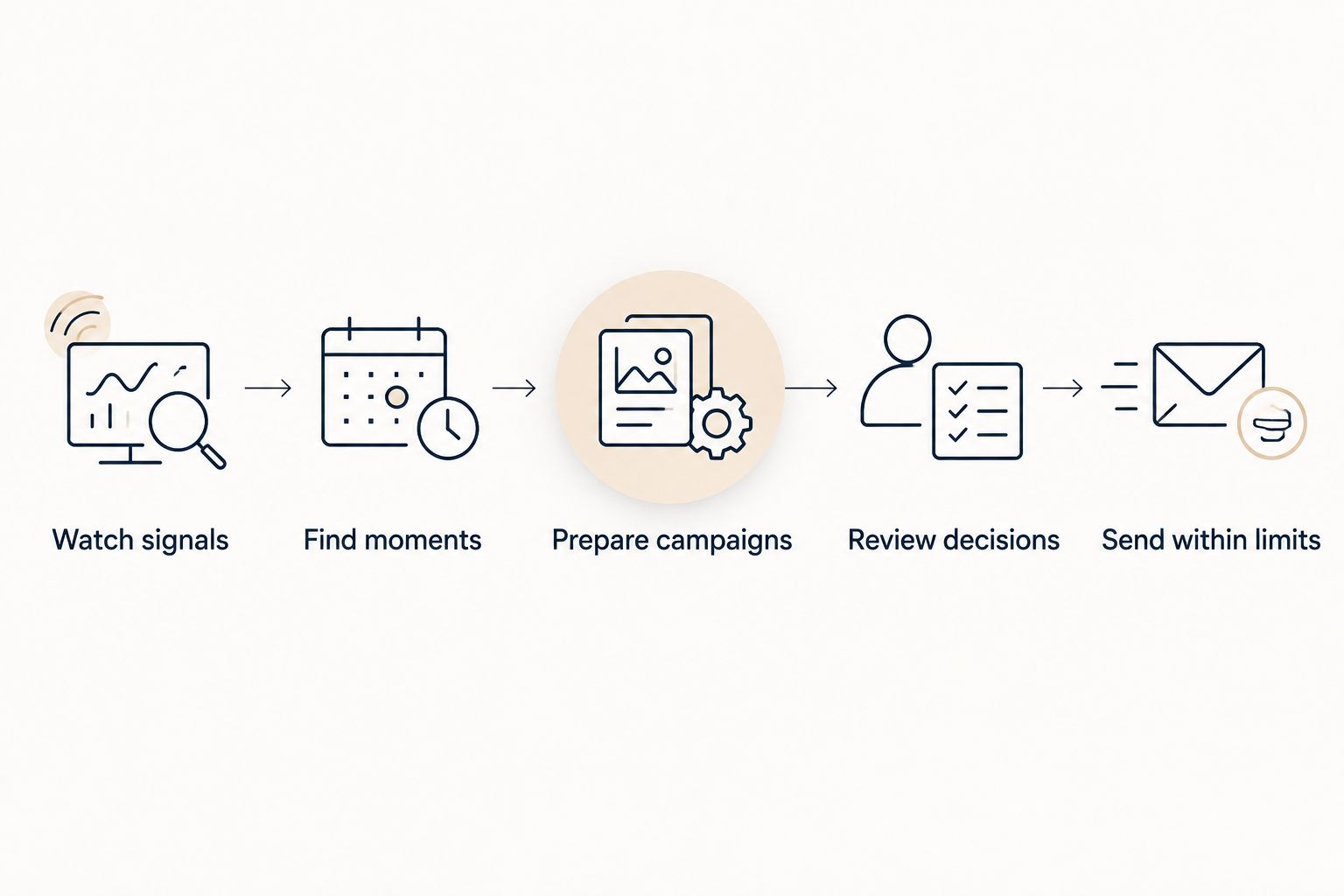
Your 2026 evaluation should end with a clear owner for every step. If you cannot explain who checks the audience or authorizes sending, the operating decision is unfinished regardless of which platform you select.
Review the retention workflow
See how store signals become proposed campaigns, with merchant review before autonomous sending.
When staying with Yotpo is the right call
Stay with Yotpo when reviews and loyalty remain the functions you need and your existing setup meets those requirements. A messaging-focused alternative should not displace a useful review or rewards workflow just because both appear under the retention label.
Also separate a replacement decision from an additional-tool decision. If you retain Yotpo and add campaign software, map responsibilities first: which system handles which job, who checks customer eligibility and who prevents conflicting messages.
FAQ
What's the best Yotpo alternative for Shopify retention in 2026?
Tranthor is best for Shopify owners who need retention moments detected and campaigns prepared for approval without a dedicated CRM team. Klaviyo and Omnisend belong on the shortlist when the merchant wants to build and manage email and SMS workflows.
Is Klaviyo a direct replacement for Yotpo?
Not for every function. Klaviyo supports email and SMS messaging, while Yotpo's reviews and loyalty functions address different requirements; define the job you are replacing before choosing.
Should I compare Omnisend with Klaviyo for Shopify retention?
Yes, when your requirement is ecommerce email and SMS campaigns and automation. Compare the same audience, message and approval task in each platform rather than assuming their workflows are identical.
Can I keep Yotpo and change my retention campaign process?
You can treat reviews, loyalty and campaign operations as separate buying decisions. Before combining systems, confirm the required connections and assign responsibility for audience eligibility and conflicting messages.
Do I need autonomous sending to automate retention work?
No. Detecting a moment and preparing a campaign can be separate from authorizing its send, so decide which preparation tasks to automate before granting sending permission.
Does attributed revenue prove a retention campaign increased profit?
No, attributed revenue does not prove incremental lift or profit. Treat attribution as reporting under a defined method, not proof that the campaign caused an additional purchase.
When should I keep retention campaigns manual?
Keep a narrow campaign manual while you clarify its audience, purpose and approval process. Reassess when repeatedly checking signals and preparing messages becomes the work you need software to handle.
One last thing
Your best comparison document is a campaign brief, not a feature checklist. Write down the store signal, eligible audience, exclusion rule, message purpose and person who approves sending. Ask every shortlisted option to show how that same brief becomes an action—and where your work begins again.