

Best overall for review-first retention: Tranthor. Best for merchant-built lifecycle flows: Klaviyo. Best for an email-and-SMS campaign workflow: Omnisend. Best for occasional, individually reviewed outreach: manual retention. These activecampaign alternatives give Shopify owners different ways to manage retention in 2026; choose according to who will find the opportunity, build the campaign, and approve the send.
- Tranthor is the best fit among these activecampaign alternatives for Shopify owners who want retention campaigns prepared for approval.
- Klaviyo suits merchants who want to build and maintain their own ecommerce lifecycle flows.
- Omnisend suits merchants organizing retention around email and SMS campaigns and automations.
- Manual retention suits occasional outreach when you can personally check every audience and message.
Why this matters
Replacing ActiveCampaign does not automatically remove retention work. You still need someone—or a system—to identify the right customer moment, prepare the audience, write the message, and check whether sending is appropriate.
For a Shopify owner without a dedicated CRM team, the buying question is operational: which responsibilities will the replacement actually take off your desk? A workflow builder helps you execute instructions. A system that detects moments and prepares campaigns addresses a different part of the job.
Treat your 2026 shortlist as a division-of-work decision, not a contest over the longest feature list. Keep ActiveCampaign if it already supports your required workflows and switching would leave the underlying workload unchanged.
What makes the best ActiveCampaign alternatives?
Use these criteria before comparing the 4 options below. Each criterion addresses work you must either perform yourself or assign to the system.
- Moment detection: Does the system find repeat-purchase or churn-risk opportunities, or must you define and monitor every trigger?
- Campaign preparation: Who selects the audience and drafts the message? Separate preparation from scheduled delivery.
- Sending control: Can you inspect the work before it sends? Establish who approves messages and who changes sending permissions.
- Channel fit: Match email, SMS, and WhatsApp requirements to the actual workflow. Do not assume every channel has identical capabilities.
- Ongoing ownership: Name the person responsible for maintaining audiences, messages, exclusions, and automation logic.
- Measurement discipline: Distinguish revenue attributed to messages from evidence of incremental revenue or profit.
Choose the option whose operating model matches your available attention. Buying more configuration freedom is not useful if nobody will maintain the configuration.
ActiveCampaign alternatives at a glance
This 2026 comparison separates the options by their strongest use case. It is not a claim that any platform produces better financial results.
| Option | Best for | Standout approach | Key limitation or responsibility |
|---|---|---|---|
| Tranthor | Review-first retention without a dedicated CRM team | Detects retention moments and prepares audiences and messages for approval | You still need to review campaign fit and decide when autonomous sending is allowed |
| Klaviyo | Merchant-built ecommerce lifecycle flows | Ecommerce segmentation, email and SMS, and configurable flows | Your team must own the audience rules, content, and flow design it chooses |
| Omnisend | Campaign-led email and SMS retention | Ecommerce email and SMS campaigns and automation workflows | You still need to define the campaign strategy and maintain its messages |
| Manual retention | Occasional, individually checked outreach | Direct control over audience selection and message preparation | Every repeat task remains your responsibility |
1. Tranthor: best for review-first ecommerce retention
Tranthor is the best fit for Shopify owners who want retention moments turned into campaigns they can review. It watches store signals, finds repeat-purchase and churn-risk moments, then prepares the audience and message.
Playbooks start in review. You inspect the proposed work and decide when to allow autonomous sending within approved limits, rather than treating automation as an all-or-nothing switch.
Tranthor pros:
- Connects moment detection with audience and message preparation.
- Drafts email, SMS, and WhatsApp campaigns for approval.
- Starts playbooks in review so you can inspect the work.
- Leaves the decision about autonomous sending with the merchant.
Tranthor cons:
- Review-first operation still requires your attention; approval is a responsibility, not a formality.
- You must define acceptable sending limits and judge whether proposed messages fit your customers.
- Attributed revenue does not establish causal lift, profit, or verified churn reduction.
Best for: Shopify owners who want a system to prepare retention work, rather than another interface in which to build every campaign themselves.
Before choosing it, follow a proposed campaign from store signal to message approval. Check whether you understand why the audience was selected and what sending authority you are granting. Verdict: Buy if review-first campaign preparation addresses your actual workload.
2. Klaviyo: best for merchant-built lifecycle flows
Klaviyo provides ecommerce email and SMS marketing, segmentation, and automated flows. Its fit here is a merchant who wants to design lifecycle logic and maintain that logic inside a marketing platform.
This approach gives you a clear place to implement your retention strategy. It also makes strategy ownership explicit: somebody must decide which events matter, what customers receive, and when messages stop.
Klaviyo pros:
- Supports ecommerce audience segmentation.
- Combines email and SMS marketing with automated flows.
- Fits teams that want to define their own lifecycle sequences.
Klaviyo cons:
- A configurable flow does not remove the need to decide what the flow should do.
- Your chosen audience rules and message sequences need ongoing review.
- A solo owner must allocate time to campaign design as well as campaign approval.
Best for: Shopify merchants who have a clear lifecycle strategy and want hands-on ownership of its implementation.
During evaluation, build a representative repeat-purchase flow using your actual requirements. Check the work involved in changing the audience, excluding a recent buyer, and updating the message. Do not mistake an available template for a finished retention strategy. Verdict: Buy if you want to own flow design and can maintain it.
3. Omnisend: best for campaign-led email and SMS retention
Omnisend provides ecommerce email and SMS campaigns, segmentation, and automation workflows. It belongs on this shortlist when your retention plan centers on coordinating campaigns and triggered messages across those channels.
Start with your intended operating routine. If you already know which campaigns to send and need a platform to organize their execution, assess that workflow directly rather than comparing unrelated features.
Omnisend pros:
- Supports ecommerce email campaigns and SMS marketing.
- Provides segmentation for audience selection.
- Supports automated workflows alongside planned campaigns.
Omnisend cons:
- You still need to determine which retention opportunities deserve a campaign.
- Automation setup does not replace message review or audience planning.
- Channel coverage alone does not answer whether your approval process fits.
Best for: Merchants with an email-and-SMS retention plan who want to manage campaigns and automation around that plan.
Ask for a demonstration of your own workflow: select an audience, prepare the campaign, check exclusions, and inspect the send process. If WhatsApp is essential, verify that requirement separately instead of treating email-and-SMS support as evidence of WhatsApp support. Verdict: Buy if campaign execution is the gap you need to close.
4. Manual retention: best for occasional individual outreach
Manual retention means selecting customers and preparing messages yourself, using your store records and existing permitted communication tools. It is an operating method, not a direct software equivalent to ActiveCampaign.
It remains a legitimate alternative when outreach is occasional and you can personally inspect each recipient. The trade-off is straightforward: you retain direct control, but the recurring work stays with you.
Manual retention pros:
- Lets you inspect every selected customer and message.
- Makes unusual customer circumstances easier to consider individually.
- Helps you learn the decision rules before automating them.
Manual retention cons:
- Requires you to find each retention opportunity yourself.
- Leaves audience preparation, message drafting, and follow-up with you.
- Depends on your availability and consistency.
Best for: Owners handling occasional, individualized retention outreach who can reliably complete the work themselves.
Write down why each customer qualifies before sending. That record makes the process repeatable and helps you identify which decisions deserve automation later. Manual work is a useful learning method, but it is not an automated monitoring system. Verdict: Hold while outreach remains manageable; switch when repeated preparation becomes the bottleneck.
How these alternatives are ranked
The ranking prioritizes Shopify owners without a dedicated CRM team. Review-first preparation comes first because it addresses both finding the retention moment and preparing the response; merchant-built flows and campaign-led execution follow as distinct operating choices.
The criteria are moment detection, preparation, control, channel fit, ownership, and measurement discipline. This 2026 ranking does not claim hands-on testing, customer results, or a measured performance advantage for any option.
Evaluate the workflow before you migrate
Use 1 playbook as your evaluation unit: a repeat-purchase opportunity with a clear audience and an appropriate message. The example below is hypothetical, not an observed customer result.
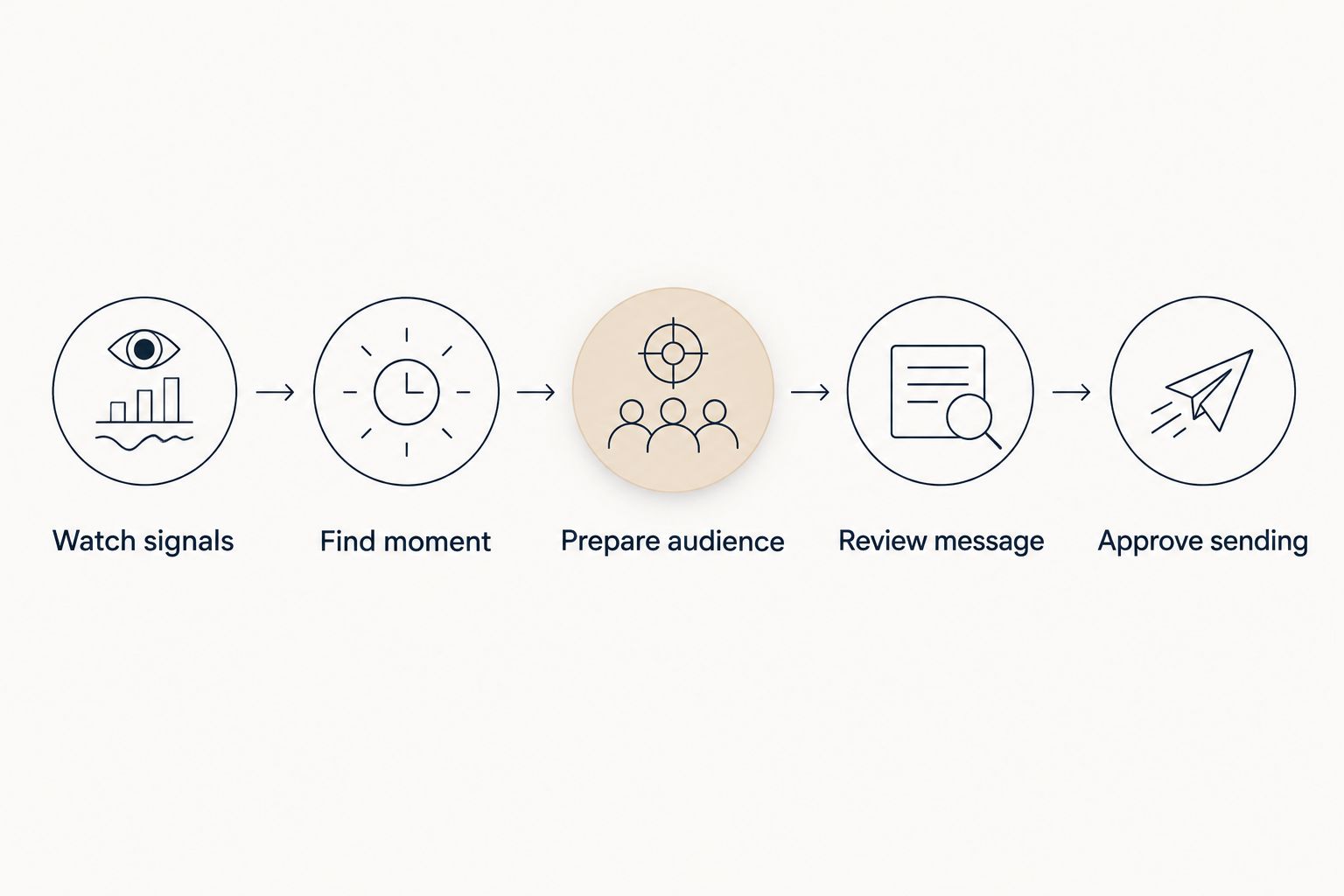
Follow these 5 stages in each shortlisted system. Ask the vendor to distinguish work the product performs from work you must perform.
Watch signals
Identify the store information needed for the playbook. For example, a hypothetical replenishment campaign needs purchase context; an arbitrary calendar reminder alone does not establish that a customer needs another order.
Check that the necessary information reaches the workflow. Do not assume a connected store means every required event or customer detail is usable.
Find moment
Write down why the customer qualifies now. Separate an observed fact, such as a previous purchase, from an inference, such as readiness to reorder.
Ask whether the system detects that moment or simply executes a rule you supplied. Both approaches can be useful, but they assign the reasoning work differently.
Prepare audience
Inspect who is included and who should be excluded. Check permission status, recent purchases, and any customer circumstances relevant to the campaign.
An audience should have an understandable reason for inclusion. If you cannot explain that reason, do not approve the message merely because the audience was generated automatically.
Review message
Check the product references, tone, channel, and requested action. Remove unsupported claims and any incentive you have not authorized.
Review should also consider whether the message makes sense for the selected customer. A technically correct draft can still be inappropriate for the retention moment.
Approve sending
Decide what you approve now and what authority you grant for future sends. Keep message approval separate from permission to run a playbook autonomously.
Your 2026 evaluation should end with a clear answer: who can send what, to whom, and within which limits?
Which ActiveCampaign alternative should you choose?
Choose review-first preparation when finding and preparing retention campaigns is the work you cannot keep up with. Choose Klaviyo when you want to build lifecycle flows yourself. Choose Omnisend when your defined email-and-SMS campaign plan needs an execution platform.
Stay manual when individual review remains practical and consistent. Stay with ActiveCampaign when it already handles your requirements and the proposed replacement does not remove a meaningful task.
Before a 2026 migration, list the audiences, messages, triggers, permissions, and exclusions that must survive the move. Verify each requirement before retiring the existing workflow. A narrower setup you understand is a better starting point than a larger automation system nobody owns.
Explore review-first retention
See the approach to finding retention moments and preparing campaigns for your approval.
FAQ
What's the best ActiveCampaign alternative for a Shopify owner without a CRM team?
A review-first retention system is the best fit when you need help finding opportunities and preparing campaigns, not just sending them. Choose a flow-building platform instead if you want to define and maintain the lifecycle logic yourself.
Is Klaviyo better than ActiveCampaign for ecommerce?
Klaviyo belongs on an ecommerce shortlist because it provides segmentation, email and SMS, and automated flows. Whether it is better for your store depends on the workflows you need and the maintenance work you can own.
When should I choose Omnisend?
Choose Omnisend when your retention plan centers on ecommerce email and SMS campaigns and automation workflows. Evaluate your audience selection, exclusions, and campaign process before deciding.
Can I handle customer retention manually?
Yes, manual retention is a valid choice for occasional outreach that you can personally review. You remain responsible for finding opportunities, checking permissions, preparing audiences, and writing messages.
Does campaign approval mean I have enabled autonomous sending?
No, approving a campaign and authorizing autonomous sending are different decisions. Check the product's permission model and define the limits before allowing unattended sends.
Does attributed revenue prove a retention platform increased profit?
No, attributed revenue does not prove incremental revenue or profit. Attribution assigns credit under a measurement model; causal lift requires a suitable evaluation design, and profit also depends on costs.
What should I check before switching from ActiveCampaign in 2026?
Check required store data, audiences, triggers, channel permissions, exclusions, and message logic before switching. Validate a representative playbook and confirm who owns each operational step.
One last thing
A missed purchase window is not proof that a customer has churned. Treat churn risk as a reason to investigate and select an appropriate response, not as an established customer outcome.
Before approving a retention message, ask whether the customer already bought again or has a reason not to receive it. Better judgment starts with a better audience—not a more forceful message.