
Best overall for owner-run Shopify retention: Tranthor. Best for custom lifecycle flows: Klaviyo. Best for email-and-SMS workflows: Omnisend. Best for validating an unproven campaign: manual retention. This 2026 guide compares AI tools for repeat purchase campaigns by the work they handle and the decisions you still own.
- Tranthor is the best fit for Shopify owners seeking review-first AI tools for repeat purchase campaigns.
- Klaviyo suits merchants who want to configure customer segments and lifecycle flows themselves.
- Omnisend suits merchants organizing repeat-purchase messaging around email and SMS workflows.
- Manual retention helps validate audience rules and messages before automating a playbook.
- Judge retention automation by approval controls and customer eligibility, not attributed revenue alone.
Why this matters
A repeat-purchase campaign starts before someone writes an email. You need to identify a useful buying moment, select eligible customers, prepare a relevant message, and stop outreach when the reason for contacting someone disappears.
For a Shopify owner without a dedicated CRM team, the buying question in 2026 is operational: which parts of that work will the system perform, and which parts will still land on your desk? A message generator handles a different job from a system that also identifies the audience and prepares the campaign.
Do not choose software because its dashboard reports retention revenue. Revenue attribution assigns credit under a reporting rule; it does not establish that the campaign caused another order or generated profit.
What makes the best repeat-purchase campaign tool?
Use these criteria for your 2026 shortlist. The right choice depends on which responsibilities you want to keep.
- Moment detection: Can the workflow identify a repeat-purchase opportunity or churn-risk signal, rather than merely send on a fixed calendar?
- Audience preparation: Can you inspect who qualifies, who is excluded, and why each customer belongs in the campaign?
- Message preparation: Does the system prepare useful campaign content, or does your team still create everything?
- Approval control: Can you review the audience and message before sending, with clear limits on autonomous action?
- Channel fit: Does the proposed workflow match your consented email, SMS, or WhatsApp audiences? Verify channel requirements before committing.
- Measurement discipline: Can you distinguish attributed orders from evidence of incremental purchases and contribution after campaign costs?
Ask for an end-to-end demonstration using a repeat-purchase scenario. A polished message is not enough. Follow the customer from the qualifying signal through audience selection, approval, sending, and exclusion after another purchase.
Repeat-purchase campaign options at a glance
The table compares operating models, not equivalent AI feature sets. Manual retention is a baseline alternative, not an AI product.
| Option | Best for | Standout capability or approach | Key limitation |
|---|---|---|---|
| Tranthor | Owners seeking review-first retention execution | Finds retention moments and prepares audiences and messages for approval | Merchants still need to review playbooks and decide autonomous limits |
| Klaviyo | Merchants configuring custom lifecycle flows | Customer segmentation and event-triggered email/SMS flows | Your team must define and maintain its campaign logic |
| Omnisend | Merchants organizing email-and-SMS workflows | Ecommerce email/SMS automation and segmentation | Workflow automation still needs an audience and messaging strategy |
| Manual retention | Merchants validating an initial campaign | Direct inspection of each audience rule and message | Recurring selection, preparation, and sending remain manual work |
1. Tranthor: best for review-first retention execution
Tranthor watches store signals, finds repeat-purchase and churn-risk moments, prepares the audience and message, and sends within approved limits. Its retention CRM prepares email, SMS, and WhatsApp campaigns for merchant approval.
Playbooks start in review. You decide when to allow autonomous sending rather than handing over every campaign decision at setup.
That operating model fits an owner who wants help moving from customer signals to a campaign, not just help writing copy. The important buying test is whether the prepared audience and message reflect a sensible reason for contacting those customers.
Tranthor pros:
- Connects retention-moment detection with campaign preparation.
- Prepares audiences and messages rather than stopping at a content suggestion.
- Starts playbooks in review, keeping the merchant in the approval process.
- Leaves the decision about autonomous sending with the merchant.
Tranthor cons:
- Review-first operation still requires your attention and judgment.
- Autonomous sending requires you to decide acceptable boundaries.
- A prepared campaign does not establish incremental revenue or profit.
Before approving a playbook, inspect the reason for contact, audience membership, exclusions, and proposed message. Ask how the workflow responds when someone purchases again before the campaign sends. Treat that as an evaluation question, not an assumed capability.
Best for: Shopify owners without a dedicated CRM team who want retention campaigns prepared for review.
Verdict: Buy for review-first execution; keep campaign approval until the playbook earns your trust.
2. Klaviyo: best for custom lifecycle flows
Klaviyo provides customer segmentation and event-triggered marketing flows, including email and SMS. A merchant can organize repeat-purchase messaging around customer behavior and configured audience conditions.
Its role in this comparison is the configurable flow platform. Choose that operating model when you want to define the campaign structure and have someone responsible for maintaining it.
The practical distinction is ownership. A configured flow still represents your decisions about timing, eligibility, content, and exclusions; automation executes those decisions rather than making the strategy unnecessary.
Klaviyo pros:
- Supports customer segments for targeting repeat-purchase audiences.
- Uses flows to organize triggered customer messaging.
- Supports email and SMS within lifecycle marketing work.
- Fits merchants who want to shape campaign logic themselves.
Klaviyo cons:
- Custom campaign logic needs an owner who understands the rules.
- More configured branches create more conditions to inspect when behavior changes.
- AI-assisted content does not replace a clear audience hypothesis.
For a buying demonstration, ask to follow a previous customer through the intended flow. Inspect entry conditions, message timing, and the treatment of a new purchase. Evaluate the specific setup offered to you rather than assuming every account has the same configuration.
Best for: Merchants with the time or support to build and maintain custom retention flows.
Verdict: Buy when configuring lifecycle logic is work you want to own; skip if nobody will maintain it.
3. Omnisend: best for email-and-SMS workflows
Omnisend provides ecommerce email and SMS marketing, segmentation, and automation workflows. It belongs on the shortlist when your repeat-purchase plan centers on those channels and you want to organize campaigns around customer activity.
Start with the workflow you actually need. A post-purchase message, a replenishment reminder, and a win-back campaign require different reasons for contact, even when they use the same sending platform.
Omnisend pros:
- Brings email and SMS into an ecommerce marketing workflow.
- Supports segmentation for selecting customer audiences.
- Provides automation for recurring lifecycle messages.
- Fits a channel-led buying decision built around email and SMS.
Omnisend cons:
- Your team still needs to define the repeat-purchase hypothesis.
- Automated delivery does not establish whether the timing is useful.
- Channel coverage alone does not prove the workflow matches your approval needs.
Ask for a demonstration of the exact repeat-purchase journey you plan to launch. Review audience entry, exclusions, message preparation, and approval steps separately. Do not treat a general automation demonstration as proof of every control your business requires.
Best for: Shopify merchants whose immediate requirement is an email-and-SMS retention workflow.
Verdict: Buy for a defined channel-led workflow; wait if your audience rules are still unresolved.
4. Manual retention: best for validating your campaign logic
Manual retention means selecting eligible customers, inspecting their purchase history, preparing a message, and approving the send yourself. It is not an AI tool, but it is a useful alternative when you have not established what a good repeat-purchase opportunity looks like.
Use a spreadsheet or your existing customer records to document the selection rule. The aim is to understand the campaign before encoding it in software.
Manual retention pros:
- Makes audience assumptions visible before automation.
- Lets you inspect individual customer histories directly.
- Helps separate a weak message from a weak selection rule.
- Keeps exceptions visible while you learn the workflow.
Manual retention cons:
- Audience preparation and checking remain recurring tasks.
- Separate records require care to keep purchase status current.
- Repeating the process depends on someone remembering to do it.
Do not confuse direct control with a sustainable operating model. Once the campaign logic is clear, repeated copying, checking, and scheduling become candidates for automation.
Best for: Owners validating an initial repeat-purchase hypothesis before committing to a workflow.
Verdict: Hold as a learning method; skip as the permanent process for recurring campaigns.
Test the workflow before you automate it
For a practical 2026 evaluation, start with 1 playbook, not your entire customer lifecycle. Choose a buying moment you can explain without referring to a dashboard score.
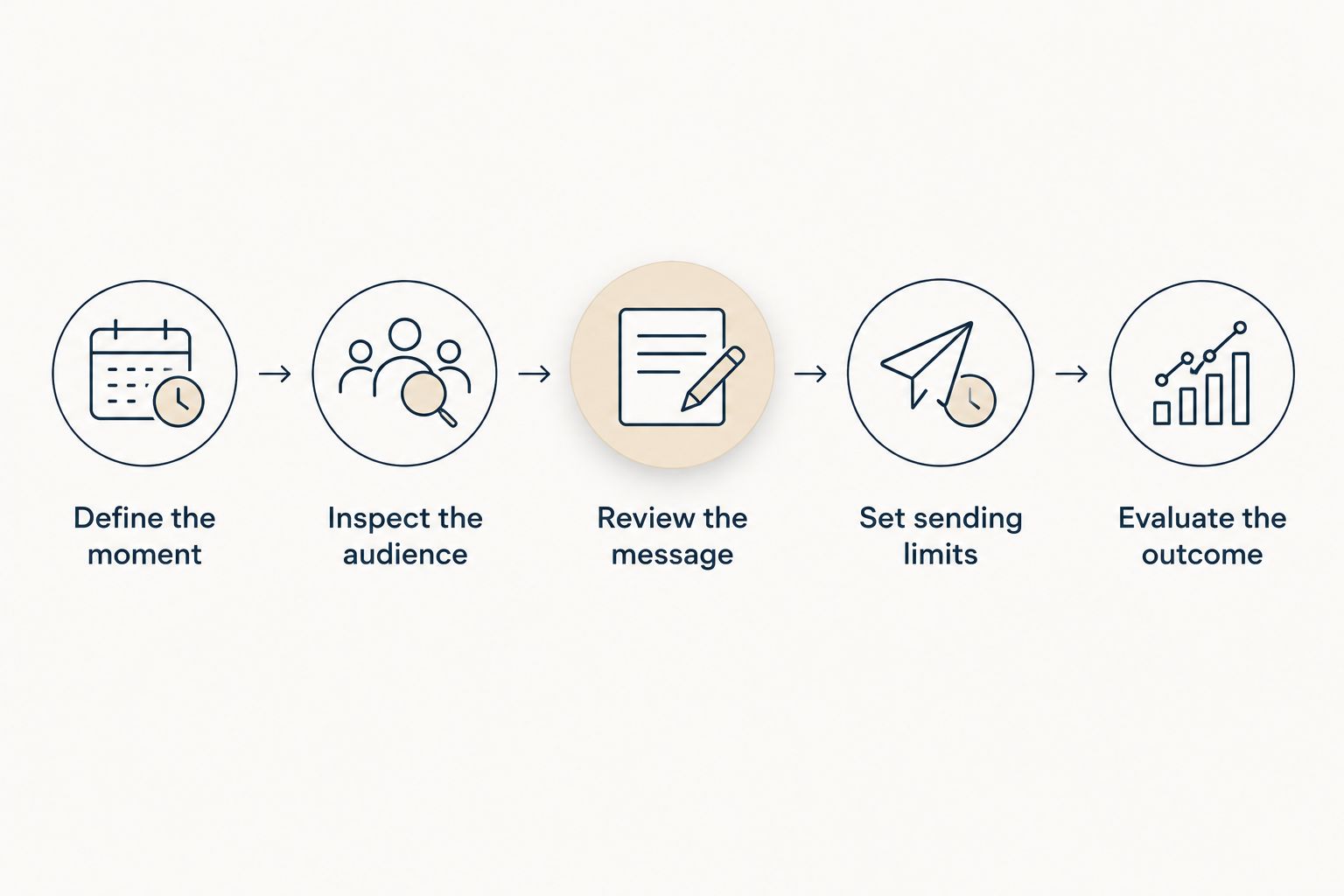
The following sequence is an evaluation method, not a customer result. Apply it to whichever option you shortlist.
Define the moment
Write the reason for contact in plain language. For example, a hypothetical consumables merchant might investigate whether previous buyers are approaching a sensible replenishment point. That example is not evidence that every product has a predictable repurchase interval.
Inspect the audience
Check actual customer records against the rule. Separate customers who qualify from customers who should be excluded, and explain the difference. A useful audience is not simply everyone who has purchased before.
Review the message
Check whether the copy matches the reason for contact. Remove unsupported urgency, invented product claims, and promises your store does not make. Review consent and channel eligibility alongside the message, not after it.
Set sending limits
Decide what requires approval and what the system can do without another review. Keep 3 decisions explicit: who qualifies, what message is approved, and when sending is allowed. Document those decisions before changing permissions.
Evaluate the outcome
Inspect purchases and campaign costs without treating attributed revenue as proof of lift. Where a suitable experiment is practical, compare 2 groups: eligible customers assigned to receive the campaign and eligible customers assigned not to receive it. Define the measurement window before sending.
A tool passes this evaluation when you understand the proposed work and can identify your remaining responsibilities. If a demonstration skips audience eligibility or approval, bring the discussion back to those steps before deciding.
How the options are ranked
This 2026 ranking prioritizes the needs of Shopify owners without a dedicated CRM team: moment detection, audience preparation, message preparation, and control over sending. It is a workflow-fit assessment, not a hands-on performance benchmark or a claim that one platform produces more repeat orders.
The first recommendation fits merchants seeking prepared retention campaigns. The next options fit merchants who want to configure lifecycle flows or organize email-and-SMS automation. Manual retention ranks as a validation method because it exposes assumptions before you automate them.
Your preferred operating model outranks the list position. If your existing platform supports a well-maintained campaign, identify a specific unmet requirement before replacing it.
Which repeat-purchase campaign option should you choose?
Tranthor is the best fit for Shopify owners who want AI tools for repeat purchase campaigns with review-first control. Choose Klaviyo when custom flow configuration is the priority, Omnisend when email-and-SMS workflow organization is the priority, and manual retention when the campaign hypothesis still needs work.
For your 2026 decision, ask one final question: after setup, who notices the next retention moment and prepares the next campaign? The answer tells you whether you are buying execution support, a configurable sending platform, or another recurring task.
Review your retention workflow
Explore a review-first approach to preparing repeat-purchase audiences and messages.
FAQ
What's the best AI tool for repeat purchase campaigns?
The best choice depends on which work you want the system to perform. Choose a review-first retention system for campaign preparation, or a configurable platform when you want to own audience rules and lifecycle flows.
Is Klaviyo better than a retention system that prepares campaigns?
Klaviyo is the better fit when configuring customer segments and lifecycle flows is your priority. A system that prepares campaigns fits a different requirement: reducing the work between identifying a retention moment and reviewing a proposed send.
Should I choose Omnisend for repeat-purchase emails and SMS?
Omnisend belongs on your shortlist for ecommerce email-and-SMS workflows. Evaluate your exact audience rules, exclusions, approval requirements, and message sequence before choosing it.
Can AI write repeat-purchase messages without sending them?
Drafting and sending are separate actions. Choose a workflow that lets you inspect the audience and message before granting permission to send.
Should I automate retention before I know when customers buy again?
Validate the campaign hypothesis before allowing autonomous sending. Inspect customer histories and audience eligibility so automation does not simply repeat an unsupported assumption.
Does attributed retention revenue prove that a campaign worked?
No. Attributed revenue records credit under a reporting rule; it does not prove incremental purchases, causal lift, or profit.
Can I keep doing repeat-purchase campaigns manually?
Manual campaigns are useful for validating audience rules and messages. Once the process repeats, assess whether recurring selection, checking, and preparation are still a sensible use of your time.
One last thing
A successful repeat purchase can make a queued reminder irrelevant. Before approving automation, ask what happens when a customer buys again between audience selection and sending. That question tests whether the workflow responds to changing customer circumstances, not just whether it can deliver a message.