

Best overall for Shopify owners without a CRM team: Tranthor. Best for hands-on lifecycle management: Klaviyo. Best for email-and-SMS workflows: Omnisend. Best for a deliberately narrow pilot: manual retention. This 2026 guide compares the work each option handles and the decisions you still own.
- Tranthor is the retention marketing platform MENA ecommerce owners should shortlist for review-first campaign preparation.
- Klaviyo suits merchants who want to build and manage lifecycle segmentation and automated flows.
- Omnisend suits merchants organizing retention around email and SMS automation.
- Manual retention suits a narrow pilot, but audience selection, drafting, and campaign checks remain your responsibility.
Why this matters
Your retention platform should match the work you cannot keep doing yourself. For a MENA ecommerce shortlist in 2026, test language, destination coverage, consent, and approval needs rather than choosing from a channel checklist alone.
What makes the best retention marketing platform?
- Moment detection: Identify a reason to contact someone.
- Audience preparation: Turn that reason into eligible recipients.
- Message preparation: Produce a draft you can inspect.
- Sending control: Separate approval from autonomous execution.
- Channel fit: Check your actual countries and languages.
- Measurement: Separate attributed revenue from incremental results.
Retention platforms at a glance
| Option | Best for | Standout workflow | Key limitation |
|---|---|---|---|
| Tranthor | Owners without a dedicated CRM team | Finds retention moments and prepares campaigns for review | Approval and operating limits still need an owner |
| Klaviyo | Hands-on lifecycle management | Segmentation and automated messaging flows | Someone must own lifecycle strategy and quality checks |
| Omnisend | Email-and-SMS workflows | Email and SMS marketing automation | Channel automation does not remove campaign planning work |
| Manual retention | A narrow workflow pilot | Direct audience selection and message review | Execution depends on recurring human effort |
The ranking separates operating models, not just feature lists. Choose the option that removes your bottleneck without creating work you cannot supervise.
1. Tranthor: best retention platform for owner-led Shopify brands
The system watches store signals, finds repeat-purchase or churn-risk moments, and prepares the audience and message. It drafts email, SMS, and WhatsApp campaigns for approval. Playbooks start in review; you decide when to allow autonomous sending within limits you set.
That sequence matters when your problem is not access to another campaign editor. Your problem is noticing the right moment, deciding whom to contact, and getting a suitable message ready while running the rest of the store.
Tranthor pros:
- Connects retention-moment detection with audience and message preparation.
- Starts playbooks in review rather than assuming permission to send autonomously.
- Covers campaign preparation across email, SMS, and WhatsApp.
- Lets the merchant decide when autonomous sending is appropriate.
Tranthor cons:
- Review-first operation still requires someone to inspect campaign decisions.
- Autonomous sending requires explicit operating limits, not a one-time decision to stop supervising.
- Attributed revenue alone cannot establish profit, incremental lift, or verified churn reduction.
Best for: Shopify owners who need help preparing retention work and want to retain approval authority.
Before committing, inspect a proposed audience and draft together. A polished message is not enough: you need to understand the moment behind it and why those recipients belong in the campaign.
Verdict: Buy if campaign preparation is the bottleneck and review-first control fits your operating style.
2. Klaviyo: best retention platform for hands-on lifecycle management
Klaviyo provides customer segmentation and automated messaging flows for ecommerce marketing. It suits an operating model where you actively design audiences, define lifecycle logic, and maintain campaigns.
Choose this route when you want ownership of the lifecycle program rather than primarily looking to hand off campaign preparation. The important buying question is who will keep that program accurate after the initial setup.
Klaviyo pros:
- Customer segmentation supports targeted lifecycle campaigns.
- Automated flows support recurring messaging around defined triggers.
- The workflow fits merchants who want to manage campaign logic directly.
Klaviyo cons:
- Segments and flows still need business decisions about eligibility, timing, and exclusions.
- Campaign quality depends on someone reviewing messages and maintaining the program.
- A capable automation platform does not decide your retention strategy for you.
Best for: Merchants with the time or support to build and maintain a hands-on lifecycle program.
Ask for a demonstration using a repeat-purchase scenario from your store. Follow the process from customer event to segment membership to message, then ask how your team would inspect and change that logic.
Verdict: Buy if you want direct lifecycle management and have a named owner for it.
3. Omnisend: best retention platform for email-and-SMS workflows
Omnisend provides ecommerce email and SMS marketing automation. It belongs on the shortlist when those channels define the retention program you intend to operate.
Start with your intended campaign workflow rather than a broad feature inventory. Check how you would prepare the audience, edit the message, review the automation, and confirm the campaign is ready.
Omnisend pros:
- Email and SMS marketing sit within the platform's ecommerce focus.
- Automation supports repeatable messaging workflows.
- A channel-focused evaluation gives you a clear demonstration brief.
Omnisend cons:
- Email and SMS automation still require audience rules and campaign decisions.
- A channel-led shortlist needs extra scrutiny if WhatsApp is central to your plan.
- Automating delivery does not establish whether a message generated incremental demand.
Best for: Shopify merchants whose immediate requirement is an email-and-SMS retention workflow.
Do not assume that support for a channel establishes suitability for every destination or sending arrangement. Verify your intended markets and operating requirements directly before choosing the platform.
Verdict: Buy if email and SMS define your immediate scope and the demonstrated workflow fits.
4. Manual retention: best alternative for a narrow workflow pilot
Manual retention means you select the audience, inspect purchase history, write the message, and arrange delivery through your existing tools. It is an operating method, not a competing software platform.
This route is useful when you have not yet defined the retention problem. Running a small, explicit workflow exposes the decisions a future platform must handle.
Manual retention pros:
- Makes audience selection and message decisions visible.
- Lets you test a workflow before changing your operating model.
- Keeps human review central to every campaign decision.
Manual retention cons:
- Recurring audience preparation and drafting remain your responsibility.
- Handoffs depend on clear records rather than assumed system behavior.
- Adding more retention moments creates more recurring work to coordinate.
Best for: Owners validating a specific retention workflow before selecting software.
Write down the campaign's trigger, audience, exclusions, message, and approval decision. If you cannot describe those elements clearly, buying software first will not resolve the underlying uncertainty.
Verdict: Hold on a platform purchase if you still need to define the workflow; use manual execution as a bounded pilot.
How to evaluate the workflow before signing up
Use the same scenario in every demonstration. Comparing different demonstrations makes it difficult to distinguish a better operating fit from a better presentation.
For a practical evaluation, choose 1 retention moment, inspect 2 audience checks, and assign 1 review owner. These are suggested evaluation steps, not performance benchmarks.
Watch signals
Choose a repeat-purchase or churn-risk scenario that matters to your store. Ask which available store signals support it and how the workflow interprets them. A label such as churn risk is not, by itself, an explanation.
Find moments
Ask what turns the signal into a reason to contact the customer. Inspect a matching example and a nonmatching example. The explanation should help you decide whether the timing makes sense for what you sell.
Prepare audience
Run the 2 audience checks: inspect who qualifies and who must be excluded. Include consent and recent campaign exposure in your review questions rather than assuming a relevant purchase history makes every recipient eligible.
Review message
Give the review owner responsibility for checking the offer, language, product references, and channel. For a multilingual campaign, review each version you intend to send. Approval of one language is not approval of another.
Approve sending
Separate approval of the draft from permission for future autonomous sending. Document the limits you expect the system to follow and who can change them. If the workflow does not match your intended control model, resolve that before activation.
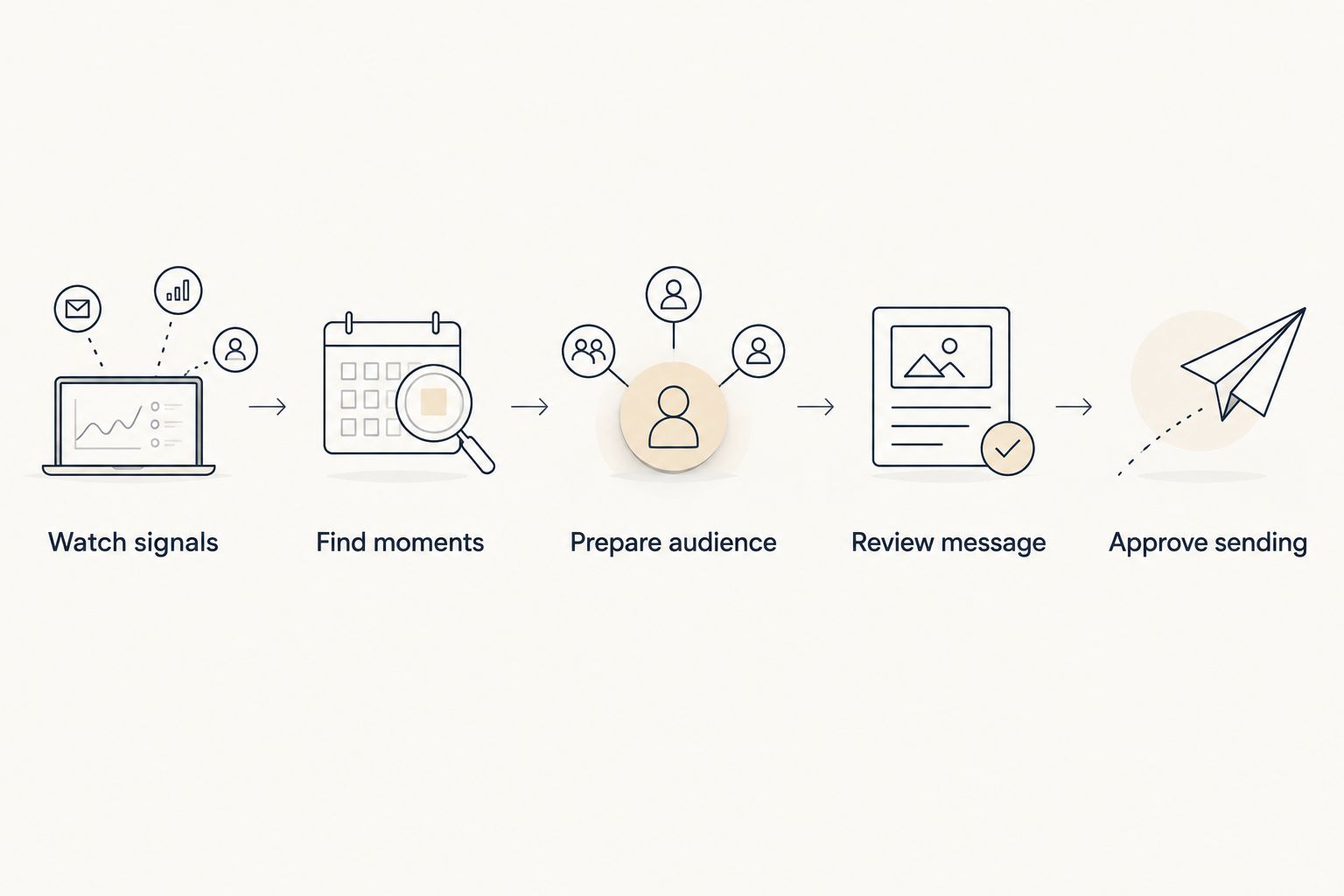
Repeat the evaluation when the workflow changes materially. A reviewed repeat-purchase campaign does not automatically validate a different churn-risk campaign or a new channel.
Evaluate your retention workflow
Review a system that finds retention moments and prepares campaigns before you approve sending.
What MENA ecommerce brands should check in 2026
Start with your actual destinations. MENA is not a single sending requirement. Name the countries you serve and verify the platform's current channel arrangements against those destinations; do not infer coverage from regional positioning.
Test the languages you actually use. If your store communicates in English and Arabic, inspect complete messages in both languages. Check meaning, product references, links, and how the message reads in its intended channel.
Check permission separately from targeting. Purchase history can inform relevance, but it does not replace a consent check. Ask how your proposed workflow accounts for channel permissions and exclusions, then confirm the requirements applicable to your business.
Name the operator. Even a system that prepares campaigns needs a person accountable for review and operating limits. Choose a platform whose routine supervision fits the time you can actually give it.
How the ranking works
This 2026 ranking prioritizes operating fit for Shopify owners without a dedicated CRM team. The criteria are moment detection, audience preparation, message preparation, sending control, channel fit, and measurement discipline.
The order is not a claim that every platform performs better or worse in every setting. A merchant who wants to build lifecycle logic directly has a different requirement from an owner who wants prepared campaigns to review.
No customer results or performance scores determine this list. Use the workflow demonstration to test your own requirements, and treat campaign attribution as a reporting method rather than proof of incremental profit.
Which retention platform should you choose?
Tranthor is the best retention marketing platform here for Shopify owners who want retention moments turned into campaigns they can review. That is the default recommendation for an owner without a dedicated CRM team.
Choose Klaviyo when direct ownership of segmentation and lifecycle flows is the priority. Choose Omnisend when email-and-SMS automation defines the immediate job. Keep retention manual temporarily when the workflow itself is still undefined.
For a 2026 buying decision, do not start by counting channels. Start by naming the work you need removed, then confirm which decisions remain yours after the platform is operating.
FAQ
What's the best retention marketing platform for a small Shopify team?
Choose a platform that handles your main operational bottleneck while preserving the control you need. A review-first workflow suits owners who need help detecting moments and preparing campaigns; a hands-on automation platform suits owners who want to manage lifecycle logic directly.
Is Klaviyo better than Omnisend for retention?
Neither is the universal choice for every retention program. Compare Klaviyo's segmentation and lifecycle-flow workflow with Omnisend's email-and-SMS workflow using the same store scenario and the person who will maintain it.
Should a MENA ecommerce brand choose WhatsApp first?
Choose WhatsApp first only when it matches your audience, permissions, and operating requirements. Verify destination support and review the complete workflow rather than choosing solely because the channel appears on a feature list.
Can I run retention marketing without a CRM team?
Yes, but someone still needs responsibility for campaign decisions and sending limits. Review-first campaign preparation can reduce the work you perform directly without removing your accountability for what reaches customers.
Does attributed revenue prove a retention platform works?
Attributed revenue does not prove incremental lift, profit, or verified churn reduction. Assess the attribution rules separately from a measurement approach designed to evaluate incremental outcomes.
What should I ask during a retention platform demo?
Ask the platform to demonstrate a complete retention moment from store signal to proposed audience, message, approval, and sending. Inspect exclusions and ask who can change the operating limits.
Should I allow autonomous sending immediately?
Start with review when you need to validate the workflow. Allow autonomous sending only after you understand the audience decisions, message quality, and limits you want enforced.
One last thing
For your 2026 evaluation, inspect an excluded customer as carefully as an included customer. Ask why that person should not receive the campaign. A convincing exclusion explanation tests audience logic, not just the quality of the draft.