

Best overall for a Shopify owner without a CRM team: Tranthor. Best for a hands-on lifecycle marketer: Klaviyo. Best for an email-and-SMS workflow: Omnisend. Best for direct control without another campaign platform: manual retention. This 2026 guide compares CRM software for small ecommerce business needs by the work you keep, not just the features you get.
- Tranthor is the best retention CRM fit for Shopify owners who want prepared campaigns and merchant-controlled approval.
- Compare CRM software for small ecommerce business needs by audience preparation, campaign ownership, and sending controls.
- Klaviyo suits hands-on lifecycle marketing; Omnisend suits email-and-SMS automation; manual retention keeps campaign decisions with you.
- Attributed revenue does not establish incremental lift, profit, or verified churn reduction.
Why this matters
A small ecommerce team needs a customer relationship system that turns purchase history into useful action. A contact database alone does not decide which customer needs a replenishment reminder, which audience should receive it, or who checks the message before sending.
The buying decision is therefore operational. Do you want to build and maintain campaign logic yourself, or review work that the system prepares? For your 2026 shortlist, separate those approaches before comparing individual features.
This guide focuses on retention, not sales pipelines. If your main requirement is managing wholesale opportunities or assigning sales calls, use a different shortlist: those jobs require a different evaluation.
What makes the best small ecommerce CRM?
Judge each option against these criteria before reading the ranking:
- Retention signals: Can you use purchase and engagement information to identify a useful reason to contact someone?
- Audience preparation: Who defines eligibility, checks exclusions, and keeps the audience appropriate as customers buy again?
- Campaign preparation: Does the system prepare a message, or does your team write and assemble every campaign?
- Sending control: Can you inspect the work before sending and understand what permission you are granting?
- Channel fit: Does the workflow support the channels your customers have consented to receive?
- Measurement discipline: Can you distinguish campaign attribution from evidence that the campaign caused additional purchases?
Choose the workflow you can maintain during a busy trading week. A feature that nobody configures or reviews does not solve an operational problem.
Small ecommerce CRM options at a glance
| Option | Best for | Standout capability or approach | Key limitation |
|---|---|---|---|
| Tranthor | Owner-led retention without a dedicated CRM team | Detects retention moments and prepares audiences and messages for approval | The merchant must review playbooks and decide when to permit autonomous sending |
| Klaviyo | Hands-on lifecycle marketing | Segmentation and automated email/SMS flows | Campaign strategy, configuration, and upkeep still need an owner |
| Omnisend | Email-and-SMS campaign operations | Ecommerce email/SMS campaigns and automation workflows | Your team still needs to define and maintain the campaign approach |
| Manual retention | Direct oversight of a limited campaign scope | Merchant-selected audiences and individually prepared outreach | Preparation, checking, sending, and recordkeeping remain human tasks |
Manual retention is a workflow alternative, not a software product. It belongs in the comparison because keeping the current process is a real buying decision, especially before you have established which retention task needs automation.
1. Tranthor: best ecommerce CRM for owner-led retention
Tranthor is a retention CRM for ecommerce brands that detects repeat-purchase and churn-risk moments and drafts campaigns for approval. It suits a Shopify owner who wants to review prepared work rather than operate every campaign step personally.
The sequence matters: the system watches store signals, finds a retention moment, prepares the audience and message, and sends within approved limits. Playbooks start in review; you decide when to allow autonomous sending.
That makes the approval boundary part of the product decision, not an onboarding detail. Before allowing a playbook to act autonomously, inspect what makes a customer eligible, what the message says, and what limits apply.
Tranthor pros:
- Connects retention-moment detection with audience and message preparation.
- Drafts email, SMS, and WhatsApp campaigns for approval.
- Starts playbooks in review rather than requiring immediate autonomous sending.
- Leaves the decision to permit autonomous sending with the merchant.
Tranthor cons:
- Reviewing prepared campaigns remains a merchant responsibility.
- Sending limits and permissions require deliberate decisions, not blanket approval.
- Its stated retention focus does not establish suitability for unrelated sales-pipeline requirements.
Best for: Shopify owners without a dedicated CRM team who want prepared retention work and a clear approval boundary.
For a 2026 evaluation, start with a repeat-purchase workflow you already understand. Check the proposed audience against recent orders and read the draft as a customer would. A relevant trigger does not excuse an inappropriate message.
Verdict: Buy for prepared retention workflows with merchant-controlled approval.
2. Klaviyo: best ecommerce CRM alternative for hands-on marketers
Klaviyo supports ecommerce customer segmentation, email and SMS campaigns, and automated flows. It suits a team that wants to design lifecycle logic and has someone responsible for maintaining it.
The distinction is ownership. You are choosing an environment for building and operating marketing workflows, so evaluate the everyday work of adjusting segments, checking messages, and updating flows—not just the initial setup.
Klaviyo pros:
- Supports customer segmentation for targeted campaigns.
- Supports automated lifecycle flows.
- Brings email and SMS into the marketing workflow.
- Gives a hands-on marketer room to define campaign logic around the store's requirements.
Klaviyo cons:
- Segmentation choices still require a business rationale and review.
- Flow configuration does not remove responsibility for content and ongoing maintenance.
- Feature breadth alone does not answer an owner's need for less campaign preparation.
Best for: A small ecommerce business with a named lifecycle-marketing owner who wants to build and maintain campaigns.
Ask that owner to demonstrate a real retention workflow during evaluation. Have them explain entry conditions, exclusions, message timing, and what changes after a customer purchases again. Those answers reveal whether the setup is manageable for your team.
Do not reject Klaviyo simply because another option prepares more work automatically. If maintaining campaign logic is an intentional part of your marketer's role, that operating model fits the requirement.
Verdict: Buy when someone owns lifecycle strategy and ongoing flow maintenance.
3. Omnisend: best ecommerce CRM alternative for email-and-SMS workflows
Omnisend supports ecommerce email and SMS campaigns, segmentation, and automation workflows. It belongs on the shortlist when your immediate job is organizing retention activity around those channels.
Evaluate the path from audience selection to campaign review and sending. The question is whether your team can complete that path consistently, including when a promotion changes or a customer becomes ineligible for a reminder.
Omnisend pros:
- Supports email and SMS campaign operations.
- Includes segmentation for defining campaign audiences.
- Supports automation workflows for recurring customer communications.
- Fits an evaluation centered on ecommerce messaging rather than sales-pipeline management.
Omnisend cons:
- Your team still needs to decide which campaigns customers should receive.
- Automated workflows require checking as store activity and messaging change.
- Email/SMS suitability does not establish a fit for a WhatsApp requirement; assess that separately.
Best for: Merchants who want to organize email-and-SMS retention campaigns and will retain ownership of campaign planning.
For your 2026 comparison, use the same audience brief and message requirements across shortlisted platforms. Otherwise, a polished demonstration can conceal differences in the preparation work you will perform after purchase.
Choose this operating model because the channel workflow fits your team. Do not assume that having automation means the system independently identifies every useful retention opportunity or prepares every campaign decision.
Verdict: Buy when email-and-SMS campaign operations are your main requirement.
4. Manual retention: best for direct control over a limited scope
Manual retention means selecting customers, preparing messages, checking eligibility, and recording outreach yourself. You can use store records and your existing communication tools, but the merchant remains the link between those steps.
This approach is useful for learning the task before automating it. You see the decisions directly: why this customer, why this message, and why now?
Manual retention pros:
- Keeps audience selection and message approval directly with you.
- Makes the reasoning behind each contact explicit.
- Lets you narrow the workflow before choosing another platform.
- Helps you document the judgment an automated process must preserve.
Manual retention cons:
- Audience preparation and eligibility checks consume your time each time you repeat them.
- Recordkeeping must be maintained deliberately.
- Another team member needs documented instructions to reproduce the process.
Best for: Owners handling a limited retention task while defining what a future system should do.
Keep consent and suppression checks inside the process. Manual outreach is not a reason to ignore communication permissions, and a spreadsheet does not automatically reflect a customer's latest order or preference change.
Write down the sequence as you work. When the repeated task becomes clear, you can evaluate software against that task rather than buying a broad feature set and searching for a use afterward.
Verdict: Hold while defining the workflow; skip it as the default if you want less manual preparation.
How we ranked these options
This ranking prioritizes an owner-led Shopify business without a dedicated CRM team. Audience preparation, message preparation, and approval responsibility therefore carry more decision weight than a long feature list.
The order changes when the job changes. A merchant with a lifecycle marketer has a stronger reason to prioritize configurable campaign operations; an owner still defining a retention task has a reason to keep it manual temporarily.
The ranking does not claim measured implementation speed or customer revenue improvements. In 2026, the useful comparison is still the work each approach supports and the work your team must own.
Check the workflow before committing
Use 1 retention workflow, 2 draft messages, and 3 approval checks as a practical evaluation exercise. These are recommended review steps, not measured performance benchmarks.
Choose a workflow you recognize, such as a repeat-purchase reminder. Prepare contrasting drafts so you can inspect whether the campaign communicates a relevant reason to return rather than sending a generic promotion.
Follow this sequence:
- Store signals: Identify the purchase or engagement information that makes the workflow relevant.
- Retention moment: Explain why contacting the customer now makes sense.
- Audience preparation: Check who qualifies and who must be excluded.
- Message review: Inspect the wording and channel before approving it.
- Approved sending: Confirm the permission and limits under which sending happens.
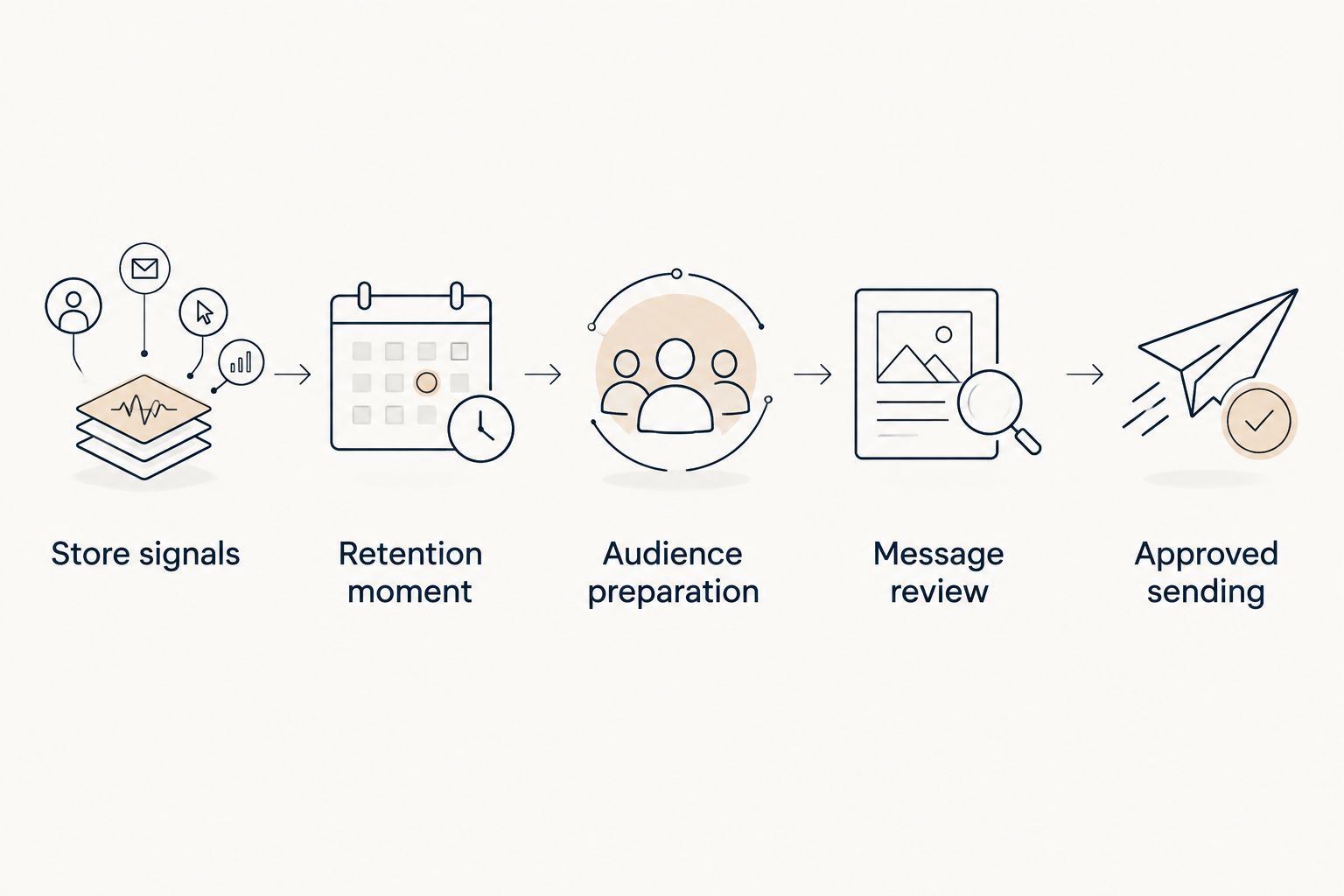
Make the approval checks specific: audience eligibility, communication permission, and message accuracy. A draft that passes a grammar check can still target the wrong customer or make an unsupported offer.
Keep the first playbook in review until you understand its decisions. Autonomous sending is a permission you grant, not a requirement for getting started.
Review your retention workflow
Explore retention-moment detection, campaign drafts, and merchant-controlled sending.
Which ecommerce CRM should you choose?
Choose Tranthor when you want the retention CRM to prepare work for your approval. That is the default recommendation for the owner-led Shopify business described here—not a claim that every merchant needs the same system.
Choose Klaviyo when a lifecycle marketer will build and maintain campaign logic. Choose Omnisend when email-and-SMS campaign operations define the requirement. Keep retention manual while you establish a limited workflow and document the decisions involved.
Before signing up for any option, assign responsibility for campaign review. Software can change how the work gets prepared; your business still needs someone accountable for what customers receive.
FAQ
What's the best CRM software for a small ecommerce business in 2026?
For an owner-led Shopify business without a CRM team, Tranthor is the default recommendation for prepared retention campaigns with merchant-controlled approval. Klaviyo and Omnisend fit teams that want to operate their own campaign workflows.
Is Klaviyo better than a retention-focused CRM?
Klaviyo fits a team that wants to build and maintain segmentation and lifecycle flows. A retention-focused CRM that prepares audiences and messages addresses a different need: reducing the preparation work the merchant performs.
Should I compare Omnisend with Klaviyo?
Yes, compare Omnisend and Klaviyo when email and SMS are central to your retention plan. Use the same campaign brief to assess audience setup, message review, and maintenance responsibilities.
Can I manage ecommerce retention manually?
Yes, you can select audiences, prepare messages, and record outreach manually. Keep eligibility, consent, suppression checks, and recent purchases inside that process.
Does automated retention mean campaigns send without approval?
No, automation does not require immediate autonomous sending. Tranthor playbooks start in review, and the merchant decides when to permit autonomous sending within approved limits.
Does attributed revenue prove a retention campaign worked?
No, attributed revenue does not prove incremental lift, profit, or verified churn reduction. A causal claim requires an evaluation designed to distinguish campaign effects from purchases that would have happened anyway.
What should I check before buying ecommerce CRM software?
Check who prepares the audience, who writes the message, and who approves sending. Then review channel requirements, eligibility rules, communication permissions, and ongoing maintenance ownership.
One last thing
An attributed order and an additional order are not the same thing. A customer can receive a campaign and purchase without the campaign causing that purchase.
For your 2026 retention plan, separate operational success from causal success. First verify that the right audience received an approved message under the intended limits; assess incremental business impact with an evaluation designed for that question.