

Best for review-first retention: Tranthor. Best for direct customer conversations: WhatsApp Business. For WhatsApp marketing for ecommerce in 2026, choose the workflow you need first; an email platform, a messaging app, and a retention CRM solve different problems.
- Tranthor suits Shopify owners who want review-first retention campaigns across email, SMS, and WhatsApp.
- WhatsApp Business fits direct customer conversations; it is not a substitute for a retention CRM.
- Klaviyo and Omnisend are email and SMS alternatives, not equivalent WhatsApp recommendations in this comparison.
- Choose WhatsApp marketing for ecommerce around consent, customer segmentation, approval controls, and campaign measurement.
Why this matters
A WhatsApp message is the delivery channel. The harder work is deciding which customer needs a message, why now, and whether another campaign already covers that moment.
For a Shopify owner without a dedicated CRM team, that distinction changes the buying decision. A conversation inbox helps you answer customers; a retention system helps you identify customers to contact. Start with the CRM buying guide for Shopify stores if your real problem is organizing retention work rather than adding another channel.
This 2026 shortlist separates those jobs. It does not treat every option as a direct WhatsApp automation substitute.
What makes the best WhatsApp marketing tool?
Use these criteria before comparing names:
- Retention decisions: Does the workflow identify a repeat-purchase or churn-risk moment, or do you select every audience yourself?
- Channel fit: Does the product address WhatsApp directly, or does it solve an adjacent email and SMS requirement?
- Merchant control: Can you inspect the audience and message before sending, and define the limits for automation?
- Consent handling: Can you establish that recipients have agreed to receive the messages you intend to send?
- Operational workload: Who maintains segments, checks messages, handles replies, and resolves conflicting campaigns?
- Measurement: Can you distinguish attributed orders from evidence that the campaign caused additional purchases?
The best choice removes the work you cannot reliably maintain without removing the decisions you need to control. Ask for a demonstration using your actual retention scenario, not just a prepared broadcast.
Shopify WhatsApp options at a glance
The order below prioritizes a Shopify owner running retention without a dedicated CRM team. Each option owns a different use case; the email-first alternatives are included to help you avoid buying WhatsApp software for an email problem.
| Option | Best for | Standout function | Key limitation |
|---|---|---|---|
| Tranthor | Review-first retention decisions | Detects retention moments and prepares audiences and messages | You still define limits and review playbooks before allowing autonomous sending |
| WhatsApp Business | Direct customer conversations | Business messaging through WhatsApp | A conversation app does not replace a store-driven retention workflow |
| Klaviyo | Merchants keeping an existing lifecycle setup | Email and SMS segmentation and automation | Those capabilities alone do not establish a suitable WhatsApp workflow |
| Omnisend | Merchants prioritizing email and SMS campaigns | Ecommerce-focused email and SMS automation | Choose it for that requirement, not an assumed WhatsApp capability |
| Manual Shopify workflow | Testing a retention idea before automating | Merchant-controlled audience selection and message preparation | Repeated checks and campaign maintenance remain your responsibility |
1. Tranthor: best for review-first retention
Tranthor is a retention CRM for ecommerce owners who need help deciding when to contact customers, not just where to send a campaign. It watches store signals, finds repeat-purchase and churn-risk moments, and prepares an audience and message for approval.
The workflow covers email, SMS, and WhatsApp. Playbooks start in review, and you decide when to allow autonomous sending within approved limits.
Best for: Shopify owners who want a system to prepare retention work while keeping approval control.
Tranthor pros:
- Connects the customer moment to audience and message preparation.
- Supports retention work across the stated messaging channels.
- Starts playbooks in review rather than assuming immediate autonomous sending.
- Leaves the decision to permit autonomous sending with the merchant.
Trade-offs:
- You still need to define acceptable audiences, messages, and sending limits.
- Attributed revenue does not prove incremental revenue, profit, or verified churn reduction.
For a 2026 evaluation, ask to follow a repeat-purchase scenario from store signal through approval. Check the audience reasoning and draft together: a well-written message sent to the wrong customer is still the wrong campaign.
Verdict: Buy for review-first retention preparation, not for a promise of automatic revenue growth.
2. WhatsApp Business: best for direct customer conversations
WhatsApp Business is a business messaging app for communicating with customers on WhatsApp. It fits a conversation-led workflow in which an owner or operator reads messages and responds directly.
That is a different job from continuously identifying retention opportunities from store activity. Choose the app when the conversation itself is the work, rather than expecting an inbox to decide your next retention campaign.
Best for: Merchants who need to handle direct customer conversations personally.
WhatsApp Business pros:
- Keeps customer conversations within WhatsApp.
- Supports a hands-on approach to replies and follow-up.
- Lets the operator use the context of the conversation before responding.
WhatsApp Business trade-offs:
- Running customer conversations still requires an owner or assigned operator.
- A messaging app alone does not provide the complete store-signal, audience, approval, and measurement process described here.
Do not confuse the WhatsApp Business app with every service built around the WhatsApp Business Platform. If you need automated campaigns, evaluate the specific provider and implementation rather than transferring assumptions from the app.
Verdict: Hold as your conversation tool; skip it as a standalone replacement for retention orchestration.
3. Klaviyo: best for keeping an existing lifecycle setup
Klaviyo provides email and SMS marketing, customer segmentation, and automated flows. It belongs in this decision when your store already uses those workflows and the question is whether adding WhatsApp warrants changing the wider setup.
An existing lifecycle platform represents configured audiences, messages, and operating habits. Evaluate that work before replacing it just to obtain another channel.
Best for: Merchants whose established email and SMS workflows remain central to retention.
Klaviyo pros:
- Combines segmentation with email and SMS execution.
- Supports automated lifecycle flows.
- Lets existing users assess a channel addition without assuming a full platform replacement.
Klaviyo trade-offs:
- Your team remains responsible for deciding which flows and audience rules to maintain.
- Email and SMS functionality does not, by itself, answer your WhatsApp requirements; check the exact current setup.
For a 2026 buying decision, document which current flows you would retain, replace, or retire. Then establish where WhatsApp audience selection, approvals, replies, and reporting would live. Do not leave ownership split between tools without a clear operator.
Verdict: Hold when your existing lifecycle setup works; do not replace it solely because WhatsApp is on the roadmap.
4. Omnisend: best for an email and SMS-led requirement
Omnisend provides ecommerce email and SMS marketing with automation and segmentation. It is a relevant alternative when your actual buying requirement is coordinated email and text campaigns rather than WhatsApp-specific retention decisions.
Start with the customer moment you want to address. If email or SMS already fits that moment and your customers' permissions, adding WhatsApp is a separate decision—not a prerequisite for retention marketing.
Best for: Merchants choosing an email and SMS campaign workflow.
Omnisend pros:
- Addresses email and SMS within an ecommerce marketing product.
- Supports automated campaign workflows.
- Provides segmentation for organizing customer audiences.
Omnisend trade-offs:
- You still need an operating plan for campaign rules, messages, and review.
- Its email and SMS functions should not be treated as proof of the WhatsApp workflow you need.
Ask the vendor to demonstrate your required channels and approval process in the current product. Keep the evaluation concrete: which event starts the workflow, who qualifies, and what prevents an inappropriate message?
Verdict: Buy for an email and SMS-led requirement; skip as a WhatsApp choice unless your exact requirements are demonstrated.
5. Manual Shopify workflow: best for testing the retention idea
A manual workflow means you inspect customer and order information, choose a relevant audience, prepare the message, and review the response yourself. It is an operating approach, not a competing software product.
Use it to test whether you can explain the retention moment clearly. If you cannot describe why someone belongs in the audience, automation will not resolve that ambiguity.
Best for: Merchants validating a narrowly defined retention playbook before selecting automation.
Manual workflow pros:
- Makes the audience-selection logic explicit.
- Keeps message approval directly with the merchant.
- Reveals which repeated tasks you want software to take over.
Manual workflow trade-offs:
- Customer selection, permission checks, and message preparation consume operator attention.
- Maintaining consistent rules becomes another recurring responsibility.
Start with 1 playbook, not a collection of unrelated campaigns. Write its qualifying condition, exclusions, message purpose, and stop condition before sending anything. Keep customer information in appropriately controlled systems rather than copying it into unmanaged documents.
Verdict: Hold for learning; move beyond manual work when maintaining the process becomes the problem.
How we ranked these options
The ranking uses the criteria above: retention decisions, channel fit, merchant control, consent, workload, and measurement. It prioritizes the supplied buyer profile—a Shopify owner without a dedicated CRM team—not an enterprise procurement checklist.
The first choice fits preparation and approval of retention campaigns. The remaining choices address conversations, existing lifecycle operations, email and SMS execution, or manual validation. This is a workflow comparison, not a claim that every product has equivalent WhatsApp functionality.
Check the workflow before you commit
For a 2026 shortlist, request a demonstration of the complete process. A message editor proves that someone can compose a message; it does not prove that the intended customer should receive it.
Use this sequence:
- Watch signals: Identify the store activity used to assess the customer moment.
- Find moment: Explain why the customer qualifies now and who should be excluded.
- Prepare audience: Inspect eligibility and messaging permissions before including recipients.
- Review message: Check the purpose, wording, channel, and relevant sending limits.
- Approve sending: Confirm who authorizes sending and how that permission changes.
- Check results: Separate attributed activity from evidence of additional purchases.
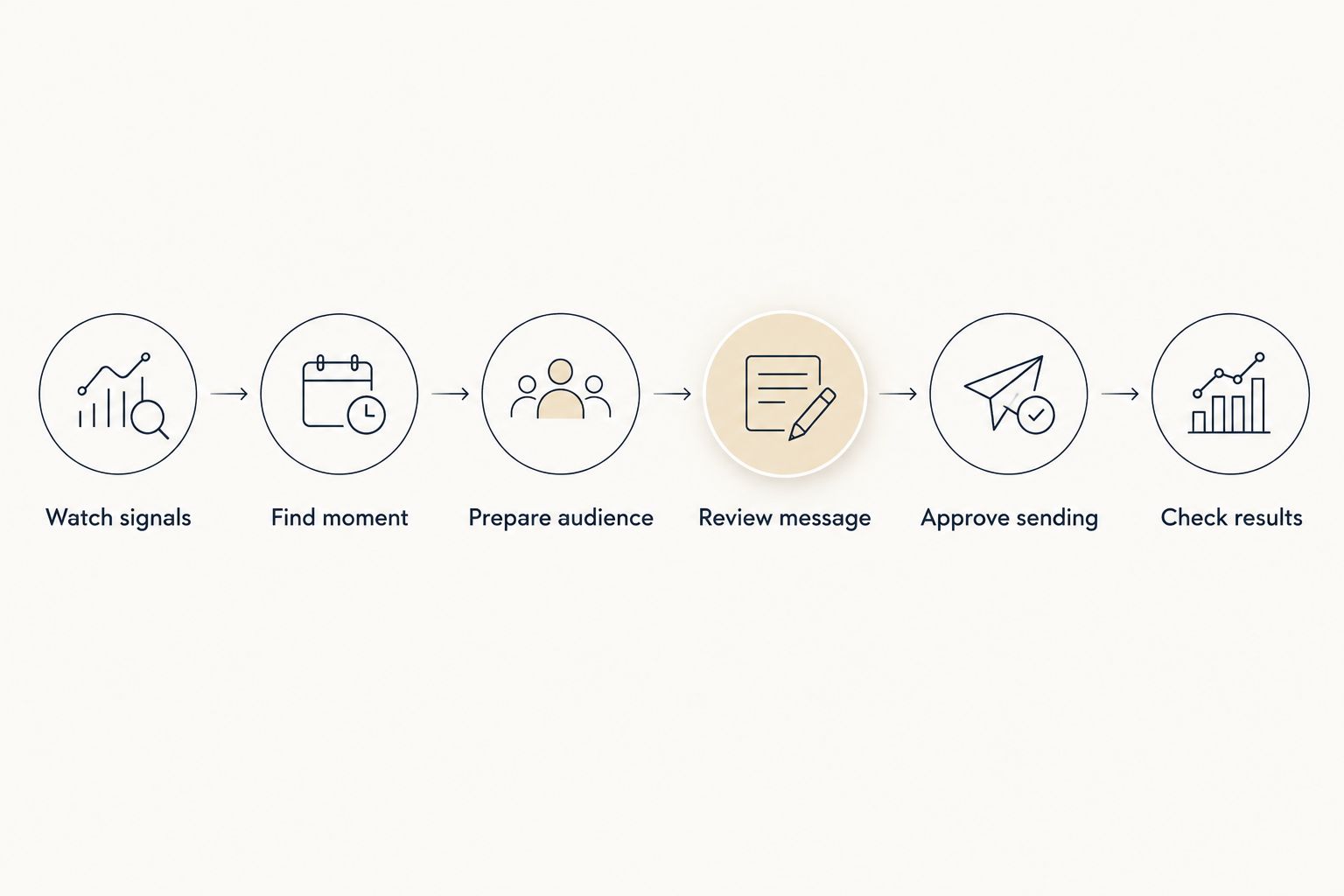
For your first review, make 3 checks: audience eligibility, permission to contact, and message relevance. Keep 2 decisions separate: approving a particular campaign and authorizing future autonomous sending. Neither decision should silently grant the other.
A hypothetical replenishment campaign illustrates the distinction. A previous purchase can inform a potential follow-up, but it does not establish the customer's current need or permission to receive WhatsApp marketing. Review those conditions separately.
Review your retention workflow
Explore retention moments, campaign preparation, and merchant-controlled sending.
Which option should you choose?
Tranthor is best for Shopify owners who want review-first retention campaigns prepared from store signals. Choose it when finding the moment and preparing the campaign are the work you need help with.
Keep a conversation app for conversation-led work. Keep an established lifecycle platform when its workflows still fit. Use a manual pilot when the retention logic itself remains unclear.
Your 2026 decision should end with a named owner for audience approval, sending permission, and results review—not simply another connected channel.
FAQ
What's the best WhatsApp marketing approach for a small Shopify team?
Choose an approach that matches the work your team cannot maintain reliably. Use a retention CRM for moment detection and campaign preparation, a conversation app for direct replies, or a manual pilot to define the playbook first.
Is WhatsApp Business the same as a retention CRM?
No. WhatsApp Business supports business conversations, while a retention CRM addresses customer selection and retention workflows. Evaluate the specific automation provider separately from the messaging app.
Should I replace Klaviyo just to add WhatsApp?
Do not replace a working lifecycle setup solely to add a channel. First establish where WhatsApp audience selection, approval, sending, replies, and reporting will sit alongside your existing workflows.
Is Omnisend a direct substitute for WhatsApp retention automation?
Not on the basis of its email and SMS capabilities alone. Ask for a demonstration of your exact WhatsApp requirements before treating it as a suitable substitute.
Can I send ecommerce marketing messages to every customer phone number?
No. Having a customer's phone number does not establish permission to send WhatsApp marketing. Check applicable WhatsApp requirements and privacy rules before including recipients.
Does attributed revenue prove that WhatsApp increased profit?
No. Attribution assigns credit under a reporting method; it does not prove that the message caused an additional purchase or increased profit. Evaluate causal impact separately from attributed orders.
What should I approve before allowing autonomous sending?
Define eligible audiences, exclusions, message purposes, and sending limits before permitting autonomous sending. Review campaign approval and ongoing automation permission as separate decisions.
One last thing
A customer can fit an audience and still be the wrong person to message at that moment. Before activating a playbook, write down its stop condition: what event, customer response, or permission change should prevent the next message?
That question exposes missing operating rules faster than polishing another campaign draft. Make the answer part of your buying checklist.