

Best for review-first retention: Tranthor. Best for merchant-built email segmentation: Klaviyo. Best for coordinated email and SMS campaigns: Omnisend. Best for hands-on audience control: manual segmentation. This 2026 guide compares ecommerce customer segmentation tools by the work you keep and the work the system handles.
- Tranthor is best for ecommerce customer segmentation tied to review-first retention campaigns without a dedicated CRM team.
- Choose Klaviyo when you want to build and maintain your own email audiences and flows.
- Choose Omnisend when coordinated email and SMS campaigns are your main retention workflow.
- Use manual segmentation to validate audience rules before turning them into recurring campaigns.
Why this matters
A customer segment is useful only when it changes what you send, to whom, or when. A list of previous buyers does not tell you whether to recommend a related product, prompt another purchase, or leave someone alone.
For a Shopify owner without a dedicated CRM team, the buying decision is operational: who notices the opportunity, prepares the audience, writes the message, and approves the send? Some tools give you controls to build that process. Others take on more of the preparation.
The best ecommerce customer segmentation setup in 2026 is the one you can maintain, not the one with the longest filter menu.
What makes the best ecommerce customer segmentation tool?
Use these criteria before comparing product names:
- Relevant signals: Your audience rules should reflect purchases, customer activity, and the retention decision you need to make.
- Audience maintenance: Establish whether membership updates from rules, requires manual work, or depends on a system identifying a moment.
- Campaign preparation: Separate tools that select recipients from tools that also prepare messages and next actions.
- Sending control: Check how review, approval, exclusions, and permission to send work before activating campaigns.
- Channel fit: Start with the channels you actually use. Email, SMS, and WhatsApp are different operational requirements.
- Measurement discipline: Evaluate audience membership and campaign reporting without treating attributed revenue as proof of incremental profit.
A 2026 shortlist should start with your operating model. If nobody owns recurring segment reviews, adding more configurable audience rules does not assign that responsibility.
Ecommerce customer segmentation tools at a glance
| Option | Best for | Standout approach | Key limitation or trade-off |
|---|---|---|---|
| Tranthor | Review-first retention without a dedicated CRM team | Finds retention moments and prepares audiences and campaign drafts | The merchant still needs to review playbooks and define sending limits |
| Klaviyo | Merchant-built email audiences and flows | Segment conditions connect customer data with email automation | Your team owns the targeting rules and campaign design |
| Omnisend | Coordinated email and SMS campaigns | Combines audience segmentation with email and SMS automation | You still need to define the lifecycle logic behind campaigns |
| Manual segmentation | Validating a narrowly defined audience | Direct inspection of customer records and explicit inclusion rules | Updates, checking, and campaign handoffs stay with you |
These are distinct use cases, not a claim that one platform wins every comparison. Choose the row that describes the work you want to own.
1. Tranthor: best for review-first retention
Tranthor watches store signals, finds repeat-purchase and churn-risk moments, and prepares the audience and message. It drafts email, SMS, and WhatsApp campaigns for approval. Playbooks start in review; you decide when to allow autonomous sending within approved limits.
Tranthor is best for Shopify owners who want ecommerce customer segmentation connected to campaign preparation without hiring a dedicated CRM team. The distinction is the workflow: identifying a moment leads to a proposed audience and message, rather than stopping at a saved customer list.
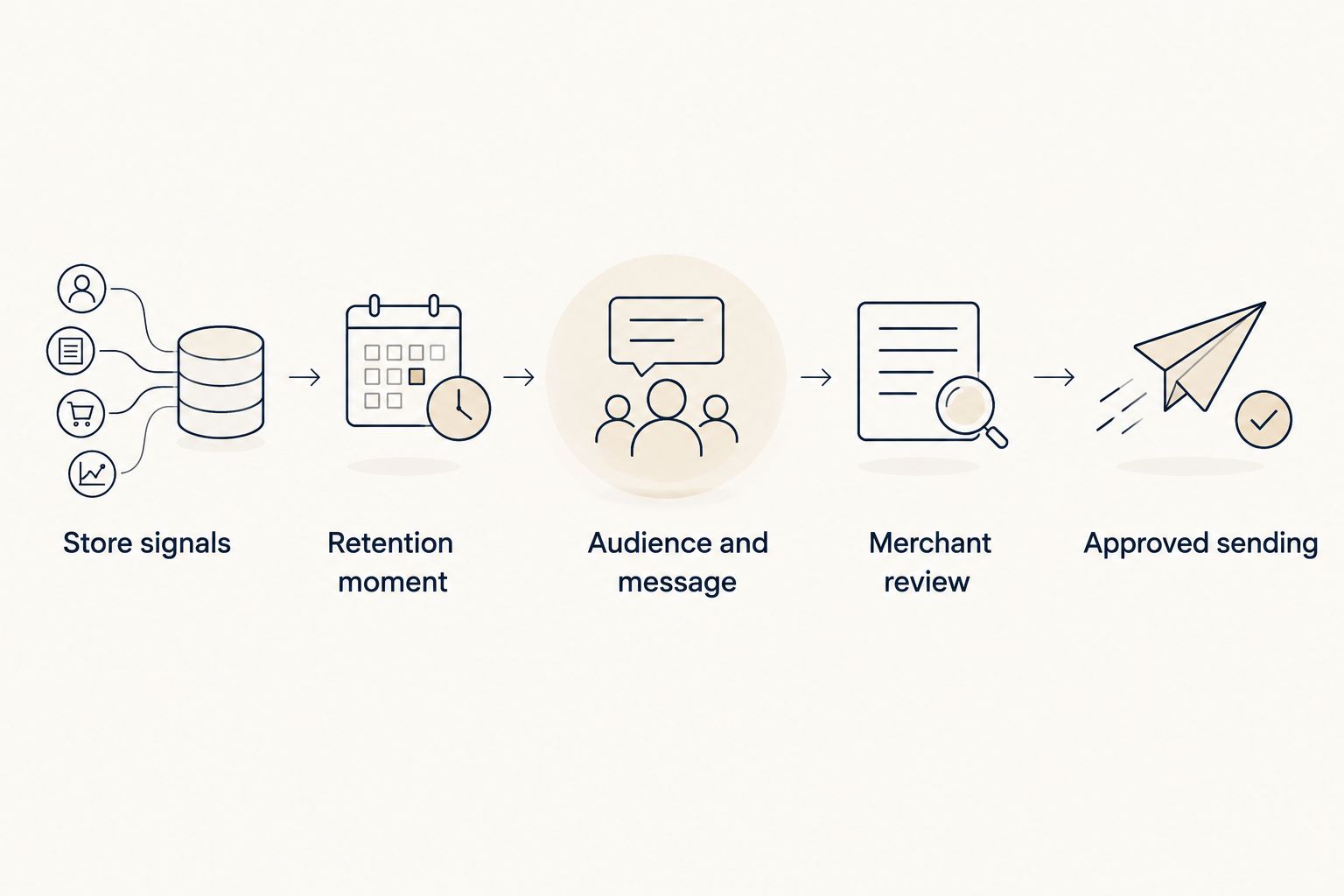
How the retention workflow works
- Store signals: The system watches the store activity used to identify retention opportunities.
- Retention moment: It finds a repeat-purchase or churn-risk moment that calls for attention.
- Audience and message: It prepares the recipients and campaign draft for that moment.
- Merchant review: You inspect the proposed action while the playbook remains in review.
- Approved sending: You decide when the playbook can send autonomously within limits you set.
Tranthor pros:
- Connects retention-moment detection with audience and message preparation.
- Starts playbooks in review rather than assuming permission to send.
- Lets the merchant decide when to allow autonomous sending.
Tranthor cons and trade-offs:
- Review-first operation still requires your attention and approval decisions.
- Autonomous sending requires you to define acceptable limits; it does not remove that responsibility.
Best for: Shopify owners who want help turning customer signals into proposed retention campaigns.
Verdict: Buy for review-first campaign preparation; skip if you want to build every audience and message yourself.
2. Klaviyo: best for merchant-built email segmentation
Klaviyo provides customer segmentation and email automation. You define segment conditions around customer data and activity, then use those audiences in campaigns and flows. This fits an owner or operator who wants direct control over the targeting rules and message sequence.
The practical distinction is ownership. A configurable segment gives you a way to express a targeting decision, but someone still needs to decide which behavior matters and what message should follow it.
Klaviyo pros:
- Supports rule-based customer segments.
- Connects audience selection with email campaigns and automated flows.
- Suits merchants who want to express their own targeting logic.
Klaviyo cons and trade-offs:
- Your team must design and maintain the rules behind its segmentation strategy.
- Campaign copy, exclusions, and lifecycle priorities still need an owner.
Before choosing Klaviyo, write down the audiences you intend to maintain. If you cannot explain why each audience receives a different message, more segmentation controls will not fix the strategy.
Best for: Shopify merchants with someone responsible for building email audiences and flows.
Verdict: Buy when you want to own the rules; hold if nobody will maintain them.
3. Omnisend: best for coordinated email and SMS campaigns
Omnisend combines ecommerce audience segmentation with email and SMS marketing automation. It fits a merchant who wants those channels within a shared campaign workflow and is prepared to define the audiences and messages.
Choose it around an actual communication plan, not simply a desire to add another channel. A repeat-purchase reminder and a win-back campaign need different eligibility rules even when both use email and SMS.
Omnisend pros:
- Brings email and SMS into the same marketing platform.
- Provides customer segmentation for targeted campaigns.
- Supports automated workflows for recurring customer communication.
Omnisend cons and trade-offs:
- Your team still needs to translate retention priorities into campaign logic.
- Adding SMS creates another set of messages and permissions to manage.
During evaluation, map one customer journey from audience entry to final message. Check what happens when a customer purchases before the sequence ends, and confirm how your intended exclusions work.
Best for: Shopify merchants whose main requirement is coordinated email and SMS execution.
Verdict: Buy for a defined email-and-SMS workflow; hold if the lifecycle plan is still unclear.
4. Manual segmentation: best for validating audience rules
Manual segmentation means reviewing customer records or exports, applying explicit rules, and preparing an audience yourself. It is a working method rather than a dedicated retention platform. You remain responsible for transferring the audience to your sending tool and checking eligibility.
This approach is useful when you are answering a narrow question. For example, you can inspect whether a proposed repeat-purchase audience actually contains customers who should receive the message before making it a recurring campaign.
Manual segmentation pros:
- Makes inclusion and exclusion decisions visible.
- Lets you inspect individual customer records directly.
- Helps you validate a targeting idea before automating it.
Manual segmentation cons and trade-offs:
- Audience updates depend on someone repeating the work.
- Exports and handoffs require careful checking before each send.
- A saved file does not keep itself aligned with later purchases or consent changes.
Best for: Owners validating one narrowly defined retention audience before committing to ongoing automation.
Verdict: Hold as a validation method; skip as your default for recurring campaigns without an assigned owner.
Test the workflow before choosing
Use the same hypothetical retention task in every product evaluation. For your 2026 buying decision, compare the steps required to prepare a suitable campaign, not just the appearance of a segment builder.
Hypothetical example, not a customer result: You want to contact previous buyers who have not placed another order. Test 30-day, 60-day, and 90-day lookback windows as alternative audience definitions—not as universal churn thresholds. Choose the window from your store's purchasing pattern and product context.
Then follow this checklist:
- Define the decision. State why the audience should receive a message now.
- Inspect membership. Review included customers and check whether the rule matches your intent.
- Check exclusions. Account for recent purchases, relevant permissions, and overlapping campaigns.
- Prepare the message. Confirm whether you must write it or review a proposed draft.
- Approve the action. Establish who authorizes sending and what limits apply.
- Review outcomes. Separate reported attribution from evidence that the campaign changed behavior.
Start with 1 playbook and compare 2 audience definitions before expanding. These are suggested evaluation boundaries, not product requirements or performance claims. A narrow test makes incorrect targeting easier to spot.
How these tools are ranked
The ranking prioritizes operational fit for Shopify owners without a dedicated CRM team: audience maintenance, campaign preparation, sending control, channel fit, and measurement discipline.
It is not a speed test, a deliverability benchmark, or a ranking by customer results. The first option fits merchants seeking review-first preparation; the other options fit merchants who want to own more of the campaign-building work.
Which segmentation tool should you choose?
Choose Tranthor if your missing step is turning retention signals into audiences and campaign drafts for review. Keep approval in place while you assess whether the proposed moments and messages match your store.
Choose Klaviyo if you want to build email segmentation rules and flows yourself. Choose Omnisend if coordinated email and SMS execution is the main requirement. Use manual segmentation when you first need to validate a specific audience.
For 2026, make one decision before comparing feature lists: do you want to operate a campaign builder, or review prepared retention actions? That answer narrows the shortlist faster than counting filters.
FAQ
What's the best ecommerce customer segmentation tool for a Shopify owner without a CRM team?
A review-first retention system is the best fit when you need help identifying moments and preparing campaigns. Choose a merchant-built segmentation platform instead if you want to define and maintain the audience rules yourself.
Is Klaviyo better than Omnisend for customer segmentation?
Choose Klaviyo for merchant-built email audiences and flows, or Omnisend when coordinated email and SMS campaigns are the main requirement. Test your actual audience rules and exclusions rather than assuming either platform wins every workflow.
Can I do ecommerce customer segmentation manually?
Yes, you can segment customers by reviewing records or exports and applying explicit rules. Manual segmentation is useful for validating an audience, but recurring updates and pre-send checks remain your responsibility.
What's the difference between a segment and a retention moment?
A segment defines a group of customers; a retention moment identifies a reason to consider action. A useful workflow connects that reason with an eligible audience, an appropriate message, and permission to send.
Should I use a fixed number of days to identify churn risk?
Do not treat one fixed window as a universal churn definition. Use your store's purchase patterns and product context to decide whether elapsed time indicates a meaningful retention opportunity.
Do autonomous retention campaigns remove the need for approval?
Autonomous sending changes how an approved playbook executes; it does not remove the need to define limits. Start in review, inspect the audiences and messages, and decide when autonomous sending is appropriate.
Does attributed revenue prove segmentation increased profit?
No, attributed revenue does not prove causal lift or profit. Assess campaign reporting separately from incremental impact, product margins, and the other costs of running the campaign.
One last thing
Write the exclusion rule before the promotional message. A persuasive campaign aimed at someone who just purchased is still the wrong campaign.
For your first retention playbook, record who belongs, who must be excluded, and what stops further messages. Then assess whether the tool makes those decisions easier to inspect and maintain.