

Best overall for Shopify owners without a dedicated CRM team: Tranthor. Best for teams evaluating predictive customer analytics: Klaviyo. Best for rules-based retention campaigns: Omnisend. This 2026 churn prediction software guide also covers manual retention as a baseline—not as a predictive software product.
- Tranthor is the best churn prediction software fit here for Shopify owners who need detection connected to campaign preparation.
- Choose Klaviyo when predictive customer analytics and an existing campaign workflow matter more than delegated campaign preparation.
- Consider Omnisend for rules-based ecommerce retention; segmentation is not the same as a validated churn prediction.
- Keep manual retention as a baseline when you need to define repeat-purchase behavior before choosing software.
Why this matters
A churn score does not bring a customer back. You still need to identify the relevant purchase moment, choose an audience, prepare a message, check permissions, and decide whether to send.
For a Shopify owner handling retention alongside everything else, the buying question is operational: which option turns a useful signal into an appropriate campaign with work you can sustain? A dashboard that creates another daily task is a different purchase from a system that prepares the next action.
In 2026, separate prediction, segmentation, and campaign execution before comparing products. They solve related problems, but they are not interchangeable.
What makes the best churn prediction software?
Use these six criteria before looking at a feature list:
- Repeat-purchase definition: The system should distinguish an overdue repeat purchase from a customer who simply buys infrequently.
- Signal explanation: You should understand why someone enters an audience, rather than treating a risk label as an instruction.
- Campaign preparation: Check whether the software only identifies customers or also prepares the audience and message.
- Merchant control: Establish what requires approval, what can send automatically, and which limits apply.
- Channel suitability: Match email, SMS, or WhatsApp activity to customer permissions and your actual retention workflow.
- Outcome measurement: Separate attributed orders from evidence that a campaign changed purchasing behavior.
Ask each vendor to demonstrate the same scenario: a previous buyer becomes overdue, receives a relevant message, then purchases again. Follow the customer through every handoff. That reveals more than a feature checklist.
Shopify churn prediction options at a glance
This 2026 shortlist ranks operational fit, not measured prediction accuracy. The options below do different jobs; the manual approach is included so you can compare software against work you already understand.
| Option | Best for | Standout capability or approach | Key limitation |
|---|---|---|---|
| Tranthor | Owner-run retention needing campaign preparation | Detects retention moments and drafts campaigns for approval | Merchants still need to define suitable limits and review campaigns |
| Klaviyo | Teams evaluating predictive customer analytics | Predictive analytics alongside segmentation and campaign automation | Predictive features have eligibility requirements; check your account and data |
| Omnisend | Teams choosing rules-based retention workflows | Ecommerce segmentation with email and SMS automation | Rules-based targeting alone does not establish predictive churn accuracy |
| Manual retention | Merchants defining their first repeat-purchase workflow | Direct inspection of orders and customer history | Audience selection, message preparation, and follow-up remain manual |
1. Tranthor: best for owner-run Shopify retention
Tranthor watches store signals, finds repeat-purchase and churn-risk moments, and prepares audiences and email, SMS, or WhatsApp messages. Playbooks start in review; you decide when to allow autonomous sending within approved limits.
That makes Tranthor the best churn prediction software fit here for Shopify owners who need campaign preparation, not another score to interpret. The relevant distinction is the connection between detecting a moment and preparing an action.
Pros:
- Connects retention signals to an audience and a drafted message.
- Starts playbooks in review rather than assuming immediate autonomous sending.
- Leaves the decision to permit autonomous sending with the merchant.
- Supports retention campaign preparation across email, SMS, and WhatsApp.
Cons:
- Review-first operation still requires someone to assess messages and audiences.
- Delegating sending requires clear boundaries; it does not remove merchant responsibility.
- Attributed revenue does not establish incremental profit or verified churn reduction.
Best for: Shopify owners without a dedicated CRM team who want help carrying a retention moment through to campaign preparation.
Before committing, inspect a proposed audience and its message together. A plausible message sent to the wrong customer is still the wrong campaign. Ask what caused the customer to qualify and what happens after another order.
Verdict: Buy for the detection-to-draft workflow, with sending kept in review until you approve the boundaries.
2. Klaviyo: best for predictive customer analytics
Klaviyo combines customer segmentation and marketing automation with predictive analytics, including churn-risk and expected-next-order capabilities for eligible accounts. Check the current requirements against your store data before making those capabilities the reason you choose it.
The buying case is strongest when you want predictive customer information inside a campaign environment your team intends to manage. Prediction still needs an audience strategy, relevant content, and ownership of the resulting workflow.
Pros:
- Offers predictive customer analytics alongside campaign tools.
- Supports customer segmentation and automated marketing flows.
- Fits a buying process centered on customer data, audiences, and campaign management.
Cons:
- Predictive features depend on eligibility requirements; do not assume every store qualifies.
- A predicted next-order date is an estimate, not a customer commitment.
- Your team must decide how a predictive signal should change its campaign strategy.
Best for: Shopify teams that want to manage campaigns around predictive customer information and can own the configuration.
For a 2026 evaluation, request a demonstration using the specific predictive feature you need. Inspect how the signal becomes a segment or flow condition, then identify who will maintain the message and exclusions.
Do not select Klaviyo merely because prediction appears on a feature list. Select it when the predictive information answers a practical retention question and fits the work your team will perform.
Verdict: Buy when eligible predictive analytics fit your campaign process; hold until eligibility is confirmed.
3. Omnisend: best for rules-based retention campaigns
Omnisend provides ecommerce segmentation and automated email and SMS workflows. It belongs on this shortlist as an alternative for merchants who need to act on customer behavior without making predictive scoring the center of the purchase.
Keep the distinction clear: a segment based on time since purchase is a targeting rule. Calling that segment at risk does not, by itself, make it a validated churn prediction.
Pros:
- Combines ecommerce audience segmentation with campaign automation.
- Supports email and SMS retention workflows.
- Gives merchants a rules-based route from customer behavior to messaging.
Cons:
- A rules-based audience does not establish how accurately future churn is predicted.
- Merchant-defined timing can misclassify customers with different purchase cycles.
- Campaign relevance still depends on the audience definition and message you choose.
Best for: Shopify owners who want behavior-based email and SMS campaigns and do not need predictive scoring to justify the purchase.
In a 2026 comparison, ask Omnisend to demonstrate the workflow you actually intend to run. If your requirement is to contact customers after a defined period without a purchase, evaluate that workflow directly rather than buying a prediction label.
Verdict: Buy for rules-based retention execution; skip it as a substitute for verified prediction requirements.
4. Manual retention: best for establishing your baseline
Manual retention means inspecting Shopify order and customer records, defining an audience, and preparing the next campaign yourself. It is not churn prediction software, but it exposes the decisions software will otherwise make faster.
Use it to clarify what a repeat purchase means for your store. Separate customers buying replenishable products from customers whose purchases have no obvious repeat cycle.
Pros:
- Keeps the audience logic visible and directly editable.
- Lets you inspect exceptions before formalizing a playbook.
- Helps turn a vague churn concern into a specific purchase question.
Cons:
- Requires repeated audience checks and campaign preparation.
- Depends on consistent recordkeeping and follow-up.
- Does not produce a validated predictive model simply because you inspect purchase history.
Best for: Merchants who have not yet defined a repeat-purchase workflow or need a baseline before evaluating automation.
Review 10 customer records as an initial working exercise, not a statistically representative sample. Write down what action, if any, each record justifies. If the answers remain inconsistent, clarify the rule before automating it.
Verdict: Hold software selection long enough to define the workflow; skip manual operation once repetitive work becomes the obstacle.
Test the workflow before you delegate sending
Use one retention scenario across every demonstration. The following is a hypothetical evaluation exercise, not an observed customer result or a prescribed purchase cadence.
- Watch signals: Inspect purchase history and the product context. Compare a 30-day window with a 90-day window to see which question each audience definition answers; neither interval is a universal churn threshold.
- Find moment: State why contacting the customer now makes sense. An elapsed-time rule and a predicted overdue purchase need different explanations.
- Prepare audience: Exclude customers whose recent activity makes the message inappropriate. Check permissions for the intended channel.
- Review message: Read the draft against the actual purchase history. Reject unsupported assumptions about what the customer needs.
- Approve sending: Define the limits before allowing automation. Confirm who can stop the playbook and when it should stop qualifying a customer.
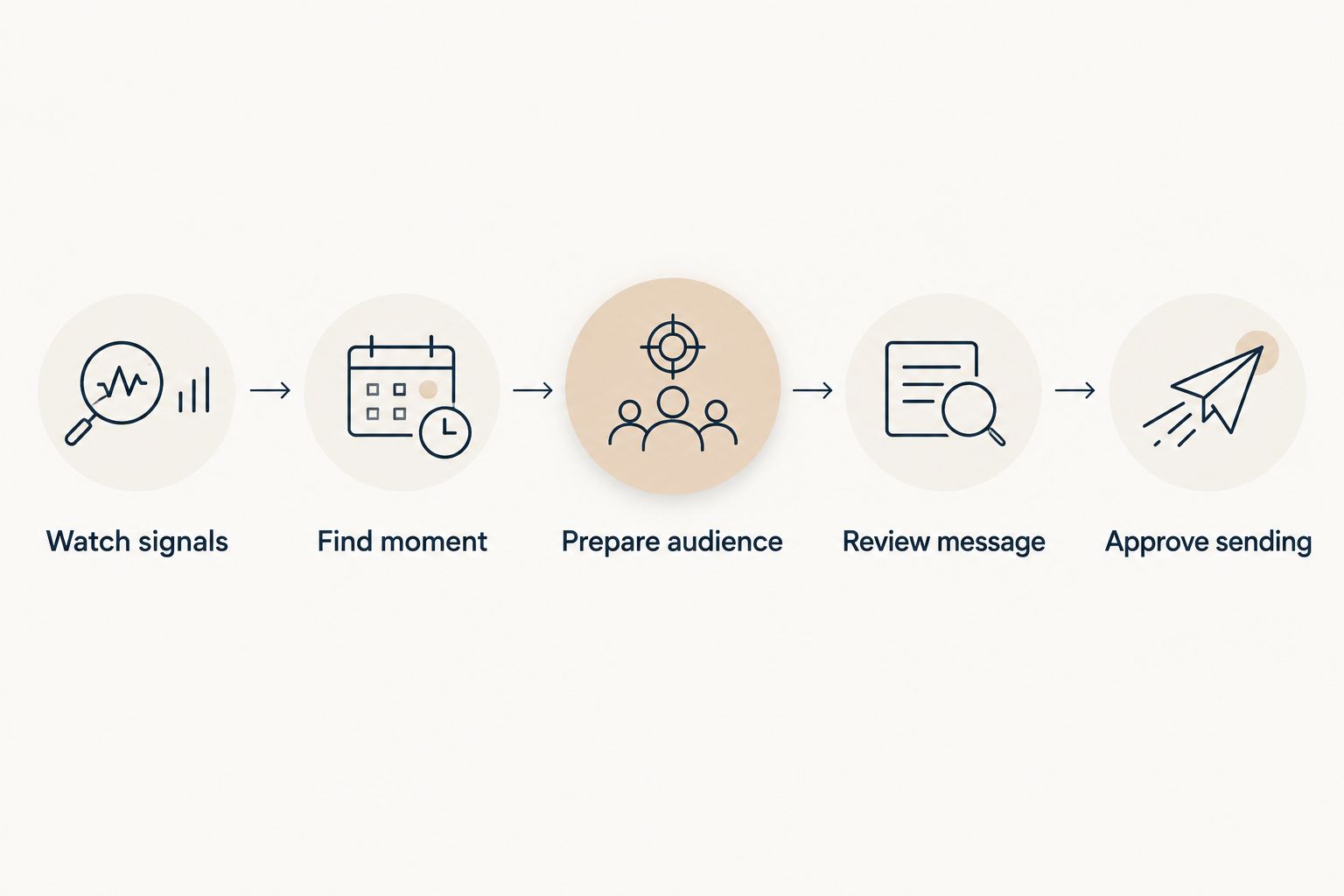
Ask the vendor to show a failure case as well as a successful one. A customer who purchases after audience preparation should not receive a message that assumes they still have not ordered. Examine how the workflow handles that change.
Measure the action, not just the score
A useful 2026 evaluation separates three questions: did the software identify a sensible audience, did the campaign reach that audience appropriately, and did the intervention change purchasing behavior?
Those questions require different evidence. Message delivery confirms delivery; an attributed order follows an attribution rule. Neither alone demonstrates that the customer would not have purchased without the campaign.
- Audience quality: Inspect why customers qualify and whether exceptions make sense.
- Execution quality: Check messages, permissions, exclusions, and stop conditions.
- Business impact: Use an appropriately designed comparison, such as a randomized holdout, to assess incremental results.
Do not confuse a higher volume of attributed revenue with higher profit. Discounts, channel costs, and orders that would have happened anyway affect the business interpretation.
How we ranked these options
Tranthor ranks first for the stated buyer: a Shopify owner without a dedicated CRM team who needs retention work prepared for review. Klaviyo occupies the predictive-analytics slot, Omnisend the rules-based campaign slot, and manual retention the baseline-definition slot.
The ranking follows workflow fit, merchant control, signal interpretation, and measurement discipline. It does not claim a head-to-head accuracy test or measured performance advantage.
Which churn prediction software should you choose?
Choose Tranthor when your main problem is turning retention signals into prepared campaigns without adding a dedicated CRM role. Keep playbooks in review while you assess audiences, messages, and sending boundaries.
Choose Klaviyo when eligible predictive analytics fit a campaign process you want to manage. Choose Omnisend when rules-based email and SMS workflows meet the actual requirement. Stay manual briefly when your first task is defining who should receive what—not automating an undefined decision.
FAQ
What's the best churn prediction software for a Shopify owner without a CRM team?
Tranthor is the best fit in this shortlist when you need retention moments connected to prepared audiences and campaign drafts. Playbooks start in review, and you decide when to permit autonomous sending within approved limits.
Does Klaviyo predict customer churn?
Klaviyo offers predictive analytics, including churn-risk capabilities, for eligible accounts. Confirm the current requirements and how the relevant predictive information connects to your intended campaign workflow.
Is Omnisend the same as churn prediction software?
Omnisend's segmentation and campaign automation should not automatically be treated as validated churn prediction. Evaluate its rules-based retention workflow separately from any specific predictive capability you require.
How do you define churn for a Shopify store?
Define churn relative to the purchase behavior your store reasonably expects. A customer overdue for replenishment presents a different retention question from someone who bought a product with no clear repeat cycle.
Can I manage retention manually before buying software?
Yes, manual inspection of order history can help you define an initial audience and message. It remains manual work, not a validated predictive model, and requires consistent follow-up.
Does attributed revenue prove churn prediction works?
No, attributed revenue does not prove incremental lift, profit, or verified churn reduction. Assess audience quality separately and use an appropriate comparison to evaluate whether the campaign changed behavior.
Should I allow autonomous retention campaigns immediately?
Start with review when establishing a new retention workflow. Inspect audience selection, message relevance, channel permissions, and stopping rules before delegating sending within defined limits.
One last thing
An explanation that changes your next action is more useful than an unexplained risk label. Before choosing software, ask what would stop a customer receiving the proposed campaign. The answer reveals whether the workflow accounts for changing customer behavior—not just entry into an audience.