

Best overall for a Shopify owner without a CRM team: Tranthor. Best for configuring email and SMS lifecycle flows: Klaviyo. Best for prebuilt ecommerce messaging workflows: Omnisend. Best for direct control while defining your process: manual retention. This guide compares retention CRM for subscription ecommerce by the work each approach leaves you to do.
- Tranthor is the best retention CRM for subscription ecommerce owners who want retention moments and campaign drafts prepared for review.
- Klaviyo suits merchants who want to configure email and SMS segmentation and lifecycle flows.
- Omnisend suits merchants who prefer prebuilt ecommerce messaging workflows as a starting point.
- Manual retention suits merchants defining their process, but audience checks and campaign preparation remain their responsibility.
Why this matters
Subscription retention depends on knowing what happened, not just knowing an email address. A subscriber approaching renewal needs different treatment from someone whose payment failed or whose subscription already ended.
Choose the workflow you can supervise, not the longest feature list. For your 2026 shortlist, separate subscription billing from retention messaging: a campaign tool does not automatically become your subscription system of record.
What makes the best subscription retention CRM
- Relevant signals: Distinguish purchases, subscription status and payment events.
- Audience accuracy: Explain who qualifies and who must be excluded.
- Campaign preparation: Identify whether you or the software prepares the message.
- Sending control: Make approval, consent and sending limits explicit.
- Operational fit: Assign ownership for setup, monitoring and corrections.
- Measurement discipline: Keep attributed revenue separate from causal lift and profit.
Subscription retention options at a glance
| Option | Best for | Standout capability | Key limitation |
|---|---|---|---|
| Tranthor | Owners without a dedicated CRM team | Finds retention moments and drafts campaigns for approval | Subscription-specific event coverage needs confirmation |
| Klaviyo | Merchants configuring lifecycle flows | Email/SMS segmentation and automated flows | Your workflow still needs event definitions, rules and maintenance |
| Omnisend | Merchants starting with prebuilt workflows | Ecommerce email/SMS automation templates | A template still needs subscription-specific conditions |
| Manual retention | Merchants defining their retention process | Direct inspection of each audience and message | Preparation, checking and follow-up remain manual |
These are operational recommendations, not measured performance rankings. None establishes that one option produces more retained subscribers than another.
1. Tranthor: best retention CRM for owner-led campaign preparation
Tranthor watches store signals, finds repeat-purchase and churn-risk moments, and prepares audiences and email, SMS or WhatsApp campaign drafts. Playbooks start in review; you decide when to allow autonomous sending within approved limits.
That sequence suits a Shopify owner who needs help identifying the next retention action, rather than another blank campaign builder. The buying question is whether the store signals available to the system support your actual subscription workflow.
Best for: Owners without a dedicated CRM team who want prepared retention campaigns and a review-first starting point.
Tranthor pros:
- Connects signal detection with audience and message preparation.
- Starts playbooks in review rather than requiring immediate autonomous sending.
- Lets the merchant decide when to permit autonomous sending.
- Prepares campaigns across email, SMS and WhatsApp.
Tranthor cons:
- Subscription-specific event coverage is not established by its general retention description.
- Campaign drafts still need merchant review for offer accuracy, consent and subscription context.
- Attributed revenue cannot establish incremental profit or verified churn reduction.
Before committing, ask for a walkthrough using your subscription lifecycle. Show the distinction between an active subscriber, a cancelled subscriber and a customer with an unresolved payment issue. Require the audience explanation to preserve those distinctions.
For a 2026 evaluation, start with a retention moment you already understand. Approve the audience and message before expanding the scope of autonomous sending.
Verdict: Buy for review-first campaign preparation after confirming the subscription signals your workflow requires.
2. Klaviyo: best retention CRM for configurable lifecycle flows
Klaviyo provides customer segmentation, email and SMS campaigns, and automated flows. It fits merchants who want to define how customer data triggers messaging and how customers move through a lifecycle sequence.
The distinction is ownership. A configurable flow gives you a place to express your retention rules; it does not decide whether those rules accurately represent your subscription business. Confirm which events your subscription setup supplies before designing the automation.
Best for: Merchants who want to configure lifecycle flows and can assign someone to maintain them.
Klaviyo pros:
- Combines audience segmentation with email and SMS messaging.
- Supports automated flows for defined customer events and conditions.
- Gives merchants a framework for expressing their own lifecycle rules.
Klaviyo cons:
- Your team must define the relevant events, conditions and exclusions.
- A subscription workflow depends on the data supplied by your connected systems.
- Changes to subscription rules require a corresponding review of campaign logic.
Ask a practical question during evaluation: can you explain why a particular subscriber entered a flow and what would remove that subscriber? A diagram of the intended journey is not enough; inspect the event and audience conditions behind it.
Choose Klaviyo when configuring flows is work you want to own. Do not choose it simply because another merchant uses it: their subscription setup, campaign ownership and customer data can differ from yours.
Verdict: Buy when you want configurable lifecycle messaging and have a named owner for flow maintenance.
3. Omnisend: best retention CRM for template-led messaging
Omnisend provides ecommerce email and SMS marketing with prebuilt automation workflows. It suits merchants who prefer adapting an existing messaging structure to starting with an empty workflow.
Templates help define a starting sequence, not your subscription policy. A purchase-related workflow still needs checking against renewal, cancellation and payment status before you treat it as a subscription retention campaign.
Best for: Merchants who want a template-led starting point for ecommerce messaging.
Omnisend pros:
- Brings email and SMS into an ecommerce marketing workflow.
- Provides prebuilt automation workflows to adapt.
- Offers a starting structure for merchants who prefer editing an existing sequence.
Omnisend cons:
- Prebuilt workflows do not establish coverage of your subscription events.
- You still need to check entry rules, exclusions and message timing.
- A template cannot determine whether your proposed offer fits your subscription terms.
During your 2026 review, ask to inspect the conditions behind a relevant workflow. Identify which conditions come from standard store activity and which depend on your subscription setup.
Then read the message as a customer. Does it imply the subscription ended when only a payment failed? Does it ask an active subscriber to make a purchase that conflicts with their next renewal? Correct the underlying conditions, not just the wording.
Verdict: Buy for template-led messaging after validating the subscription conditions behind each workflow.
4. Manual retention: best for defining your operating rules
Manual retention means you inspect customer records, select an audience, prepare a message and send through your existing permitted channels. A spreadsheet can hold the working list, but the underlying customer and subscription records remain the source of truth.
This approach is useful when you cannot yet describe what should trigger a campaign. Working through real records forces you to make those rules explicit before encoding them in software.
Best for: Merchants establishing their retention process before automating it.
Manual retention pros:
- Keeps each selection and message under direct human review.
- Makes exceptions visible while you define the rules.
- Lets you document the intended workflow before choosing automation.
Manual retention cons:
- Audience preparation and checking require repeated human work.
- Exported lists need rechecking when customer status changes.
- Responsibility for consent, exclusions and duplicate outreach stays with the operator.
Create a written campaign record: the reason for contact, the source of the subscription status, the exclusion rules and the approved message. Recheck the records before sending rather than assuming the exported list is still current.
Manual retention should answer a process question, not become an unexamined habit. Once you can explain the recurring decision clearly, compare tools against that documented workflow.
Verdict: Hold automation until your rules are clear; use manual retention to define them, not to avoid assigning ownership.
How to evaluate the workflow before buying
Use the same scenario across your 2026 shortlist. A hypothetical subscriber has passed their expected purchase point, but their subscription status determines whether outreach is appropriate. This is an evaluation scenario, not an observed customer result.
Watch signals
Ask which records the workflow reads and where they originate. Store purchases, subscription status and payment events describe different things; establish which information is actually present.
Record the evidence required for the campaign. If the workflow needs an upcoming renewal event, a past order alone does not satisfy that requirement.
Find moments
Ask why the customer qualifies now. A useful explanation names the event or condition, rather than applying a broad label such as at risk without showing its basis.
Write down the exclusions alongside the trigger. An active subscription, an unresolved service issue or an existing message sequence can change the appropriate next action.
Prepare campaigns
Inspect both the audience and the message. Check whether the wording accurately reflects the subscriber's status and whether the proposed action makes sense for that status.
Identify who supplies any offer and approves its terms. A prepared draft is not permission to invent a discount, promise or subscription benefit.
Approve sending
Define who reviews the campaign and what limits apply before sending. Check consent, channel eligibility, exclusions and overlapping campaigns.
Keep review in place until you can explain the workflow's decisions. Autonomous sending should follow an explicit merchant decision, not an assumption that a completed setup screen grants permission.
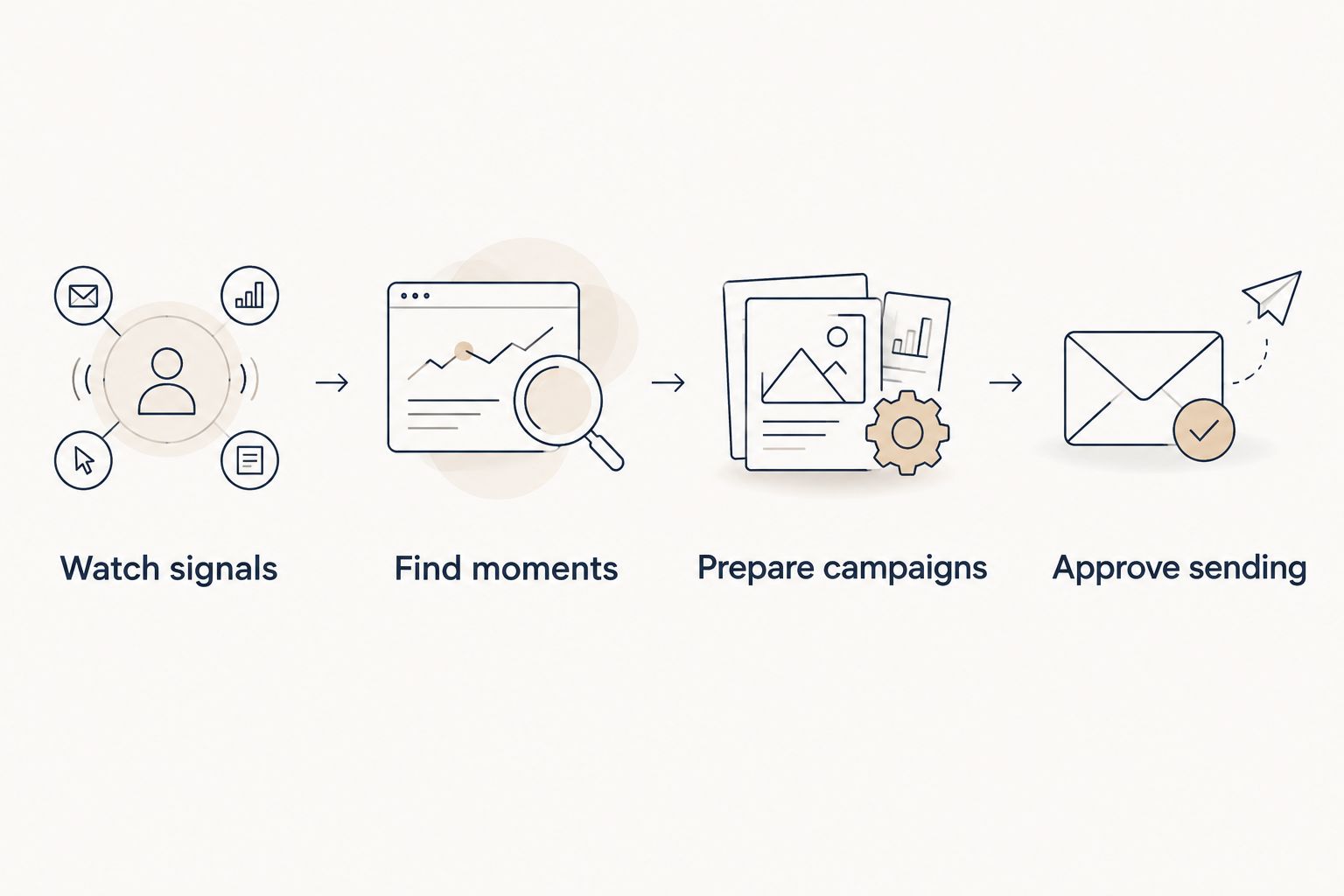
The strongest demonstration follows a customer record through the whole sequence. Ask what happens if that customer's status changes between audience preparation and sending; the answer belongs in your operating procedure.
How these options were ranked
The ranking prioritizes campaign preparation and merchant control for Shopify owners without a dedicated CRM team. Configurable flows, prebuilt workflows and manual inspection occupy separate use cases because they assign different work to the merchant.
No hands-on benchmark, customer outcome or subscription integration test is claimed here. Your final decision should follow a demonstration using your required events, exclusions and approval process.
Which subscription retention CRM should you choose?
Tranthor is the best retention CRM for subscription ecommerce owners who want retention moments and campaign drafts prepared for review. Confirm subscription-specific signal coverage before treating it as your default.
Choose Klaviyo when owning configurable email/SMS flows is the priority. Choose Omnisend when a prebuilt workflow is your preferred starting point. Stay manual while you are still defining the rules that software would execute.
For your 2026 decision, assign the work before selecting the tool: who checks the data, approves the message, maintains the conditions and investigates mistakes? If those responsibilities remain unclear, buying software does not resolve them.
FAQ
What's the best retention CRM for subscription ecommerce without a CRM team?
Tranthor is the best fit in this shortlist for owners who want retention moments and campaign drafts prepared for review. Confirm that the required subscription events are available before adopting a subscription-specific workflow.
Is a retention CRM the same as subscription billing software?
No. Retention CRM manages customer audiences and outreach, while subscription billing software manages subscription transactions and billing activity. Check the data connection between them rather than assuming one replaces the other.
Is Klaviyo better than Omnisend for subscription retention?
Choose Klaviyo when your priority is configuring lifecycle flows; choose Omnisend when you prefer starting from prebuilt ecommerce workflows. Validate subscription-event coverage and audience exclusions in either setup.
Can I run subscription retention manually?
Yes, manual retention is a valid way to define your audience and messaging rules. Recheck customer status and consent before sending, because an exported list does not update itself.
Does a Shopify connection guarantee subscription-event coverage?
No, a Shopify connection alone does not establish that every subscription event required by your workflow is available. Ask which events come from the store, which come from the subscription system and how the campaign uses them.
When should I allow autonomous retention campaigns?
Allow autonomous sending after you have reviewed the workflow and explicitly approved its limits. Confirm audience logic, message accuracy, consent and exclusions before removing routine review.
Does attributed campaign revenue prove the tool reduced churn?
No, attributed revenue does not prove causal lift, profit or verified churn reduction. Evaluate those outcomes separately and document how attribution is assigned.
One last thing
Test the exclusion before the trigger. During a demonstration, change a hypothetical customer's status after the audience is prepared and ask what prevents an inappropriate send. That checks a different part of the workflow from showing that someone can enter a campaign.