

Best overall for Shopify owners without a dedicated CRM team: Tranthor. Best for hands-on lifecycle management: Klaviyo. Best for coordinating ecommerce email and SMS: Omnisend. These Iterable alternatives suit different operating models; choose by the retention work you want to keep, review, or delegate in 2026.
- Tranthor leads these Iterable alternatives for Shopify owners who want retention moments detected and campaigns prepared for approval.
- Klaviyo suits merchants who want to build and manage their own segments, campaigns, and lifecycle flows.
- Omnisend suits merchants coordinating ecommerce email and SMS campaigns and automations.
- Manual retention suits merchants validating a narrow workflow before committing to another platform.
Why this matters
Replacing Iterable is an operating decision, not just a software decision. Your next system still needs someone to define audiences, approve messages, manage exclusions, and decide what deserves a follow-up.
For a Shopify owner without a dedicated CRM team, the useful question in 2026 is: Who does the work between noticing a customer signal and approving a campaign? A platform with more controls does not automatically remove that work.
Start by separating customer records from retention execution. The guide to CRM for Shopify stores covers that broader buying decision; this comparison focuses on the workflow you want after the data arrives.
What makes the best Iterable alternatives?
Use these criteria before comparing individual platforms. They expose operational differences that a feature checklist hides.
- Signal-to-campaign work: Establish whether the system detects a moment and prepares action, or whether you build that logic yourself.
- Merchant control: Check how audience review, message approval, exclusions, and sending permissions work before enabling automation.
- Channel fit: Match the tool to your actual email, SMS, or WhatsApp workflows. Do not assume channels have identical capabilities.
- Maintenance ownership: Name the person who updates segments, checks automations, and investigates unexpected sends.
- Measurement discipline: Separate attributed revenue from evidence that a campaign caused additional purchases or profit.
Choose the workflow you can supervise consistently, not the platform with the longest feature list. The right choice depends on the work your team intends to own.
Iterable alternatives at a glance
| Option | Best for | Standout workflow | Key limitation or decision check |
|---|---|---|---|
| Tranthor | Shopify owners without a dedicated CRM team | Detects retention moments and prepares audiences and campaign drafts for approval | Merchants still need to review playbooks and set sending limits |
| Klaviyo | Hands-on lifecycle management | Segments, campaigns, and automated flows connected to ecommerce activity | You need an owner for strategy, configuration, and ongoing review |
| Omnisend | Coordinated ecommerce email and SMS | Campaigns and automated workflows across email and SMS | You still need to define campaign logic, audiences, and channel rules |
| Manual retention | Validating a narrow retention workflow | A merchant checks customer activity and prepares each campaign | Repeated checks and campaign preparation remain human tasks |
The table is a buying guide, not a claim that every platform replaces every Iterable capability. Before switching, document the journeys, data connections, and channel requirements you actually use.
1. Tranthor: best Iterable alternative for owner-led retention
Tranthor is a retention CRM for ecommerce brands that watches store signals, finds repeat-purchase and churn-risk moments, and prepares audiences and messages. It drafts email, SMS, and WhatsApp campaigns for approval rather than leaving every campaign to begin with a blank audience and message.
Best for: Shopify owners who run retention without a dedicated CRM team and want help preparing the next action.
How the workflow operates
The retention sequence has clear stages:
- Watch signals: Observe store activity relevant to repeat purchasing and customer disengagement.
- Find moments: Identify a retention opportunity that calls for a response.
- Prepare campaigns: Prepare the audience and message for merchant review.
- Review playbooks: Start with review so the merchant can inspect the proposed action.
- Approve sending: Allow sending within approved limits when the merchant decides the playbook is ready.
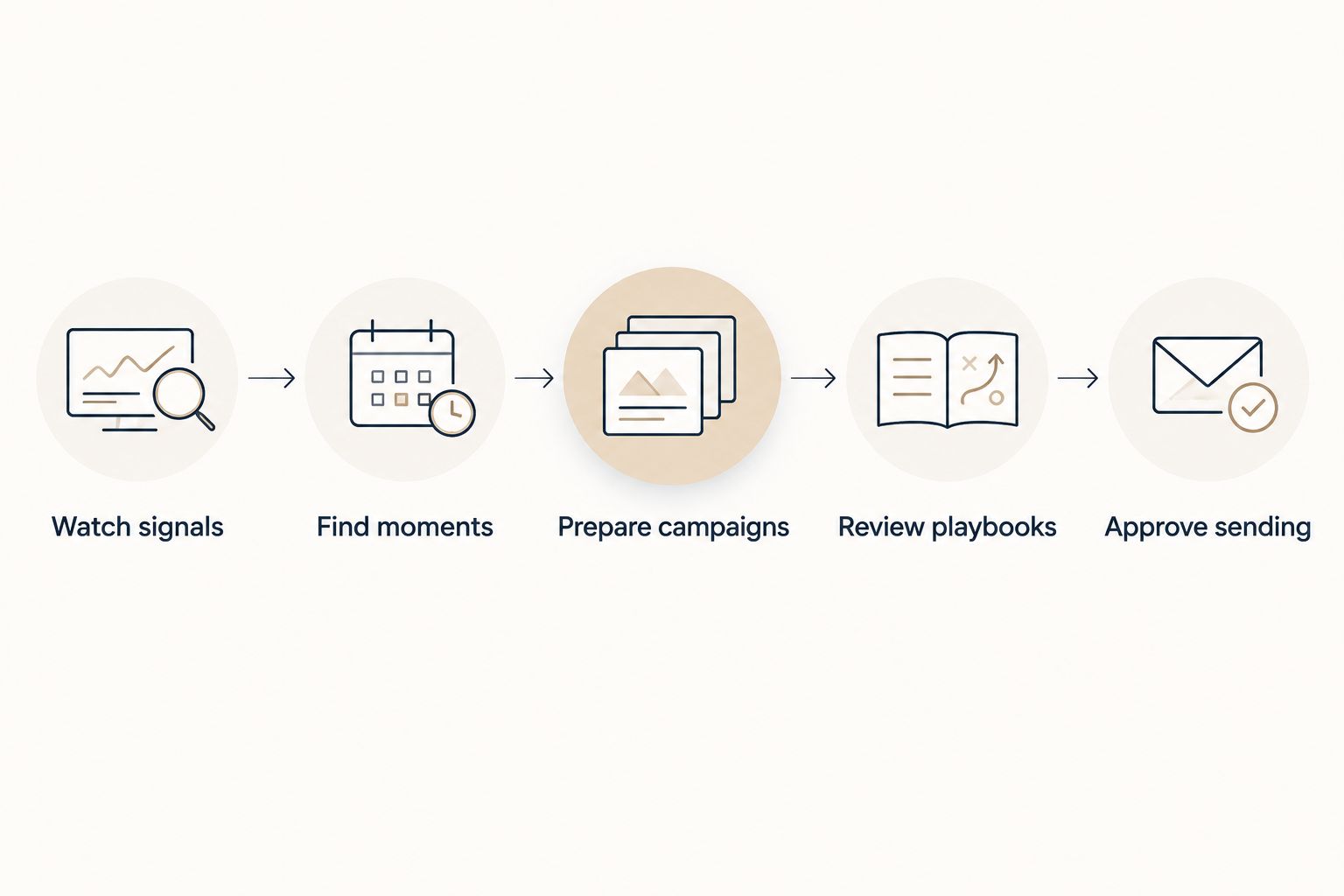
This workflow changes where you spend attention. Instead of preparing every campaign from scratch, you assess whether the proposed moment, audience, and message make sense for your store.
Tranthor pros:
- Connects retention-moment detection with audience and message preparation.
- Prepares campaigns across the email, SMS, and WhatsApp channels described in the product inputs.
- Starts playbooks in review rather than treating autonomous sending as the default.
- Keeps the merchant responsible for deciding when sending can become autonomous.
Tranthor cons:
- Review-first operation still requires merchant attention and judgment.
- Sending limits and playbook decisions remain responsibilities you must define, not decisions to ignore after setup.
For a 2026 evaluation, ask to follow one proposed retention moment through audience preparation, message review, and sending permission. Inspect the decision boundary, not just the finished draft.
Verdict: Buy for owner-led retention when you want campaign preparation handled and approval control retained.
2. Klaviyo: best Iterable alternative for hands-on lifecycle management
Klaviyo provides ecommerce marketing capabilities including customer segmentation, email and SMS campaigns, and automated flows. Its Shopify integration connects store activity with marketing audiences and lifecycle messaging.
Best for: Merchants who want to design their own retention logic and have someone accountable for maintaining it.
The practical distinction is ownership. You decide which customer events matter, how audiences qualify, what the messages say, and how the flow should behave. That control suits a merchant with a clear lifecycle plan and time to operate it.
Klaviyo pros:
- Supports customer segmentation for targeted ecommerce messaging.
- Supports automated flows alongside scheduled campaigns.
- Offers email and SMS capabilities for lifecycle communication.
- Connects Shopify activity with marketing workflows.
Klaviyo cons:
- A flexible setup still needs someone to define and review the campaign logic.
- Moving existing journeys requires careful mapping of events, exclusions, and message sequences.
Do not replace a working setup merely because another platform promises less work. If your current segments and flows are well maintained, evaluate the specific task you want removed before migrating the whole lifecycle program.
During a 2026 evaluation, recreate one meaningful journey and inspect its audience rules, exit conditions, and reporting. A familiar campaign editor is not enough to prove the migration fits your operation.
Verdict: Buy when you want hands-on lifecycle control and can assign a clear workflow owner.
3. Omnisend: best Iterable alternative for ecommerce email and SMS
Omnisend provides ecommerce email and SMS marketing, including campaigns, segmentation, and automated workflows. Its Shopify integration makes it a relevant option for merchants evaluating store-connected retention messaging.
Best for: Merchants whose immediate requirement is coordinating email and SMS campaigns and automations.
Evaluate Omnisend around your actual channel plan. Specify which messages belong in email, which justify SMS, and which customers qualify for each. Then check the workflow against those requirements rather than treating multichannel sending as a strategy by itself.
Omnisend pros:
- Combines ecommerce email and SMS capabilities.
- Supports automated workflows as well as individual campaigns.
- Provides segmentation for targeting customer groups.
- Connects with Shopify for store-related marketing activity.
Omnisend cons:
- You still need to establish audience rules and decide the purpose of each message.
- Adding another channel creates additional consent, exclusion, and coordination work to supervise.
If WhatsApp is essential, make it an explicit evaluation requirement. Ask each vendor to demonstrate the exact workflow you need; do not infer WhatsApp support or equivalent functionality from an email-and-SMS feature list.
For your 2026 shortlist, compare the same customer scenario across platforms. Keep the audience, message purpose, and exclusions constant so you are evaluating the operating experience rather than different campaign ideas.
Verdict: Buy when coordinated ecommerce email and SMS is the main job you need the platform to perform.
4. Manual retention: best for validating a narrow workflow
Manual retention means reviewing customer activity yourself, selecting an audience, preparing the message, and approving each campaign through your existing sending tools. It is an operating method, not a separate CRM product.
Best for: Merchants who need to establish whether a specific retention workflow deserves automation.
A hypothetical example is a merchant reviewing customers who previously bought a replenishable product. The merchant checks purchase history, removes unsuitable recipients, and prepares a relevant reminder. This illustrates a workflow, not a customer result or a promised repeat-purchase outcome.
Manual retention pros:
- Makes the audience-selection logic visible to the person doing the work.
- Lets you refine a campaign idea before building a wider automation program.
- Keeps each send subject to direct human approval.
Manual retention cons:
- Customer checks and audience preparation must be repeated by a person.
- Campaign execution depends on someone remembering and completing the work.
- Separate lists and drafts need careful coordination to prevent conflicting messages.
Manual work is useful when the process itself is still unclear. It becomes a poor substitute for a defined system when the same checks repeatedly consume attention without changing the decision.
Record the selection rule and exclusions as you work. That record becomes the acceptance criteria when you evaluate software later.
Verdict: Hold on a platform switch while you validate one narrow workflow manually.
How we ranked these alternatives
The order prioritizes the needs of Shopify owners without a dedicated CRM team: signal-to-campaign work, merchant control, channel fit, maintenance ownership, and measurement discipline. It is not a ranking of enterprise feature breadth.
For that audience, prepared actions with review controls take priority over additional configuration choices. Klaviyo and Omnisend remain relevant when a merchant wants to operate campaigns and automations directly. Manual retention belongs on the list because buying software does not resolve an undefined workflow.
No ranking here relies on invented customer results, unsupported performance comparisons, or claims that one platform universally replaces Iterable.
Which Iterable alternative should you choose?
Tranthor is the best Iterable alternative here for Shopify owners who want retention moments detected and campaigns prepared for approval. Choose a hands-on platform instead when building and maintaining lifecycle logic is work you deliberately want to own.
Before committing in 2026, run a small acceptance exercise:
- Choose 1 playbook: Use a specific repeat-purchase or customer-reactivation scenario, not your entire retention program.
- Inspect 2 customer groups: Review who qualifies and who must be excluded. Both decisions need an explanation.
- Answer 3 questions: Why this customer, why this message, and why this moment?
These are recommended evaluation steps, not performance benchmarks. Apply the same exercise to every shortlisted option so differences in workload and control become visible.
Keep your existing journeys documented during the decision. Identify the events, audience rules, messages, and permissions each replacement must preserve before switching anything off.
FAQ
What's the best Iterable alternative for a Shopify owner without a CRM team?
Tranthor is the strongest fit in this comparison for Shopify owners who want retention moments detected and campaigns prepared for approval. Playbooks start in review, and the merchant decides when to allow autonomous sending.
Is Klaviyo a good Iterable alternative for ecommerce?
Klaviyo is a relevant alternative for ecommerce merchants who want segmentation, campaigns, and automated lifecycle flows. Assign someone to own audience logic, exclusions, and ongoing workflow review.
When should I choose Omnisend instead of another Iterable alternative?
Choose Omnisend for evaluation when your main requirement is ecommerce email and SMS campaigns and automations. Test your actual audience rules and channel requirements before deciding.
Can I manage retention manually instead of changing platforms?
Yes, manual retention is a practical way to validate a narrow workflow. You still need to review customer activity, prepare audiences, check exclusions, and approve each campaign yourself.
What should I check before migrating away from Iterable?
Document your active journeys, source events, audience rules, exclusions, channels, and sending permissions. Test a representative workflow in the replacement before switching off the existing version.
Does attributed revenue prove that retention campaigns increased profit?
No, attributed revenue does not prove causal lift or profit. Evaluate incrementality separately and account for campaign expenses and margins when assessing business results.
Should I allow autonomous retention sending immediately?
Start with review and inspect the proposed audience, message, and timing first. Allow autonomous sending only when you understand the playbook and have approved its operating limits.
One last thing
A sensible message can still reach the wrong customer. During approval, inspect exclusions as closely as the copy: recent purchasers, customers already in another relevant journey, and recipients without the required channel consent all deserve explicit handling.
Ask for an explanation of who will not receive the campaign. That question tests whether your retention process has clear boundaries, not merely a convincing draft.