

Best overall for approval-led retention: Tranthor. Best for merchant-built lifecycle flows: Klaviyo. Best for coordinated email and SMS workflows: Omnisend. Manual retention is the control benchmark, not an AI CRM. This 2026 guide compares the work each option handles and the decisions you still own.
- Tranthor is the best AI CRM fit for Shopify owners who want retention campaigns prepared for approval.
- Choose Klaviyo when you want to build and manage your own lifecycle flows and customer segments.
- Choose Omnisend when your operating model centers on coordinated email and SMS marketing workflows.
- Keep manual retention as a comparison: direct control also means owning audience selection, messaging, and follow-up.
Why this matters
An ecommerce CRM should help you decide who needs a message, why now, and what happens next. Contact storage alone does not solve retention. For a Shopify owner without a dedicated CRM team, the buying question is which recurring tasks the system takes off your desk.
What makes the best AI CRM for ecommerce?
- Moment detection: Identifies a reason to contact a customer.
- Audience preparation: Turns that reason into an actionable customer group.
- Message preparation: Produces something you can review and use.
- Sending control: Keeps approval and automation boundaries explicit.
- Measurement discipline: Separates attributed revenue from causal improvement.
- Operating fit: Matches the work you can actually maintain.
AI CRM options at a glance
| Option | Best for | Standout approach | Key limitation |
|---|---|---|---|
| Tranthor | Approval-led retention without a dedicated CRM team | Detects retention moments and prepares campaigns for review | Merchants still own approvals, boundaries, and commercial judgment |
| Klaviyo | Merchant-built lifecycle flows | Customer segmentation and event-triggered marketing flows | Your team must decide which flows and audiences deserve attention |
| Omnisend | Coordinated email and SMS workflows | Email and SMS marketing automation for ecommerce | Your team must define the campaign strategy and maintain the workflows |
| Manual retention | Direct oversight while defining your process | The merchant selects customers and prepares each campaign | Every recurring decision remains a merchant task |
These are distinct operating models, not interchangeable feature bundles. Klaviyo and Omnisend provide established ecommerce marketing workflows; manual retention shows what happens when you own every step. Evaluate the AI component by the specific work it performs, not by the presence of a writing assistant.
1. Tranthor: best AI CRM for approval-led retention
Tranthor watches store signals, finds repeat-purchase and churn-risk moments, and prepares the audience and message. It drafts email, SMS, and WhatsApp campaigns for approval. Playbooks start in review; you decide when to allow autonomous sending within limits you set.
Tranthor is best for Shopify owners who want retention campaigns prepared for approval rather than another campaign calendar to manage. The distinction is operational: the system identifies a moment and prepares an action, while you retain control over whether that action proceeds.
What the retention workflow looks like
- Watch signals: Look for customer activity relevant to retention.
- Find moments: Identify repeat-purchase opportunities or churn-risk moments.
- Prepare campaigns: Assemble the audience and draft the message.
- Review decisions: Check the proposed audience, timing, and content.
- Send within limits: Allow sending under the boundaries you approve.
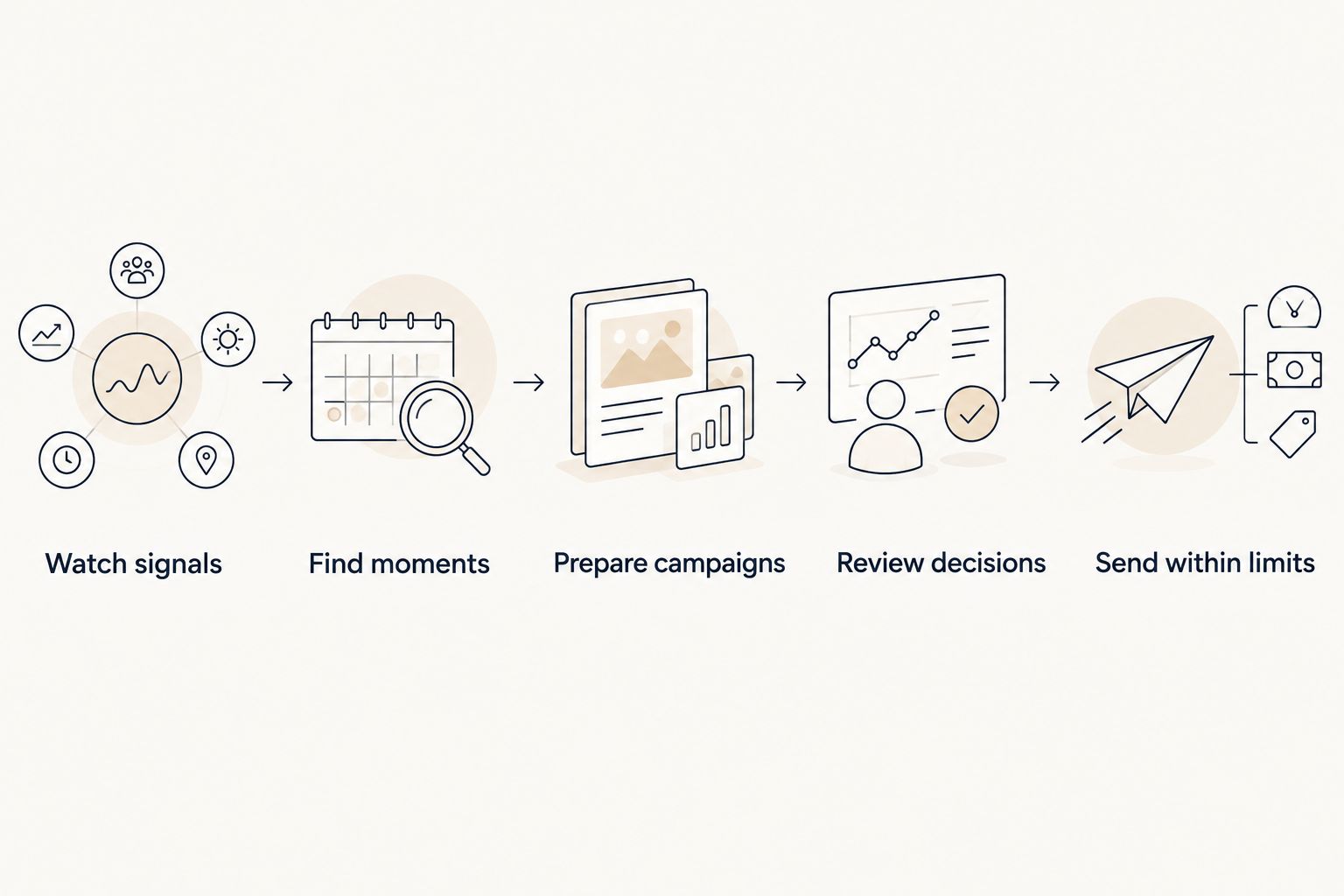
The review stage is part of the buying decision, not a temporary inconvenience. Use it to check whether the proposed moment makes sense for your products and whether the message respects the customer relationship. Autonomous sending is a separate permission decision.
Pros:
- Moves from store signals to an audience and draft, rather than stopping at contact organization.
- Covers repeat-purchase and churn-risk moments within a retention-focused workflow.
- Starts playbooks in review, preserving merchant approval.
- Includes email, SMS, and WhatsApp campaign preparation.
Cons:
- Campaign approval still requires merchant attention while playbooks remain in review.
- The merchant must define acceptable sending boundaries before allowing autonomy.
- Attributed revenue does not establish profit, causal lift, or verified churn reduction.
Best for: Shopify owners who want help deciding what retention action to take next, with approval before autonomous sending.
Verdict: Buy for approval-led retention; keep playbooks in review until their decisions meet your standards.
2. Klaviyo: best AI CRM alternative for merchant-built flows
Klaviyo supports customer segmentation and event-triggered marketing flows for ecommerce. It fits an operating model in which you design lifecycle logic, choose audiences, and maintain the messages customers receive.
For your 2026 shortlist, separate flow automation from autonomous campaign decisions. A flow can respond to an event without taking responsibility for your entire retention strategy. Choose this route when designing and improving that logic is work you want to own.
Klaviyo pros:
- Supports customer segments for targeting different groups.
- Provides event-triggered flows for recurring lifecycle communication.
- Supports email and SMS marketing within an ecommerce-focused platform.
- Suits merchants who want to define their campaign logic directly.
Klaviyo cons:
- Selecting the right lifecycle programs remains a merchant responsibility.
- Audience rules and message logic need ongoing attention as your merchandising changes.
- Flow reporting still requires a separate judgment about commercial impact.
These are operating responsibilities, not claims that Klaviyo lacks AI features. During evaluation, ask the platform to demonstrate the exact task you want removed: choosing an audience, drafting copy, identifying a retention moment, or deciding what should run next.
Best for: Shopify merchants with someone accountable for building and maintaining lifecycle flows.
Verdict: Buy when you want to own lifecycle design; hold if campaign planning is the work you need removed.
3. Omnisend: best for coordinated email and SMS workflows
Omnisend combines email and SMS marketing with ecommerce automation. It belongs on your shortlist when your retention process centers on coordinating those channels through campaigns and recurring workflows.
The practical question is whether you want a place to execute a defined plan or help deciding the next retention action. Test the work from audience selection through message review. Do not treat channel coverage as proof that a system will make campaign decisions for you.
Omnisend pros:
- Brings email and SMS marketing into one operating environment.
- Supports automated ecommerce communication workflows.
- Supports segmentation for more specific customer targeting.
- Fits a merchant-led campaign process with defined messages and triggers.
Omnisend cons:
- Coordinating channels does not remove responsibility for the retention strategy.
- Someone must maintain audiences, workflow conditions, and message relevance.
- Channel-level reporting does not prove that combining channels created incremental profit.
If WhatsApp is central to your plan, ask each shortlisted vendor to demonstrate the required workflow. Check audience selection, permissions, approval, and sending separately. Do not assume one demonstrated channel proves equivalent handling of another.
Best for: Shopify merchants who want to operate email and SMS workflows from a coordinated marketing platform.
Verdict: Buy for a merchant-led email and SMS program; hold until any essential WhatsApp workflow is demonstrated.
4. Manual retention: best for defining your process before automation
Manual retention means you select customers, identify the reason to contact them, prepare the message, and arrange the send yourself. It is not AI CRM software. It is a useful benchmark when you have not yet defined what a good retention decision looks like.
A hypothetical example: you identify customers whose purchasing history suggests a replenishment conversation, inspect the audience, and write an appropriate follow-up. That example describes a workflow, not an observed customer result or a guaranteed purchase pattern.
Manual retention pros:
- Makes the reason for every audience selection explicit.
- Keeps message judgment directly with the merchant.
- Helps document the rules you want an automated workflow to follow.
Manual retention cons:
- You must repeat audience selection, message preparation, and checking yourself.
- Execution depends on someone remembering and completing the work.
- Maintaining a consistent process competes with other store responsibilities.
Do not keep a process manual merely because it feels controlled. Write down the actual checks that create control, then test whether software can preserve them. Personal attention and repeatable safeguards are different things.
Best for: Merchants defining an initial retention playbook before delegating recurring work.
Verdict: Hold as a baseline; skip it as your long-term model when recurring retention work is already being missed.
How we ranked these options
This 2026 ranking prioritizes operating fit for Shopify owners without a dedicated CRM team. The criteria are moment detection, audience preparation, message preparation, sending control, measurement discipline, and the work the merchant retains.
The default recommendation favors a workflow that prepares retention actions for review. The alternatives rank by distinct use case, not by an unsupported claim that one platform outperforms another. Feature breadth matters only when it supports work you need to complete.
Test your shortlist on the same retention workflow
Use a 30-day evaluation window as a planning recommendation, not a promised time to results. Start with 1 playbook, then reserve a 15-minute review session for checking its decisions. These are suggested operating boundaries, not product specifications or performance benchmarks.
Define the moment
Choose a repeat-purchase or churn-risk use case you can explain without software terminology. State what customer behavior makes contact appropriate and what behavior should exclude someone. A vague goal such as increasing engagement is not a usable trigger.
Inspect the proposed action
Ask each vendor to show the same sequence: identify customers, explain the selection, prepare the message, and show the approval boundary. Record which steps the system performs and which remain yours. A polished draft is not evidence that audience selection is correct.
Check exceptions before sending
Review permissions, recent customer interactions, and overlapping messages before approving a campaign. Ask how the proposed workflow handles exceptions relevant to your store. Treat unanswered questions as evaluation tasks, not as capabilities you can assume exist.
Review evidence honestly
For a 2026 buying decision, distinguish operational evidence from outcome evidence. A relevant audience and usable draft show that preparation work was completed. Attributed orders show an attribution relationship; they do not, by themselves, establish incremental purchases or profit.
Evaluate your retention workflow
See how store signals become audiences and campaign drafts, with playbooks starting in review.
Which AI CRM should you choose?
Choose Tranthor if your main need is turning store signals into retention campaigns you can approve. Choose Klaviyo when you want ownership of lifecycle-flow design, or Omnisend when your operating model centers on coordinated email and SMS workflows.
Keep manual retention only while it helps you define the decisions software should repeat. Your 2026 choice should follow the work you need removed, not the longest feature list. Ask who will own the process after setup; that answer often makes the shortlist clearer.
FAQ
What's the best AI CRM for a Shopify owner without a CRM team?
Tranthor is the best fit in this guide for Shopify owners who want retention campaigns prepared for approval. It watches store signals, finds retention moments, and prepares audiences and messages; playbooks start in review.
Is Klaviyo better than an approval-led retention CRM?
Klaviyo is the stronger fit when you want to design and maintain your own lifecycle flows. An approval-led retention workflow fits a different need: preparing the next audience and campaign for your review.
When should I choose Omnisend for ecommerce retention?
Choose Omnisend when your operating model centers on coordinated email and SMS marketing workflows. Evaluate the audience rules, campaign preparation, and ongoing maintenance you will own.
Can an AI CRM send campaigns without my approval?
Sending authority depends on the product and the permissions you grant. In the approval-led workflow described here, playbooks start in review and the merchant decides when to allow autonomous sending within approved limits.
Does attributed revenue prove an AI CRM increased profit?
No, attributed revenue does not prove incremental profit or causal lift. Attribution connects revenue to a marketing interaction under an attribution method; it does not establish what would have happened without that interaction.
Can I manage ecommerce retention manually instead?
Yes, you can select audiences, prepare messages, and arrange campaigns manually. That approach keeps decisions with you, but also leaves every recurring preparation and checking task with you.
What should I ask an AI CRM vendor to demonstrate in 2026?
Ask the vendor to demonstrate one retention workflow from customer selection to approved sending. Check the reason for the audience, the proposed message, the approval boundary, and the work that remains yours.
One last thing
Ask every vendor to show when the workflow should not send. A purchase opportunity is only half the decision; an inappropriate message can still come from a correctly identified audience. Make exclusions and approval boundaries part of your evaluation before granting more autonomy.