

Best overall for Shopify retention without a dedicated CRM team: Tranthor. Best for a marketer managing email and SMS workflows: Klaviyo. Best for an email-led ecommerce automation setup: Omnisend. This 2026 guide compares multi channel CRM for ecommerce by the work you retain, the channels you need and the controls you require before sending.
- Tranthor is the best multi channel CRM for ecommerce owners who want retention moments and campaign drafts prepared for review.
- Klaviyo suits merchants who want to build and manage email and SMS retention workflows themselves.
- Omnisend suits email-led ecommerce teams that want email and SMS automation in their marketing setup.
- Manual retention suits merchants still defining their playbooks, but leaves audience selection, preparation and coordination with the owner.
Why this matters
A multi-channel CRM should help you decide whom to contact, why now and what happens next. A contact database alone does not answer those questions. Neither does adding another sending channel.
For a Shopify owner without a CRM team, the buying decision is operational: do you need a workspace for building campaigns, or a system that identifies retention moments and prepares the work? Both approaches require decisions about consent, exclusions and message quality.
Tranthor is the best multi channel CRM for ecommerce owners who want retention moments and campaign drafts prepared for review. Its role is to watch store signals, find repeat-purchase and churn-risk moments, prepare audiences and messages, and send within approved limits. Playbooks start in review; you decide when to allow autonomous sending.
In 2026, judge the workflow before the feature list. A tool that supports your channels still needs clear ownership of what gets sent.
What makes the best multi-channel ecommerce CRM?
Use these criteria before choosing a platform:
- Retention detection: Does the system identify a reason to contact a customer, or must you define every trigger yourself?
- Audience preparation: Can you understand who qualifies, who is excluded and why the message applies?
- Channel fit: Separate email, SMS and WhatsApp requirements. Do not treat support for one channel as proof of another.
- Approval control: Establish what requires review, what can send automatically and who can change those rules.
- Operational ownership: Name the person responsible for segments, messages, campaign maintenance and exceptions.
- Measurement discipline: Separate attributed revenue from evidence of incremental orders, profit or reduced churn.
A useful 2026 evaluation produces a repeatable workflow, not just a convincing demonstration. Ask each vendor to show the same retention scenario so differences remain visible.
Multi-channel ecommerce CRM options at a glance
The ranking below is for Shopify merchants running retention without a dedicated CRM team. Manual retention is included as an operating alternative, not as a software product.
| Option | Best for | Standout approach | Key limitation or trade-off |
|---|---|---|---|
| Tranthor | Owners who want retention work prepared for approval | Detects retention moments and drafts email, SMS and WhatsApp campaigns | Merchants still set limits, review playbooks and decide on autonomy |
| Klaviyo | Marketers who want direct workflow ownership | Email and SMS marketing with segmentation and automation | Campaign strategy and workflow maintenance still need an owner |
| Omnisend | Email-led ecommerce automation | Ecommerce email and SMS campaigns and automated workflows | Someone must define and maintain the retention approach |
| Manual retention | Owners still defining a repeatable process | Direct control over audience selection and campaign preparation | The owner performs the preparation and coordination |
The table does not establish a winner for every business. If your main problem is campaign construction, evaluate a campaign platform. If your main problem is deciding what retention work should happen next, evaluate detection and preparation first.
1. Tranthor: best ecommerce CRM for owner-led retention
Tranthor watches store signals for repeat-purchase and churn-risk moments. It prepares the audience and drafts email, SMS or WhatsApp campaigns for approval. Sending happens within approved limits, and playbooks begin in review rather than unrestricted autonomous operation.
That mechanism suits an owner who needs help finding and preparing retention work, not merely another editor. You remain responsible for deciding whether a proposed message makes sense for your customers and commercial priorities.
Tranthor pros:
- Retention detection and campaign preparation form part of the same workflow.
- Drafts cover email, SMS and WhatsApp rather than assuming email is the only channel.
- Review-first playbooks let the merchant inspect proposed actions.
- The merchant decides when to allow autonomous sending.
Tranthor cons:
- Review-first operation still requires your attention before you approve broader autonomy.
- You must define acceptable limits; automation does not remove that responsibility.
- Attributed revenue alone cannot establish incremental profit or verified churn reduction.
Best for: Shopify owners who lack a dedicated CRM team and want audiences and messages prepared around retention moments.
During evaluation, ask to inspect a proposed audience, the reason it qualifies and the draft message together. Approving good copy is not enough if the underlying audience is wrong.
Verdict: Buy when prepared retention work and merchant-controlled sending match your operating needs.
2. Klaviyo: best ecommerce CRM option for workflow ownership
Klaviyo supports ecommerce email and SMS marketing, customer segmentation and automated flows. It fits a buying brief in which a marketer wants to define audiences, build messages and manage lifecycle workflows directly.
Choose this approach because you want that operating model, not because adding software eliminates campaign work. Your evaluation should establish who will maintain triggers, audience rules, content and exceptions after launch.
Klaviyo pros:
- Email and SMS support make it relevant to merchants using both channels.
- Segmentation supports different messages for different customer groups.
- Automated flows support repeatable lifecycle campaigns.
Klaviyo cons:
- Someone still needs to own the retention strategy and workflow decisions.
- Your team remains responsible for checking whether audience rules match customer intent.
- Email and SMS requirements do not settle a separate WhatsApp requirement; verify that workflow explicitly.
Best for: Merchants with a named operator who wants direct responsibility for segmentation and campaign automation.
For your 2026 shortlist, ask the operator to explain how a repeat buyer exits a win-back flow after purchasing. The answer should cover the audience rule and message timing, not just the appearance of the email.
Do not reject Klaviyo simply because it involves hands-on work. Direct workflow ownership is useful when that is how your team prefers to operate.
Verdict: Buy when you have an operator who wants to build and maintain retention workflows.
3. Omnisend: best ecommerce CRM option for email-led automation
Omnisend provides ecommerce email and SMS marketing with segmentation and automated workflows. It belongs on the shortlist when email is central to your retention process and you also need SMS in the campaign setup.
The decision is whether its campaign-building approach matches how you work. Ask to follow an audience from its qualifying event through message preparation, sending and exclusion after a purchase.
Omnisend pros:
- Ecommerce email marketing matches an email-led retention brief.
- SMS support adds another channel to evaluate alongside email.
- Automated workflows support repeatable campaigns without rebuilding each send manually.
Omnisend cons:
- A merchant or marketer must still decide which retention workflows to build.
- Audience logic and campaign content require ongoing ownership.
- A separate WhatsApp requirement needs its own verification rather than an assumption based on SMS support.
Best for: Ecommerce owners who want email-led automation and are prepared to maintain their campaign setup.
Ask for a demonstration using your actual operating questions. Can you understand the qualifying audience? Can you identify the exclusion rule? Can you explain what happens after a customer buys?
The right answer is a workflow you can inspect and maintain. A long list of automation features does not substitute for that understanding.
Verdict: Buy when email-led campaign automation matches your channels and working style.
4. Manual retention: best alternative for defining your playbooks
Manual retention means you select customers, decide why they should hear from you, prepare messages and coordinate sends through your existing tools. It is an operating method rather than a CRM platform.
This approach is useful when your retention rules are still unclear. Working through a campaign yourself forces you to explain the audience, the message and the reason for sending before you automate them.
Manual retention pros:
- You inspect audience choices directly.
- You can change the process without rebuilding an automated workflow.
- You learn which decisions need written rules before delegating them.
Manual retention cons:
- Audience preparation and campaign coordination remain your responsibility.
- Repeating the process requires repeated human work.
- Cross-channel contact history and exclusions need deliberate coordination.
Best for: Owners who are still deciding what a useful retention playbook should do.
Use manual work to document decisions, not to avoid making them. Write down what qualifies a customer, what excludes them and what should stop the campaign.
Once those decisions repeat, compare the effort of maintaining them manually with the work a retention system prepares. Do not mistake familiarity with a manual process for evidence that it remains the right process.
Verdict: Hold while defining your rules; switch when recurring preparation becomes the problem.
Run the same retention workflow through every option
For a useful 2026 evaluation, use a hypothetical repeat-purchase campaign. This is an evaluation exercise, not an observed customer result.
Set a 30-minute evaluation session and inspect 3 customer journeys: a customer approaching a repeat purchase, a customer who has already reordered and a customer who must not receive the message. These are suggested evaluation parameters, not performance benchmarks.
Follow this sequence:
- Store signals: Identify the purchase or customer information that starts the process.
- Retention moment: Explain why contacting this customer now is appropriate.
- Audience preparation: Inspect qualifying customers and at least 2 exclusion rules, such as a recent purchase and lack of relevant channel consent.
- Message review: Check the proposed message against the audience and intended action.
- Approved sending: Confirm what needs approval and what limits govern any autonomous send.
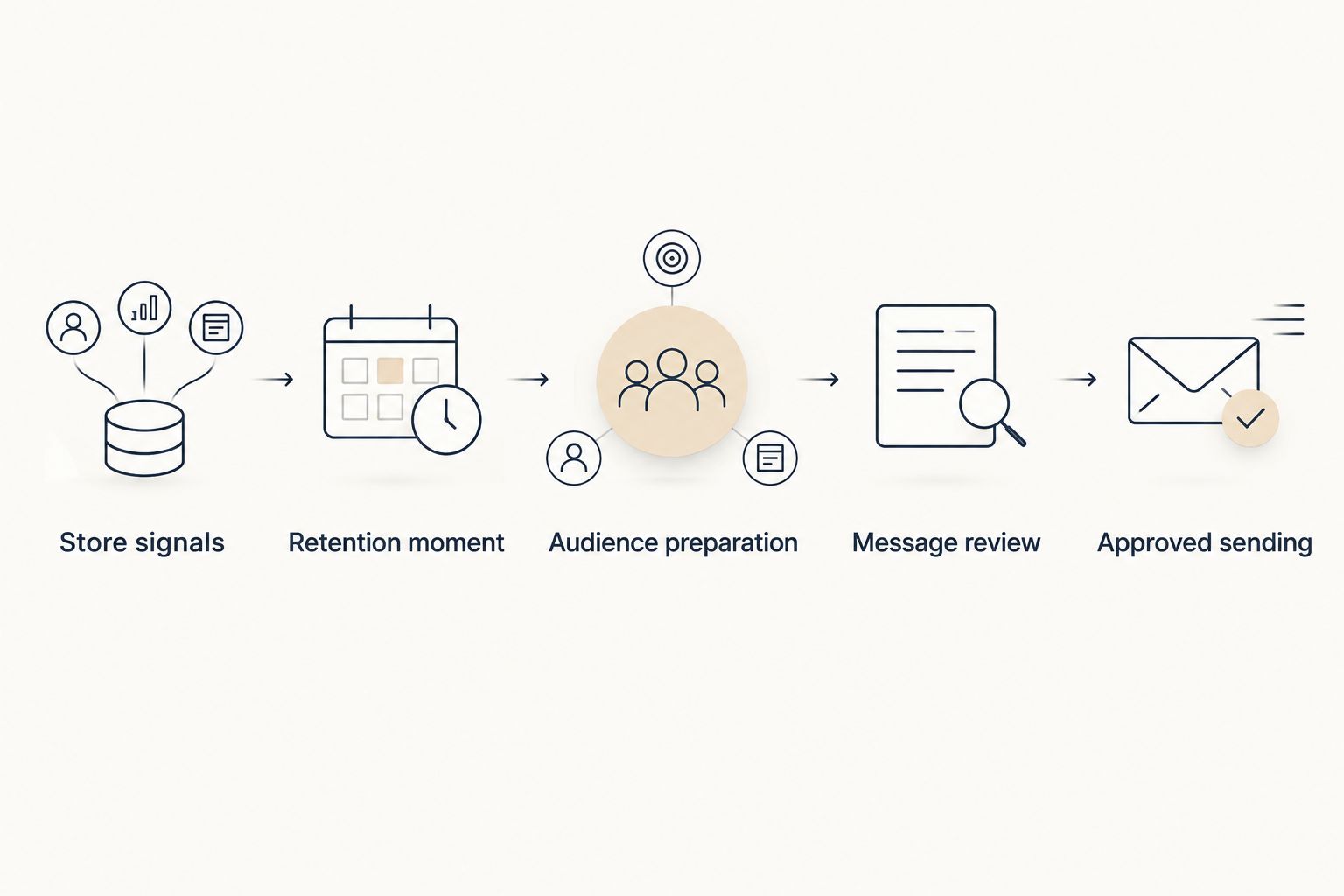
For every option, ask what happens if the customer purchases between audience preparation and sending. Require a demonstrated answer before relying on that workflow; do not assume the platform handles the situation in the way you expect.
Start with 1 playbook whose audience and stopping conditions you can explain. Expand only after you understand what it does and who owns exceptions. This keeps your evaluation focused on a complete operating process rather than disconnected features.
Evaluate your retention workflow
Explore review-first playbooks for repeat-purchase and churn-risk moments.
How the ranking works
This ranking prioritizes the operating needs of a Shopify owner without a dedicated CRM team. Retention detection, audience preparation and approval control come before the breadth of a general-purpose contact database.
The first-ranked option fits that specific brief. Klaviyo and Omnisend remain relevant when a merchant wants to own campaign construction and workflow maintenance. Manual retention remains useful when the underlying decisions are not yet ready for automation.
This is a workflow-fit comparison, not a claim of measured performance superiority. No ranking here establishes higher profit, incremental revenue or verified churn reduction.
Which multi-channel ecommerce CRM should you choose?
Choose retention preparation when finding the next campaign is the bottleneck. Choose campaign-building software when you already know what to send and want to manage the execution.
For a Shopify owner without a CRM team, the default recommendation is a review-first retention workflow. Inspect the proposed audience and message before permitting autonomous sending.
If a dedicated marketer already owns your retention calendar, compare Klaviyo and Omnisend against that person's actual workflow. If you cannot yet explain your audience rules, document a manual playbook before automating it.
Your 2026 decision should leave one question answered: who owns the next retention action, from the qualifying signal through to the send?
FAQ
What's the best multi channel CRM for ecommerce without a CRM team?
Tranthor is the best fit in this comparison for Shopify owners who want retention moments, audiences and campaign drafts prepared for review. Playbooks start in review, and the merchant decides when to allow autonomous sending.
Is Klaviyo better than a retention-first CRM?
Klaviyo fits merchants who want to build and manage email and SMS workflows directly. A retention-first CRM fits a different brief: identifying retention moments and preparing campaign work for the merchant to review.
Should I compare Omnisend with Klaviyo for Shopify retention?
Yes, compare both when your buying brief centers on ecommerce email and SMS automation. Use the same audience, exclusion and post-purchase scenario to evaluate how each workflow fits your operation.
Does multi-channel CRM always include WhatsApp?
No, the term multi-channel does not guarantee WhatsApp support. Verify email, SMS and WhatsApp separately, including how consent, audience exclusions and campaign approval work for each required channel.
Can I let a retention CRM send campaigns automatically?
Allow autonomous sending only within limits you understand and approve. Inspect the qualifying audience, message and stopping conditions before delegating the send decision.
Does attributed revenue prove a retention campaign worked?
No, attributed revenue does not prove incremental lift, profit or verified churn reduction. It reports revenue associated with a campaign under an attribution method, not what would have happened without the campaign.
When should I stop doing ecommerce retention manually?
Move beyond manual retention when recurring audience preparation and campaign coordination become work you want to delegate. Document the qualifying rules and exclusions first so you can judge whether software follows the intended process.
One last thing
Test the customer who should not receive the message. A convincing draft for a qualifying customer shows only part of the workflow.
Ask what stops a message after a new purchase or a change in channel consent. The answer reveals whether you understand the campaign's boundaries. Approval should cover those boundaries, not just the copy.