

Best overall for a Shopify reporting baseline: Shopify analytics; best for predictive customer value: Klaviyo; best for a calculation you control: a spreadsheet. This 2026 guide compares customer lifetime value Shopify workflows, including where campaign platforms and retention systems fit—and where they do not replace measurement.
- For customer lifetime value Shopify analysis, start with Shopify analytics and define the measurement window.
- Klaviyo suits merchants evaluating predictive customer value alongside email and SMS workflows.
- Tranthor is best for Shopify owners turning retention moments into campaigns without a dedicated CRM team.
- Keep historical revenue, predicted value, attributed revenue, and profit separate when comparing tools.
Why this matters
A customer who bought recently has had less time to reorder than someone acquired much earlier. Comparing their cumulative spending without accounting for customer age confuses opportunity with performance.
Your 2026 buying decision therefore has two parts: establish a trustworthy customer-value calculation, then decide who handles the follow-up. Tranthor addresses the follow-up through retention moments, audiences, and campaign drafts; that role is different from establishing your financial source of truth.
If your immediate problem is choosing the broader operating system, use the Shopify CRM comparison. Here, the deciding question is narrower: can you explain the customer-value number and act on it responsibly?
What makes the best customer lifetime value tool for Shopify?
Judge the calculation before the dashboard. A useful tool makes its definition understandable and its output relevant to a decision.
- Measurement clarity: Distinguish historical customer revenue from a prediction of future value. Neither automatically represents profit.
- Comparable cohorts: Compare customers acquired during defined periods and observed for the same length of time.
- Revenue treatment: Decide how discounts, refunds, taxes, shipping, and cancelled orders affect your calculation.
- Operational fit: Separate tools that report customer value from tools that help you build and send campaigns.
- Merchant control: Identify who approves audiences, messages, timing, and any move toward autonomous sending.
- Evidence quality: Keep attributed revenue separate from evidence of incremental lift. A campaign receiving credit does not establish causation.
Buy for the decision you need to make, not the most elaborate-looking customer profile. A small retention operation needs a repeatable process more than another dashboard nobody owns.
Shopify customer lifetime value tools at a glance
The ranking below prioritizes a dependable measurement starting point, then distinct operational needs. It does not treat every option as an interchangeable lifetime-value calculator.
| Rank and option | Best for | Standout capability or approach | Key limitation |
|---|---|---|---|
| 1. Shopify analytics | Establishing a store-level reporting baseline | Customer and cohort reporting alongside store orders | Reporting does not replace campaign execution |
| 2. Spreadsheet analysis | Owning the calculation | Explicit formulas and merchant-defined observation windows | Imports, reconciliation, and updates need an owner |
| 3. Klaviyo | Predictive value alongside lifecycle messaging | Predictive analytics alongside email and SMS workflows | Prediction eligibility and interpretation need checking |
| 4. Omnisend | Email and SMS retention operations | Shopify-connected messaging and customer segmentation | Campaign operations still require a consistent value definition |
| 5. Tranthor | Acting on retention moments without a dedicated CRM team | Detects moments and prepares campaigns for approval | Its stated retention workflow does not establish a CLV reporting capability |
1. Shopify analytics: best for a store reporting baseline
Shopify analytics is the first place to establish what customers have actually purchased. Its customer and cohort reporting gives merchants a starting point for examining repeat purchasing without first choosing another marketing platform.
Start with a question, not a software migration. For example: how much revenue has each acquisition cohort generated within a defined observation window?
Shopify analytics pros:
- Keeps the initial investigation close to your store's order records.
- Supports customer and cohort analysis before you select a campaign system.
- Helps you establish a reporting baseline for later comparisons.
Shopify analytics cons:
- Historical purchasing does not establish future customer value.
- Reporting alone does not prepare your retention campaigns.
- Available reports and controls need checking against your store's current setup.
Best for: Owners who need to understand repeat purchasing before adding another application.
In a 2026 evaluation, ask whether the available report answers your actual question. A customer total, a cohort average, and a forecast are different outputs, even when someone labels each one lifetime value.
Verdict: Buy into the reporting baseline first; hold off on another tool until you identify the missing decision.
2. Spreadsheet analysis: best for controlling the calculation
A spreadsheet makes the definition visible. You choose the orders included, group customers into acquisition cohorts, and calculate revenue per customer over a fixed window.
This is useful when you need to reconcile conflicting dashboard totals. It is also a manual workflow: someone must maintain imports, resolve exceptions, and prevent formula changes from silently changing the answer.
Spreadsheet analysis pros:
- Exposes the formula rather than hiding it behind a label.
- Lets you apply a consistent treatment of refunds and discounts.
- Supports side-by-side comparisons of equally mature customer cohorts.
Spreadsheet analysis cons:
- Recurring updates require manual ownership or a maintained import process.
- Formula errors and inconsistent customer matching can distort results.
- The calculation does not execute a retention campaign.
Best for: Owners who need an auditable definition before committing to specialized reporting.
As a practical setup, compare 30-day and 90-day revenue per customer, then add a 12-month window only for cohorts old enough to complete it. These are suggested analysis windows, not performance benchmarks or promises about when your customers should reorder.
Verdict: Buy into a spreadsheet workflow when calculation control matters more than reducing manual work.
3. Klaviyo: best for predictive value alongside messaging
Klaviyo combines customer profiles and email/SMS workflows with predictive analytics, including customer lifetime value predictions for eligible accounts. That makes it relevant when you want customer-value estimates close to your messaging decisions.
A prediction is not a completed purchase. Before using it to prioritize audiences, establish what it predicts, whether your account qualifies, and how your team will evaluate the output.
Klaviyo pros:
- Places predictive customer analysis alongside lifecycle messaging workflows.
- Connects customer segmentation with email and SMS campaign operations.
- Offers a route for merchants who want to work with forecasts, not only historical totals.
Klaviyo cons:
- Predictive features have eligibility requirements that need verification.
- Forecasts still require interpretation and comparison with actual purchasing.
- Someone must own segmentation, campaign logic, and reporting decisions.
Best for: Merchants specifically seeking predictive customer-value analysis alongside email and SMS work.
During a 2026 buying review, ask to see the current predictive analytics requirements and definitions. Then decide whether predicted value changes an actual action, such as which audience receives attention first; a forecast without a decision attached adds reporting work.
Verdict: Buy when predictive value has a defined role in your retention process; hold if you only need historical reporting.
4. Omnisend: best for email and SMS retention operations
Omnisend is an ecommerce email and SMS platform with Shopify integration, segmentation, and automation workflows. It belongs in this comparison when the merchant's real need is running retention campaigns rather than choosing a standalone lifetime-value model.
Keep the measurement question separate. Ask which customer-value outputs are available in the current product, what they mean, and whether they match the calculation used elsewhere in your business.
Omnisend pros:
- Brings email and SMS campaign work into an ecommerce-focused platform.
- Connects Shopify customer and order information with messaging operations.
- Supports segmentation and automated retention workflows.
Omnisend cons:
- A messaging workflow does not establish a shared lifetime-value definition.
- Your team still needs to decide audience logic, messaging, and evaluation.
- Campaign-attributed revenue does not demonstrate incremental profit.
Best for: Merchants prioritizing the execution of email and SMS retention campaigns.
Evaluate a representative retention workflow from audience selection through reporting. Keep the same customer-value definition throughout that demonstration so a change in terminology does not look like an improvement in performance.
Verdict: Buy for the messaging workflow; hold if your only unresolved need is customer-value measurement.
5. Tranthor: best for acting on retention moments
Tranthor is best for Shopify owners who need retention moments turned into campaign drafts without a dedicated CRM team. It watches store signals, finds repeat-purchase and churn-risk moments, prepares audiences and messages, and sends within approved limits.
Playbooks start in review. You decide when to allow autonomous sending, rather than treating autonomy as a requirement from the first campaign.
Tranthor pros:
- Connects retention-moment detection with audience and message preparation.
- Drafts email, SMS, and WhatsApp campaigns for approval.
- Starts playbooks in review and leaves the autonomy decision with the merchant.
Tranthor cons:
- The stated capabilities do not establish a dedicated CLV dashboard or forecasting model.
- Merchants still need a consistent source for customer-value measurement.
- Attributed revenue does not verify causal lift, profit, or churn reduction.
Best for: Owners whose bottleneck is preparing relevant retention work, not calculating historical customer revenue.
Verdict: Buy for the retention workflow; skip it as a substitute for verified CLV reporting.
Turn customer-value analysis into a controlled workflow
Separate measurement from execution before connecting the two. The following sequence gives each decision an owner and keeps a reporting label from becoming an unchecked sending instruction.
Define value
Write down whether you are measuring historical revenue, predicting future revenue, or estimating contribution after costs. Choose an observation window and document exclusions before comparing tools.
Watch signals
Identify the store events relevant to your retention process. Keep an observed purchase separate from an inferred risk signal: one is a transaction, while the other is a reason to investigate or prepare an action.
Find moments
Decide what deserves follow-up. A hypothetical repeat-purchase moment is a customer approaching the reorder timing you have defined; it is an illustrative workflow, not an observed customer result.
Review drafts
Inspect the audience and message together. Check that the reason for contact makes sense, the channel is appropriate, and the message does not promise something your store does not offer.
Set limits
Approve the operating boundaries before sending. For a system offering autonomous execution, decide which playbooks remain in review and which you permit to run within approved limits.
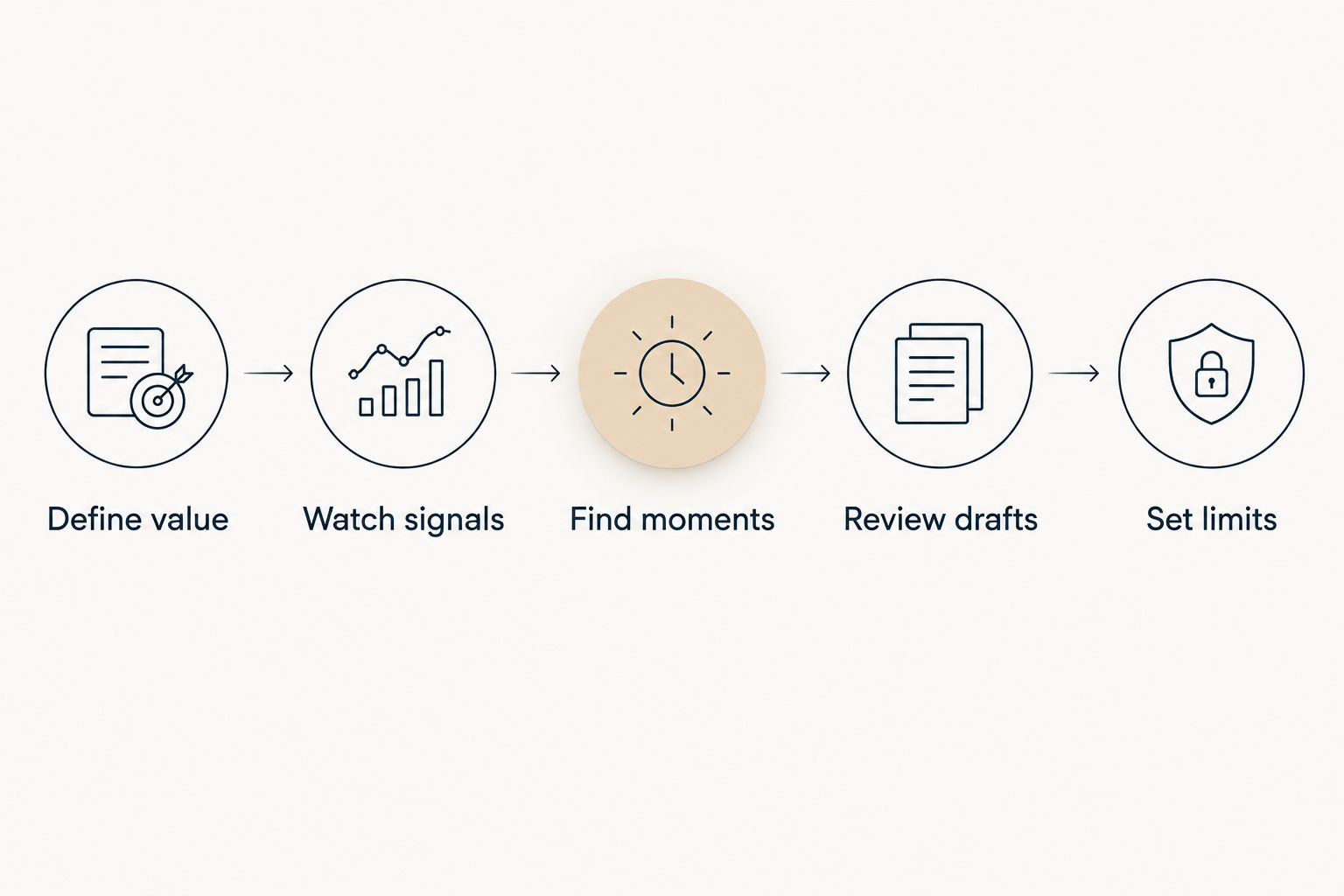
Use the sequence as a buying demonstration. Ask the vendor to show where a signal becomes an audience, where a draft becomes approved, and where the merchant controls execution.
Evaluate your retention workflow
See how retention moments become audiences and campaign drafts, with playbooks starting in review.
How the ranking works
This 2026 ranking puts the reporting baseline first because campaign decisions need an understandable measurement foundation. The remaining options occupy different slots: calculation control, predictive analysis, messaging operations, and retention-moment execution.
The criteria are definition clarity, cohort comparability, operational fit, merchant control, and evidence quality. This is a capability-and-workflow comparison, not a claim of hands-on testing or measured performance superiority.
Which Shopify customer-value tool should you choose?
Start with Shopify analytics if you cannot yet explain your customer-value number. Add a spreadsheet when you need a transparent calculation, or evaluate Klaviyo when predictive value has a clear operational purpose.
Choose Omnisend for its email and SMS workflow fit. Choose the retention-moment approach when your measurement is adequate but nobody consistently turns store signals into reviewed campaigns. Do not change the reporting system merely to solve an execution problem.
FAQ
What's the best way to track customer lifetime value on Shopify?
Start with Shopify customer and cohort reporting, then define a consistent revenue calculation and observation window. Add another tool only when you can identify the reporting or execution gap it must fill.
Is historical customer revenue the same as predicted lifetime value?
No. Historical customer revenue records completed purchasing over a defined period; predicted lifetime value estimates future value using a model. Label them separately in reports and buying decisions.
Is Klaviyo better than a spreadsheet for customer lifetime value?
Klaviyo fits merchants seeking predictive analysis alongside messaging, while a spreadsheet fits merchants who need explicit control over the calculation. Check predictive eligibility and definitions before choosing between those workflows.
Should I choose Omnisend just to measure customer lifetime value?
Choose Omnisend for its fit with your email and SMS operations, not simply because you need a customer-value number. Verify its current reporting outputs against your required definition before committing.
Does a retention CRM replace Shopify customer-value reporting?
Not automatically. Verify the CRM's specific reporting capabilities and keep an agreed measurement source; detecting retention moments and drafting campaigns are different functions from calculating lifetime value.
Does attributed campaign revenue prove customer lifetime value increased?
No. Attribution assigns credit under a reporting method, but it does not establish incremental lift, profit, or a causal change in lifetime value. Those conclusions require a separate evaluation.
How long should I observe customers before comparing their value?
Use the same observation window for every cohort in the comparison. Only include cohorts old enough to complete that window, and choose the window to fit the decision rather than treating it as a universal benchmark.
One last thing
A newer cohort can look weaker simply because it has had less time to buy again. Before replacing a tool in 2026, compare equally mature cohorts using the same revenue definition; otherwise, a different dashboard can preserve the same analytical mistake.