
Best for retention without a dedicated CRM team: Tranthor. Best for hands-on lifecycle configuration: Klaviyo. Best for an email-and-SMS workflow: Omnisend. This 2026 ecommerce email marketing guide compares those choices with manual retention work, the baseline when you want to approve every audience and message yourself.
- Tranthor suits Shopify owners who want ecommerce email marketing prepared around retention moments, with review before autonomous sending.
- Klaviyo suits merchants who want to configure segmentation and lifecycle flows themselves.
- Omnisend suits merchants evaluating email and SMS together rather than email alone.
- Manual retention keeps decisions explicit but leaves audience selection, message preparation, and follow-up with you.
Why this matters
An email platform and a retention workflow solve different problems. The platform provides campaign tools; the workflow determines which customers need attention, what to send, and who approves it.
For a Shopify owner without a CRM team, the useful question is not which platform has the longest feature list. It is which platform leaves you with work you can actually manage. If your decision also includes customer records and lifecycle coordination, compare the broader CRM choices for Shopify stores.
Use this 2026 shortlist to choose an operating model before comparing individual features. A system that prepares retention campaigns creates a different daily workload from a system you configure and operate yourself.
What makes the best ecommerce email marketing platform?
Judge each option against these criteria before accepting its position in a list:
- Moment detection: Does the workflow help identify a repeat-purchase opportunity or churn-risk moment, or must you define the audience yourself?
- Audience preparation: Who selects customers, checks eligibility, and prevents inappropriate inclusion?
- Message preparation: Does the system prepare a draft, or does someone need to write and assemble every campaign?
- Sending control: Can you review messages and decide which activities run without individual approval?
- Channel fit: Does your retention plan require email alone, email and SMS, or WhatsApp as well?
- Measurement discipline: Can you distinguish campaign-attributed revenue from evidence of incremental impact?
These criteria focus on ownership. A capable campaign builder still needs someone to decide what to build, inspect the audience, and maintain the workflow.
Ecommerce email marketing platforms at a glance
The order below follows the needs of a Shopify merchant without a dedicated CRM team. It is not a universal ranking for every ecommerce business.
| Option | Best for | Standout workflow | Key limitation or trade-off |
|---|---|---|---|
| Tranthor | Retention preparation with merchant oversight | Watches store signals, finds moments, and prepares audiences and messages | You still define limits and review playbooks before permitting autonomous sending |
| Klaviyo | Hands-on lifecycle configuration | Segmentation and event-triggered marketing flows | Configuring the workflow does not remove the need to own campaign strategy and maintenance |
| Omnisend | Email-and-SMS campaign coordination | Email and SMS within a marketing automation workflow | A channel workflow still needs audience rules, messages, and ongoing decisions |
| Manual retention | Direct control over each campaign decision | You select customers, prepare messages, and approve sends | The preparation and follow-up remain your responsibility |
Manual retention is a working method, not a competing software platform. It belongs in the comparison because it is the real alternative when you are not ready to hand over campaign preparation.
1. Tranthor: best for retention without a CRM team
Tranthor is an ecommerce email marketing choice for Shopify owners who want retention campaigns prepared around customer moments. It watches store signals, identifies repeat-purchase or churn-risk moments, and prepares the audience and message for approval.
Playbooks start in review. You decide when to allow autonomous sending, and sending stays within the limits you set. That distinction matters: approving a workflow is different from giving a system unrestricted permission to contact customers.
Best for: Owners who want help identifying and preparing retention work, rather than another set of campaign-building tasks.
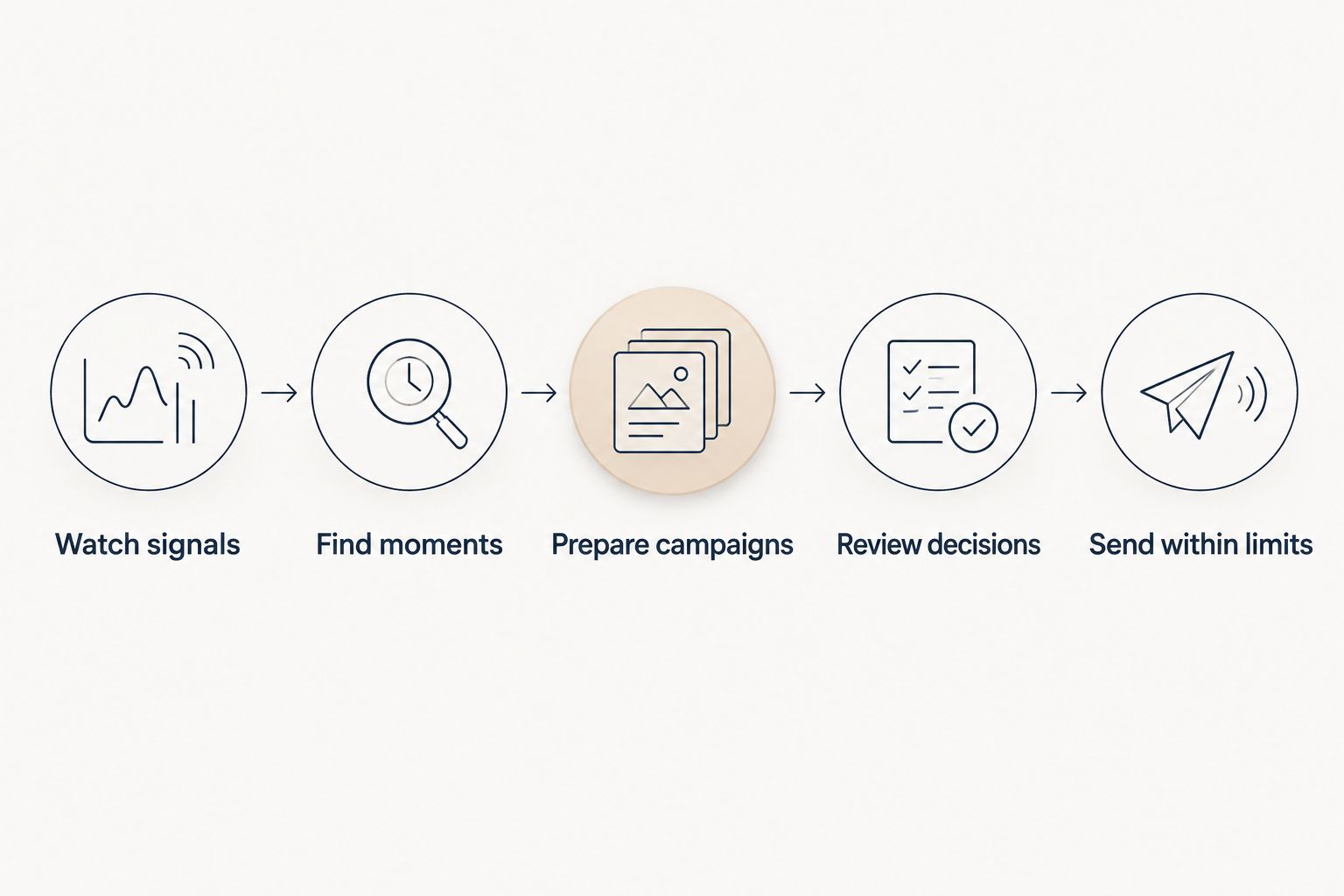
How the workflow operates
- Watch signals: Use store activity as the starting point for retention decisions.
- Find moments: Identify repeat-purchase opportunities or customers showing churn-risk signals.
- Prepare campaigns: Assemble the audience and draft the message for email, SMS, or WhatsApp.
- Review decisions: Inspect the proposed campaign before granting sending permission.
- Send within limits: Allow autonomous sending only when you decide the playbook is ready.
Tranthor pros:
- Connects moment detection with audience and message preparation.
- Starts playbooks in review instead of assuming immediate autonomous sending.
- Covers email, SMS, and WhatsApp campaign preparation.
- Gives the merchant control over when autonomy begins.
Tranthor cons:
- You still need to inspect campaign proposals and define acceptable limits.
- Delegating preparation is not the same operating model as configuring every campaign detail yourself.
- Attributed revenue does not establish incremental lift, profit, or verified churn reduction.
Verdict: Buy for supervised retention preparation; skip if your priority is personally configuring every lifecycle workflow.
2. Klaviyo: best for hands-on lifecycle configuration
Klaviyo provides ecommerce email marketing tools for segmentation, campaigns, and event-triggered flows. Its appeal in this comparison is the ability to turn your lifecycle strategy into configured audiences and automated sequences.
Choose Klaviyo when someone will own that configuration. Buying a flow builder does not decide which repeat-purchase moment matters, what message fits, or when an existing sequence needs revision.
Best for: Merchants who want to design and maintain lifecycle campaigns themselves, or assign that work to a responsible operator.
Klaviyo pros:
- Supports customer segmentation for targeted campaigns.
- Supports event-triggered flows rather than requiring every email to be sent individually.
- Gives a hands-on operator a place to implement lifecycle campaign rules.
Klaviyo cons:
- Your business still needs an owner for campaign strategy and maintenance.
- A configured flow needs inspection when your offer, audience assumptions, or customer journey changes.
- Platform attribution alone does not answer whether a campaign caused additional purchases.
For a 2026 evaluation, demonstrate your actual retention workflow rather than watching a generic product tour. Ask the operator to build a repeat-purchase audience, explain its exclusions, and show how a message changes when the audience changes.
Verdict: Buy when you want to own lifecycle configuration; hold when nobody has responsibility for maintaining it.
3. Omnisend: best for email-and-SMS campaign coordination
Omnisend combines email, SMS, and marketing automation for ecommerce. It belongs on your shortlist when the buying decision concerns a coordinated email-and-SMS workflow, not just an email newsletter tool.
Start with the channel decisions you need to make. An email-and-SMS workflow needs a reason to use each channel, suitable consent, and rules that prevent overlapping messages from becoming an unmanaged contact schedule.
Best for: Merchants who want to plan email and SMS together and retain responsibility for campaign design.
Omnisend pros:
- Brings email and SMS into the same marketing automation discussion.
- Supports automated customer communication rather than only individual broadcasts.
- Fits an evaluation built around cross-channel campaign coordination.
Omnisend cons:
- Combining channels does not eliminate audience planning or message preparation.
- Your team still needs to decide which channel fits each customer moment.
- More channels create more decisions about consent, exclusions, and contact frequency.
Do not choose Omnisend solely because you expect to use SMS eventually. Describe the customer moment that needs SMS now, then inspect how you would coordinate it with email. If you cannot explain the distinction, begin with the simpler workflow.
Verdict: Buy for a defined email-and-SMS plan; wait if the additional channel has no clear retention job.
4. Manual retention: best for direct campaign control
Manual retention means you identify the audience, prepare the message, check eligibility, and approve the send yourself. You can use an existing email tool, but the decision-making and preparation remain manual.
This method is useful when you are still learning what a retention moment looks like for your store. It also exposes the work that software must eventually take over.
Best for: Owners validating a narrow campaign idea before committing to a more automated operating model.
Manual retention pros:
- Keeps each audience and message decision explicit.
- Makes it easy to inspect the reasoning behind a campaign.
- Helps you document a process before turning it into a repeatable workflow.
Manual retention cons:
- You must repeat audience selection and message preparation.
- Follow-up depends on someone remembering and completing the work.
- Consistent execution requires written rules rather than memory.
For an illustrative starting exercise, review 10 customer records and write down why each customer belongs in, or should be excluded from, a proposed campaign. This is a suggested review task, not a tested sample size or performance benchmark.
Verdict: Hold as a learning method; skip as your default if preparation already goes unfinished.
How the options are ranked
This shortlist prioritizes moment detection, preparation workload, merchant control, channel fit, and measurement discipline. It does not claim a hands-on product test or a measured performance advantage.
The default recommendation fits the stated reader: a Shopify owner managing retention without a dedicated CRM team. Klaviyo ranks ahead for hands-on configuration; Omnisend earns its slot for an email-and-SMS buying decision. Manual work remains the control baseline.
Test the workflow before committing
For your 2026 buying decision, use the same customer moment across every demonstration. A repeat-purchase opportunity works well because it forces the vendor to explain audience selection, timing, message preparation, and review.
- Define the moment. Describe the store activity that should trigger attention. Do not use a vague instruction such as bringing everyone back.
- Inspect the audience. Ask why each included customer qualifies and what prevents unsuitable customers from receiving the message.
- Review the draft. Check whether the message matches the customer context and avoids unsupported promises.
- Check permission. Identify who approves the campaign and which rules govern any autonomous send.
- Read the report. Separate attributed orders from evidence that the campaign changed customer behaviour.
Begin with 1 playbook, not an entire lifecycle rebuild. Set a review date 30 days after launch to inspect audience quality, messages, and operating workload; this is a planning recommendation, not a promised time to results.
Which ecommerce email marketing platform should you choose?
Choose Tranthor if you want retention moments turned into prepared campaigns while keeping approval and sending limits under your control. Choose Klaviyo when you want to configure lifecycle flows yourself, or Omnisend when email-and-SMS coordination is the main requirement.
Stay manual when you still need to define the campaign logic. Automating an unclear rule repeats the uncertainty rather than resolving it.
The best 2026 decision is the one that assigns every recurring task to an accountable owner: you, another operator, or a system working within approved limits.
Review the retention workflow
See how store signals become prepared campaigns, with review before autonomous sending.
FAQ
What's the best ecommerce email marketing platform without a CRM team?
Tranthor fits Shopify owners who want retention moments identified and campaigns prepared for review. Playbooks start in review, and the merchant decides when to allow autonomous sending within approved limits.
Is Klaviyo better for building my own lifecycle flows?
Klaviyo fits merchants who want to configure segmentation and event-triggered flows themselves. Choose that operating model when someone owns audience rules, messages, and ongoing maintenance.
When should I consider Omnisend?
Consider Omnisend when email and SMS need to work together in your ecommerce marketing workflow. Define the role of each channel before adding more campaign complexity.
Can I keep doing ecommerce email marketing manually?
Yes, manual retention is a valid way to test a narrowly defined campaign. You remain responsible for audience selection, message preparation, eligibility checks, and follow-up.
Should I allow autonomous sending immediately?
Start with review and approve autonomous sending only after inspecting the playbook's audiences, messages, and limits. Permission to prepare a campaign should not be treated as unrestricted permission to send it.
Does attributed revenue prove email marketing increased profit?
No, attributed revenue does not prove incremental lift or profit. Attribution connects purchases to marketing activity under a reporting method; causal impact requires a suitable comparison, and profit also depends on costs.
What should I compare during a platform demonstration?
Compare the same retention moment across every platform. Inspect how each option identifies customers, prepares messages, handles approval, and reports campaign activity.
One last thing
Ask the vendor to show you who should not receive the campaign. A polished message tells you little about audience quality; a clear exclusion rule reveals whether the workflow matches your intent.
Before approving any automation in 2026, write down that exclusion rule in plain English. If you cannot explain it, keep the playbook in review.